A struggle for the soul of American Catholicism
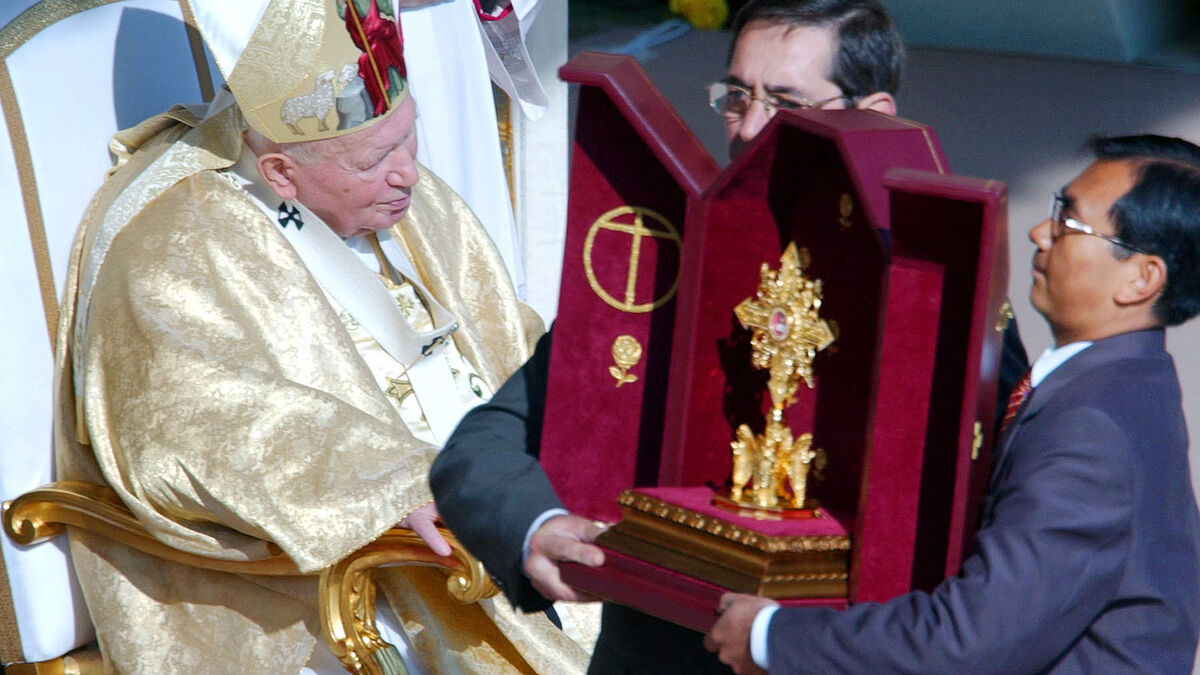
The relics of Josemaria Escriva de Balaguer, founder of Opus Dei, are brought to Pope John Paul II during the canonisation of Escriva de Balaguer at the Vatican in 2002. Picture: AP Photo/Massimo Sambucetti
Podcasts from the idiotic to the sublime now pepper the airwaves. All are to some degree or other ‘on the make’ – either by struggling to squeeze the last drop of blood from diminishing careers to attempting to break new ground as ‘the new kids on the block’. My own favourite is the American political-history podcast, The Court of History, presided over by two academics, the political journalist, Sidney Blumenthal and Seán Wilentz, an historian from Princeton University.
At present they are guiding their audience through an unusual terrain - attempting to explain the spat between the two most famous Americans in the world - President Donald Trump and Pope Leo XIV. If you’re interested in American politics, constitutional issues and historical analysis this is your patch.
While both Blumenthal and Wilentz are always worth listening to, the presence of a guest speaker keeps them at the top of their game. The latest guest was Gareth Gore whose new book is . It’s an investigative exposé of Opus Dei, a secretive organisation within the Catholic Church - and sometimes described as ‘a Church within a Church’. In particular it is about financial corruption, abuse claims and Opus Dei’s political influence in America and elsewhere around the globe.
Gore, a financial journalist and an unbeliever, was great value for The Court of History, as surfing the waves of Opus Dei with two forensic experts seems - from a first outing - a gift that will keep on giving.
A bit of background. Opus Dei is an ultra-Catholic pressure group that pushes a reactionary agenda. It was founded by Fr Josemaria Escriva in Spain in 1928. It was regarded at first as a way of expanding the role of lay people in the Church but soon emerged as an elitist secretive, obsessively controlling and politically conservative church organisation that was divisive and is difficult to control.
Two influences were significant in its history: the Spanish dictator, General Franco, and Pope John Paul II. Franco helped it establish its semi-militaristic ethos and John Paul who became infatuated with it, afforded it an extraordinarily unprecedented freedom to make their own rules. He effectively canonised its influential role in the Church and later actually canonised Escriva!
The other breakthrough was how it managed to insert itself into the American Catholic Church and become involved with republican, right-wing conservatives, and a militant brand of Catholicism that extended to the appalling MAGA brand that has so damaged American Catholicism. An indication of the mind-blowing extent of Opus Dei’s influence in America is the number of Opus Dei members and supporters appointed to the America Supreme Court by Trump, among them John Roberts and Clarence Thomas. And Opus Dei’s involvement in what was called ‘Project 25’, effectively the campaign to re-elect Trump before he became president again in 2025.
Reservations about the malign influence of Opus Dei on Catholicism are not new. Pope Benedict distrusted it but didn’t have the energy to oppose it. Pope Francis began to oppose it and hoped to neutralise it but before his work was done God called him to the Father’s House. But the signs now are that Pope Leo is about to pay the Opus Dei some attention.
Leo has the benefit of first-hand knowledge of the trouble Opus Dei can cause and the damage it can do. When he was appointed a young bishop in Peru, Opus Dei was embedded in the diocese and he sought to dislodge it from its influence. His intention now, is seems, is to examine (in the light of his experience in Peru) Opus Dei’s role in the Catholic Church.
It is not an unexpected development. But what has given it legs is the phone-call Leo made recently to Gareth Gore, the author of Opus, as mentioned earlier. Leo invited Gore to the Vatican indicating (as Gore explained it to the Court of History): ‘I want to talk to you about Opus Dei.' Gore thought that it would be a private confidential meeting and was surprised to discover that when Leo greeted him at the Vatican, he (Leo) was accompanied by two photographers ready to take pictures of the event and that a Vatican press statement was also about to be released to publicise it. It was clear that Leo was in effect sending a message to Opus Dei that they now had the attention of the Pope.
Gore, who had stumbled into the Opus Dei story while researching a book on a Spanish bank that had folded, explained in detail what he had discovered after five years of research into Opus Dei: fraud, trafficking; evidence of mind control; its narrow socially conservative interpretation of religion as with its focus on abortion rather than a fuller pro-life agenda; its obsession with sexual sin and LGBTQ; and its disinterest in social justice and the poor.
As Gore briefed Leo about a litany of abuses in the Catholic Church perpetrated by Opus Dei, he realised (he told the Court of History) that Leo was shocked by what he was telling him, including about the use by Opus Dei of a psychiatric unit in Spain where families were cut off from family members undergoing treatment and also by the levels of spiritual abuse in the manipulation even in the Vatican by Opus Dei of conservative church leaders.
What is clear to Gore is that Leo sees Opus Dei as a threat to the Catholic Church, that Leo is aware of the in-roads Opus Dei has made into politics and into Catholic life and that his intention is ‘to take Opus Dei on’. It is a struggle not just for the soul of American Catholicism but for Catholicism itself.
Thankfully Leo is indicating – in the calm, clear and considered response that he has brought to his ‘spat’ with Trump – that he has the steel needed to face the challenge that Opus Dei represents. He will need a fair wind.