Defeat is not an orphan in Mayo
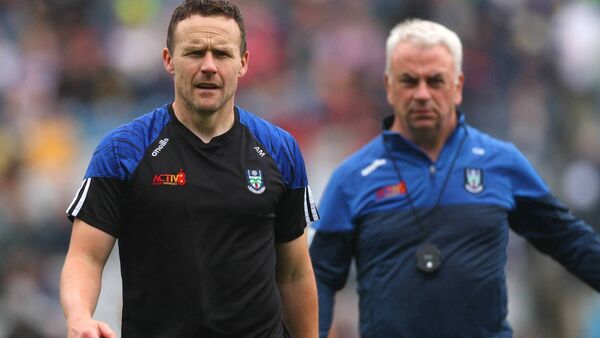
Andy Moran pictured with Monaghan manager Gabriel Bannigan in Croke Park at last season's All-Ireland SFC Quarter-Final against Donegal, when Moran operated as coach and selector to the Monaghan senior footballers. Moran will bring his Mayo side to Clones on the weekend of May 30/31 to play the Farney County in Round 1 of the All-Ireland SFC. Picture: INPHO/James Crombie
I’ve always thought that the phrase ‘victory has many fathers but defeat is an orphan’ can be flipped when applied to Mayo football.
Because of our quest to end one of the world’s most famous sporting famines, a good chunk of Mayo folk will not allow themselves to get carried away with progress or victory until the final whistle sounds on an All-Ireland final day and a Mayo man is heading for the steps up the Hogan Stand.
Nothing short of that is new to us. We have any amount of great All-Ireland semi-final wins.
For all the cheap accusations of ‘bottlers’, we have had plenty of very good All-Ireland final displays too (1989, 1996x2, 2013, 2016x2 and 2017). Just not quite good enough.
The scar tissue though for all those years of near misses and the heartbreak that goes along with it has had a major impact on the psyche of Mayo football and its support.
A hardened cynicism has come through in a good well of supporters to the extent that a defeat of any sort can be confirmation of a person’s own fears – and those fears can vary wildly from person to person.
The blame game can be particularly fierce and very wide-ranging. It could be personnel, the type of players we produce or do not produce, management selection or tactics or deeper cultural concerns.
Some of it is on the money and some might just be confirmation bias. There is even a particular type of Mayo person who almost relishes setbacks. It is almost like a safety valve for them because it’s the hope that kills them and the sooner there is a reality check, the easier it is for their mental wellbeing!
But when you look at all of this, there is no doubt that a considerable part of our problem comes from our mindset as a county and how that translates to the team themselves. For all the talk of players in the senior squad being in a bubble, they cannot separate themselves from the county they grew up in, their families and friends, the anguish they would have witnessed as young supporters, watching the despair of their own parents and grandparents.
That is the legacy of so many All-Ireland defeats.
I’ve always felt that was a key part of why Lee Keegan was always so nonchalant and took the big days in his stride. Mayo GAA was not a big part of his upbringing and he has admitted that much himself.
The weight of history weighs heavily on us.
We all have our own views on what went on against Roscommon in what I would stand over was an embarrassing display.
The causes for this latest defeat include everything from karma for the 2015 heave according to the far from unbiased Joe Brolly in the to not minding our house at the back, according to Stephen Rochford, last year’s assistant manager, in his column and everything in between.
For what it is worth, I feel it comes down to a few aspects. We have been struggling with primary possession (an issue that Mayo are encountering across the grades) which came home to roost against Roscommon.
In 2016 and 2017, when, whatever Brolly might try to argue, Mayo never came closer to winning an All-Ireland since 1996, the fundamental building block was a high calibre of defenders who could go man on man with the best Dublin could offer and still threaten at the other end. When you think of it, it was a defence packed with quality. Take your pick from Lee Keegan, Keith Higgins, Colm Boyle, Chris Barrett, Ger Cafferkey, Brendan Harrison, Paddy Durcan and Donie Vaughan. All bar Vaughan were All Stars.
Primary possession was not the challenge it is now with Tom Parsons, Séamie and Aidan O’Shea either.
But defensively Mayo were set-up to go man to man at the back but we do not have the calibre of defenders we had a decade ago. That’s not to discredit any of the current backs, just the reality it is a very high bar. Yet we still try one-to-one defending even when we are outmatched as has happened against Donegal, Kerry and Roscommon this year.
Not removed from that is how we often struggle physically to go toe to toe and fight for dirty ball, lay down markers and set the tone in games.
Now, the team of a decade ago produced plenty of flat displays too (Galway, Fermanagh, Derry, Cork and the Roscommon drawn quarter-final). But nothing like the Cavan display of ‘25 or the Roscommon game nine days ago happened on their watch.
It was interesting to see Stephen Rochford flag that Mayo’s defence last season, when he was a key part of management, conceded the least number of opposition shots per game in the entire country (an average of 24). Roscommon had 36 on Sunday week last.
It crystallises the difference in approach between last year’s management and this year’s. Andy Moran was on record as saying during the league that the ‘attacking piece’ is harder than the defensive aspect to coach and instil in a team. There were a few pointed comments about the caution Mayo played with too under the previous management.
When Mayo were playing expansive, high-scoring football in the league, Andy’s approach was lauded.
Now it feels as if we are back to square one.
The reality is that while Mayo were very good defensively last year – with much of the same staff – they were certainly too cautious and conservative with the ball. Now the two can be interlinked – too expansive and risky an attack can leave you exposed at the back.
Overall, when Kevin McStay and Stephen Rochford took over, Mayo needed a Plan B when fast, often chaotic attacks didn’t work and needed to do better with patient, slow attacking plays. The problem is Plan B became Plan A and the original Plan A was largely jettisoned. And that slow, attacking play was used far too much against Roscommon too.
Rochford’s column was very much an ‘anti-chaos’ perspective. Which begs the question about a Mayo approach. James Horan was more inclined to ‘pro-chaos’. When Rochford came in first in 2016, he fine-tuned that and came really close.
There was a feeling after the 2021 final that chaos needed to be in the rearview mirror. It came back into fashion this spring with Moran’s approach standing in contrast to last year’s approach.
Now we are back to the drawing board. An awful lot of time has been wasted deciding on the best approach and oscillating from one management to another.
The truth is there needs to be a blend between the two.
Fans are fickle. Their perspective often needs to be taken with a pinch of salt. But Mayo football needs a clearer picture of what it is about. Otherwise, we will just yo yo from one supposed solution to the next, with no overarching philosophy or sense of identity.
Mayo football is currently in an identity crisis. And a few more crises to boot.
Andy Moran saying it was only year one was not his best advised comment of all time.
But he knows now the need for learning is vital.
Ahead of the Monaghan game in four weeks, he has so many areas to work on and only so much he can do in that finite window. So the focus will have to narrow to particular areas.
Mayo need a better system for our own kick-outs and the aggression levels need to be ratcheted up.
Mayo need to respond – and any team worth their salt will react with intent after such a chastening performance.
But there are wider issues that won’t be solved as quickly as that.