Planning reform alone won't save rural areas
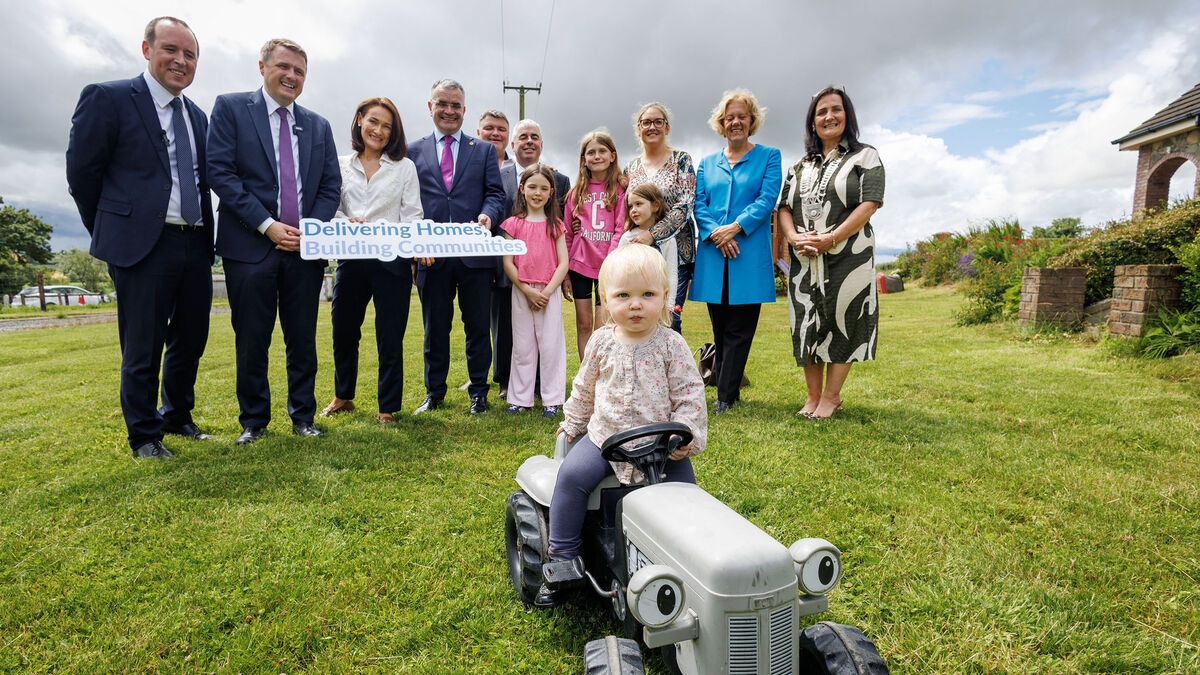
Minister James Browne announces an ‘end to the Eircode lottery’ with new national guidelines for rural and Gaeltacht housing. Also included are Minister of State John Cummins, Minister Dara Calleary, Minister of State ‘Boxer’ Moran and Caoimhe, aged 18 months, from the Sweeney family at their family home in Ardee in Co Louth. Picture: Marc O'Sullivan
If the Government believes easing one-off housing restrictions will reverse rural decline, it is sorely mistaken. It may help some families remain in their communities, but it will not solve the problems hollowing out rural Ireland.
We do need more people living in rural Ireland.
We need strong and vibrant towns and villages throughout the country, away from larger, urban centres.
We need to be able to attract more people to the west of Ireland compared to our east coast which is bursting at the seams.
But how do we do it?
The Government signed off on draft guidelines for one-off rural and Gaeltacht housing. They are describing it as ‘the biggest overhaul of rural housing rules in two decades’.
They feel the move will make it easier for local people to remain in their communities, will support rural and Gaeltacht communities, provide greater consistency across local authorities and still protect the countryside.
Politically it will curry favour, especially among beleaguered councillors who deal with complaints regarding planning refusals on a regular basis.
The Government appears to hope that the easing of planning restrictions for one-off houses in rural areas will change the game.
It will not. Whether it is a good move or not in a general sense is a different debate but the easing of these restrictions will not be a panacea for rural Ireland.
As Michael Prenty, the Mayo native who is chair of the Irish Home Builders' Association, said in these pages recently, the Government are well behind on their housing targets. Easing these restrictions could well be as much about finding a way to come closer to realising a stated target than any massive philosophical shift.
It is a subject that comes up frequently at council meetings in Mayo. A councillor will highlight a hard case of someone who has been denied planning permission to build a house on their land in the community they grew up in.
Planners and planning laws will be in the crosshairs. Sometimes with good reason, other times you can see why planning has been refused.
We are a country for whom dispersed, rural housing has been a big part of life for generations.
Planners will argue that it is entirely unsustainable development. All these one-off houses require services like water, sewerage, electricity and, now, broadband. They argue the easing will increase the dependence on private cars and undermine efforts to regenerate the centres of villages and small towns.
It is, for instance, much more economical to provide all of this for a housing estate of 30 houses than for 30 one-off houses. They are not making these arguments out of ideology alone.
That is one part of the debate. Having a clustered housing development in a rural village makes more sense from a planning and services perspective.
But rural communities are part of our existence. It is hardwired into our DNA. Many of us live in and were brought up in one-off houses.
For generations, building on family land has been regarded in rural Ireland not simply as an aspiration but almost as a birthright. Many sons and daughters of farmers have been refused planning permission to build on their land. Sometimes it is because of environmental designation, it may be because the site exits onto a national or regional road or it might be because local need hasn’t been proven.
Sometimes refusals appear entirely reasonable. Sometimes they appear impossible to explain. Much depends on the planner, the local authority and the particular circumstances.
Rural planning is often conflated with rural depopulation.
Rural school numbers are dropping at an alarming rate, particularly along the western and northern seaboard of our county where many schools have only a third of the children in them compared to 30 years ago.
Post offices, rural pubs, shops and many businesses are falling by the wayside. Once strong GAA clubs are struggling to field. Many have been forced down the route of amalgamation with neighbouring, rival clubs. A situation no one would have countenanced a generation ago.
But the easing of rural planning laws will only scratch the surface of the problem.
It will allow some families to build in their rural community who may otherwise have had to call their nearest town home. It might be the difference between a school keeping a teacher or not.
But the floodgates will not open.
The reality is that housing does not exist in isolation. It is one part of a wider ecosystem in which jobs, infrastructure, healthcare, education, childcare and broadband all play crucial roles.
It would be wrong to assume that the many parts of Mayo that are suffering from rural depopulation are centrally impacted by planning restrictions. It is a small part of it. Fundamentally, the key reason is employment opportunities.
We’re among the most centralised countries in the European Union in terms of the pull our capital city has. And it is not because, with respect, there is a great grá for Dublin among the rural masses.
Rather, it is because our governments, across decades, have enabled the continuous growth of Dublin at the expense of other parts of the country and various national spatial strategies have failed to rectify such an imbalance.
Employment opportunities abound in Dublin; the same cannot be said of the west. While there are plenty of great employers here and the region has grown, it is lagging far behind the east coast.
It’s why so many Gaelic football clubs in Mayo have to organise midweek training sessions in Dublin because that’s where many of their players reside. That they still want to play with their native club shows the grá for home.
Very few of those footballers are forced to live in Dublin because they cannot get planning in their own area. They would have to get a job in their own area first and then look for planning. And they might find it difficult but the second hurdle cannot even be attempted until the first is cleared.
And footballers are just one group within Mayo society so impacted.
I often reference the fact that our region, the Northern and Western Region, is so far behind the two other regions in Ireland by European standards. I do so because it is so central to encapsulating the problem.
We have been described as a region in transition and a lagging region in recent years.
The gap is stark. Our region sits only marginally above the EU average for GDP per head, while the Southern Region and the Eastern and Midlands Region are more than twice the European average.
The region stands 218th out of 234 European regions for transport infrastructural development. How can we hope to attract more employers when Government continues to underinvest in the region’s transport infrastructure?
Planning reform may help some families remain where they belong. But if Government genuinely wants to revive rural Ireland, it needs to stop treating planning as the problem and start tackling the real ones: jobs, infrastructure and regional investment. Without those, easier planning permission will be little more than a Band-Aid.