Retired bishop's book is for the last men standing
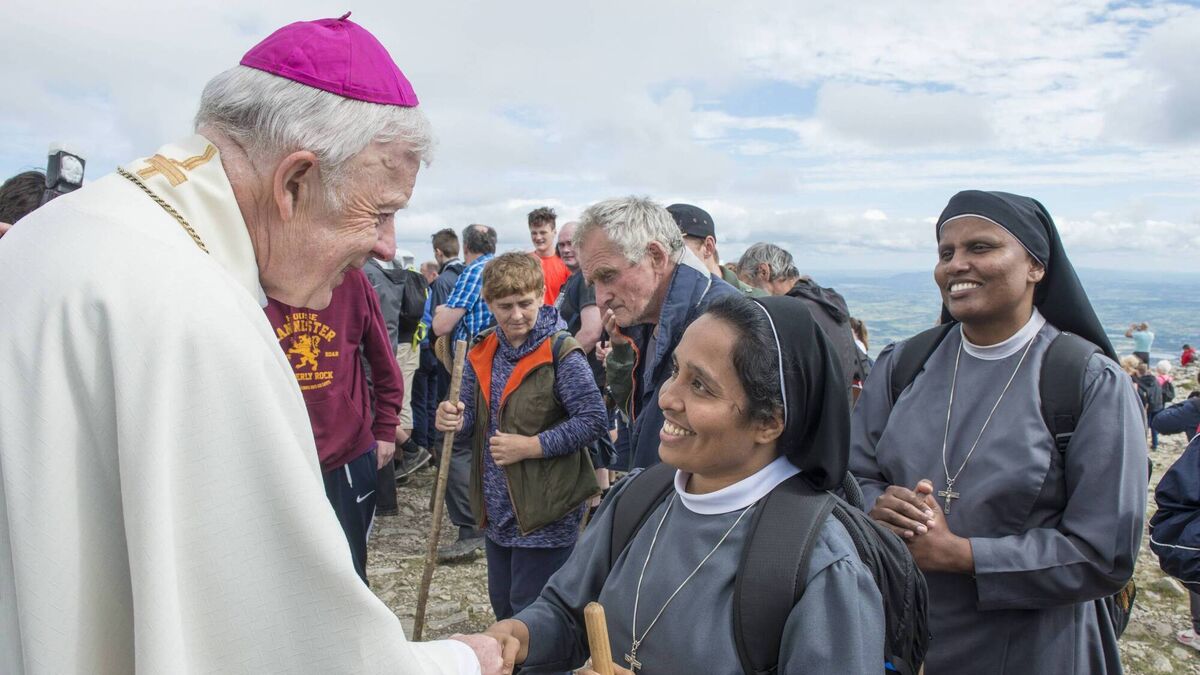
Archbishop Michael Neary greets Sr Mareena and Sr Jasmine from the Ursuline Convent, Portlaoise, during the annual Croagh Patrick pilgrimage in 2018. Picture: Michael Mc Laughlin
There’s a moment early in Archbishop Michael Neary’s new book where he tells a room full of priests that it’s alright to shake a clenched fist at God. Not figuratively. Actually, shake it. He borrows the gesture from the Psalmist, who did plenty of fist-shaking, and he hands it to men who’ve spent 50 years being told to keep the collar straight and the temper level. I read that and put the book down for a minute. You don’t often catch a bishop giving out permission to be furious with the Almighty.
That’s the register of , and it’s why the book is better than it has any right to be.
Neary is a Castlebar man, which is to say he’s from more or less my own patch of Mayo, and there’s a particular pleasure in reading a serious book by someone who knows the same weather you do. Scripture professor at Maynooth before the mitre, a licentiate from the Biblical Institute in Rome, then 27 years running the Archdiocese of Tuam and the title of longest-serving Catholic bishop in the country by the time he handed it back in 2021.
His was the wild archdiocese: Achill, Clare Island, Inishturk, the Aran Islands, Croagh Patrick, Knock. I’ve watched that same Atlantic he used to cross for Confirmations go from glass to grey rage in about the time it takes to boil a kettle.
He retired to Castlebar, and this book, now published by Aid to the Church in Need, is what a thoughtful man does amid the quiet afterwards. Retreat addresses, mostly. Talks he gave to fellow priests down the years, gathered up and tidied.
Here’s what it isn’t. It isn’t a strategy document. There’s no five-point plan for keeping a parish breathing when there are two priests left to cover twelve churches, which is roughly the arithmetic now. Maynooth, which once held five hundred seminarians, is down to a couple of dozen. The average Irish priest is well the wrong side of seventy. A few years back, the papal nuncio called it an actuarial cliff and said the freefall was coming. Ardal O’Hanlon, of all the men in Ireland, ended up making the television documentary about it, and they called the thing , and nobody in the room laughed.
So Neary is writing for the last men standing, and he knows exactly that’s who he’s writing for. What he offers them isn’t a rescue. It’s company.
His method is old, and it works. He goes back to the Bible, pulls out the people who had it worse, and holds them up to the light as a mirror. Jeremiah, who never wanted the job, who wore his heart on his sleeve and got laughed at for it.
“You have seduced me, Yahweh,” Jeremiah says, in one of the rawest lines in all of scripture, and to his credit Neary doesn’t tidy it up or sand off the anger.
Second Isaiah, preaching hope to people deported fifteen hundred miles from home who’d quietly given up on the whole business. Moses was entirely unconvinced he was fit for any of it. Peter, who talked too much, denied everything and was handed the keys anyway. And Mary, whose great contribution, in Neary’s reading, is her silence.
The reality of this modern spiritual exile runs through the book like a seam of turf, and he returns to it with insistence. The pain of Babylon, the desert, Holy Saturday, that still grey day between the cross and the empty tomb when God seemed silent, if even defeated, and nobody yet knows if He’s coming back. This is where he sees the Irish priesthood of today, and it’s the most convincing stance in the book. He isn’t pretending the churches are full, nor is he doing the thing churchmen do where they look sideways at a collapse and decide to call it a form of divinely ordained renewal. He names the emptiness, and only then asks the harder question. What on earth are you meant to do standing inside it?
Then he gives us the line the book turns on, openly writing about the scandals, the reports, the falling away of the Church’s old authority, he says the gates that were shut have been torn open, and that at least now the Lord can get in. I’ve gone back to that sentence half a dozen times, and it’s the kind of thing you can only write once you’ve stopped guarding the institution and started fretting about the faith instead. There’s a nerve in it that’s refreshing coming from a man of his vintage and rank.
He’s good, too, on the small poisons. He writes about acedia, the noonday demon the desert monks were frightened of, the grey listlessness that curdles into blaming everyone but yourself. He knows the glib remark that kills a project stone dead in its cradle: “We tried that before.”
We’ve all sat in that meeting, church, parish council or the GAA, where one tired voice lets the air out of the room in a single comment. Neary has plainly sat through a great many of them, and he’s honest enough to admit the rot can get into him as easily as anyone.
I have just one reservation, or perhaps a guarded observation, take your pick. It is, however, a small one, because a review without one would perhaps be a fiction. The book, for all its honesty about the enclosing dusk and the encroaching night, drifts toward consolation and soothes, circling the same few notes, hope and refuge and the rock and the stronghold, and after a while I wanted a note of defiance or even a rallying call. The Psalms he threads through every chapter are achingly beautiful, but the cumulative effect tips from bracing toward a resigned comfort. A younger priest, when such a rare bird can still be found, might want less balm and a bit more of a scrap.
I suspect that’s just me, a Mass goer, wanting the wrong book. Maybe consolation is the harder, rarer thing, and I only sniff at it because I’ve never had to bury a colleague on the Tuesday, christen a stranger’s baby on the Wednesday, and hold a whole parish upright on the Thursday with my own doubts howling in my ears. Neary has. He isn’t writing for the likes of me. He’s writing for the man alone in a cold presbytery at eleven at night, wondering if there is a Christian soldier willing to take up the flame he spent a lifetime fanning into life.
The Mary section is the one that remained with me the longest. Her silence, he calls it, and he ties it to our native Knock, where the Apparition said precisely nothing, not one syllable, but was rich with meaning and symbolism. In a country that cannot shut up, that can’t abide a gap without stuffing it full of noise and hot opinion and the next thing entirely, a bishop making the case for silence feels close to subversive. I grew up in a town where people drove to Knock, and it would be easy to forget the whole vision was wordless. Neary hadn’t forgotten. He builds a quiet theology of holding your tongue and waiting, and I found that I couldn’t argue with a line of it.
It’s a good book, and now and again a very good one, written by a serious man who spent his life nearer to scripture than most bishops could ever manage and who declined, at the finish, to deliver the unvarnished truth to his own about the state of a Church he dearly loves and dedicated his life to. That last part is scarcer than it ought to be. There’s no triumphalism here, no pretending the numbers can be prayed away if you only believe hard enough. Just a Castlebar man who’s watched the tide go all the way out, telling the few still left on the strand that tides have a habit of coming back, and that Babylon, for all its misery, was the exact place the hope got lit again.
I finished the book thinking about the field and the beleaguered Jeremiah. In mid-prophecy, in the unenviable storm of predicting the ruin of everything, he threw in his lot in with Divine Providence and bought a field outside Jerusalem. A seemingly irrational but defiant purchase, a calculated bet made in faith on a homecoming he would never live to see. Neary rightfully loves that story, and I think it’s the whole book’s message folded into one meaningful gesture of defiance. Buy the field and plant the thing you won’t be around to harvest. Demolition is grim work, right enough. But somebody has to believe in whatever gets built on the cleared ground, and it may as well be the last man still holding the shovel.