Overlooked Mayo remain a dangerous animal
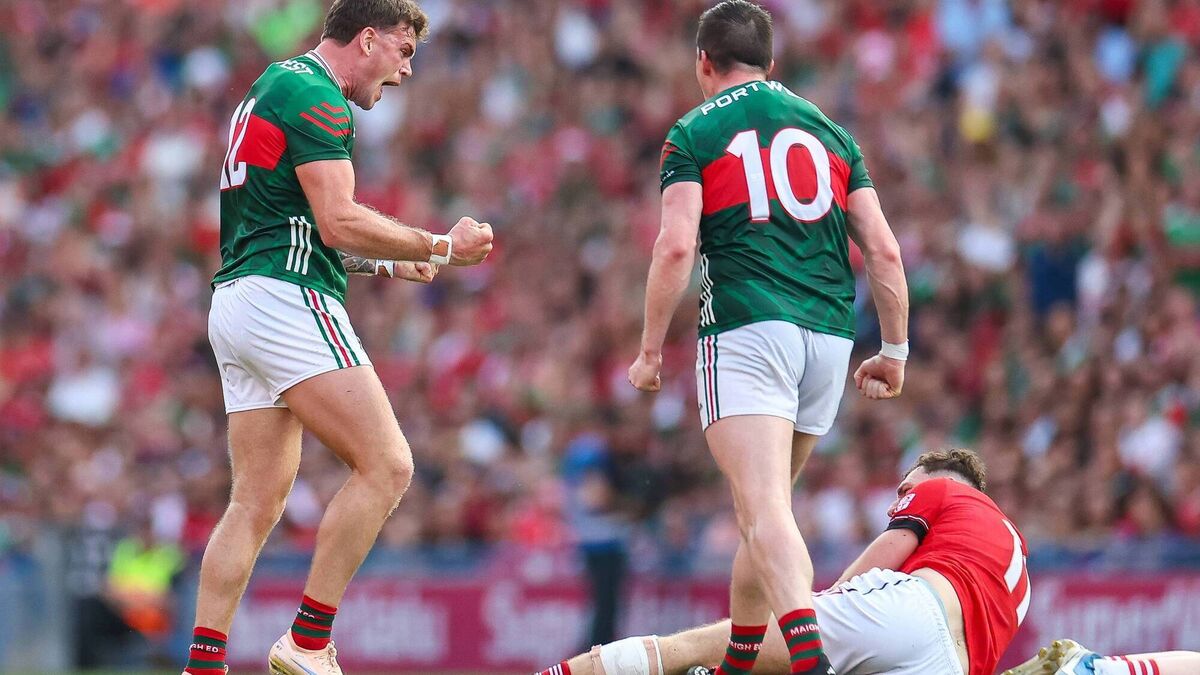
Mayo teammates Jordan Flynn and Stephen Coen celebrate winning a turnover against Louth in Saturday's semi-final at Croke Park. Picture: INPHO/James Crombie
Every championship has a favourite. Every championship has a story. And every so often, it has a team that nobody quite notices until it's standing in the tunnel on All-Ireland final day. Mayo have spent the last month quietly becoming that team.
That sounds absurd when set against the facts. Andy Moran's side have just won an All-Ireland semi-final by 17 points. They scored 3-23 and, for a second successive game, looked like a team growing more assured with every passing minute. They didn't stumble into the final. They marched there.
And yet, it still feels as though the country's gaze is fixed somewhere else.
Perhaps that is the enduring consequence of wearing a Mayo jersey. Other generations carried the burden of expectation. This one carries the burden of assumption. Before a ball is kicked in the final, most people have already convinced themselves that Mayo won’t have the quality, the experience or the history on their side. Mayo's performance against Louth hasn't really altered the conversation. It has merely earned them a seat at the table.
Which might be precisely where they want to be.
Mayo occupy a curious place in the sporting imagination. They are rarely judged on what they have just done. They are judged on what happened to the teams that came before them.
A 17-point dismantling of Louth should have sent the rest of the country scurrying back to the drawing board. Instead, Mayo remain Mayo. The crest has become heavier than the players wearing it. The irony, of course, is that this team owes precious little to those that fell agonisingly short. And yet they inherit every scar.
Perhaps that is unavoidable. Sporting history has a habit of clinging to a county until somebody finally shakes it loose. History is a magnificent servant and an appalling navigator. And it can become a lazy lens through which to view the present. Sometimes it blinds us to what is unfolding in front of our eyes.
In truth, this didn't begin against Louth. It has become the defining rhythm of Mayo's summer. Cork arrived with momentum and plenty fancied them to reach the last four. Louth captured the imagination as the championship's great fairytale. Indeed, most pundits expected them to keep their locomotive chugging all the way to the All-Ireland final at Mayo’s expense. Each hurdle throughout the summer came with a compelling reason why Mayo would fall. And each hurdle was quietly cleared.
Perhaps that shouldn't be so surprising. Mayo hasn't emerged from obscurity. They've spent years holding their own in Division One against the strongest counties in Ireland. They didn't suddenly become a good football team over the last fortnight. They've simply become one that far too many people have overlooked. Each victory was treated not as evidence but as an administrative error.
That may prove to be the greatest gift this Mayo team has been handed. For years, the county arrived at All-Ireland finals with two opponents: the team in front of them and everything that had gone before. Every match was framed as the chance to end a famine, to bury a ghost, to finally close a chapter that had remained stubbornly open for generations. Every kick was accompanied by the weight of history.
This feels different.
And that freedom is often underestimated in sport. Expectation has a habit of making athletes play the occasion rather than the game itself. Freedom allows them to see only the next pass, the next tackle, the next score.
Saturday hinted that Mayo has reached that place. They never looked hurried when Louth made the brighter start. They never chased the game emotionally. Instead, they trusted the process, tightened their grip after the break and slowly drained the contest of any uncertainty. It was the football of a team absorbed in the present rather than haunted by the past.
That mentality extended beyond the football itself. With the game won, Moran had little interest in emotion. There were no indulgent substitutions designed to reward veterans with one last ovation. His thoughts had already drifted beyond Louth. Players who may be needed in an All-Ireland final were given valuable minutes because the semi-final, emphatic as it was, represented nothing more than another step. It was a small decision, but a revealing one. There wasn't a violin to be heard. The orchestra had already packed up for the final. The focus wasn't on celebrating what had been achieved; it was fixed on what still remained.
That has perhaps been Moran's greatest strength all year. Mayo haven't been flawless, but neither have they been stubborn. Problems have arisen and, rather than defending old ideas, he has addressed them. He has treated plans the way good gardeners treat roses – pruning without sentiment. New players have been trusted. Systems have been tweaked. The team has evolved in real time. It is the mark of a manager with remarkably little interest in proving himself right and every interest in getting Mayo right.
None of this guarantees Mayo anything, of course. Football has never been that obliging. They will rightly begin the final as underdogs, just as they would against almost anyone in the country. Experience still matters.
But perhaps the greatest mistake in sport is believing history plays the game.
It doesn't.
For years, Mayo teams have walked into finals carrying a weight no performance could ever lift. This one arrives with something altogether different. It arrives with form, with freedom and with the quiet confidence of a side that has earned its place rather than inherited its burden.
The past deserves to be remembered. But it doesn't deserve a vote. This Mayo team has earned the right to be judged on its own merits, not on the heartbreaks of other men. Alas, assumptions can be harder to shake than the stickiest of corner backs.
Perhaps Moran’s greatest trick will be convincing everyone they have already seen the ending before the final chapter has even been written.