Irish Church could learn a lot from Spain
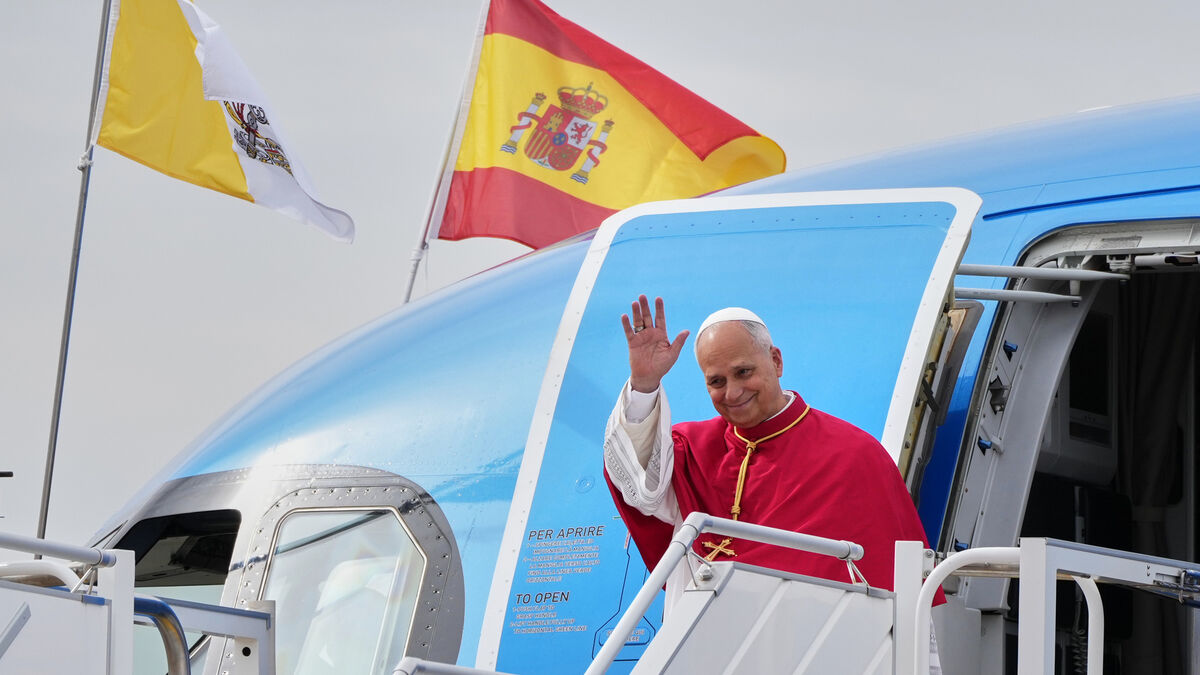
Pope Leo XIV arrives at Madrid's Adolfo Suarez International Airport on Saturday, June 6, at the start of his seven-day apostolic journey to mainland Spain and the Canary Islands. Picture: AP Photo/Alessandra Tarantino
It’s almost 50 years since September 1979, when Pope John Paul II visited Ireland – for the first papal visit to Ireland in history. The first definitive image of him was stepping off the Aer Lingus plane at Dublin Airport, kneeling and kissing the ground.
In three memorable days an estimated 2.3 to 2.5 million people attended organised events – an extraordinary figure in that the total population of Ireland, north and south, was then 4.9 million. Events and numbers attending included two significant metrics: the Open Air Mass in the Phoenix Park (in excess of 1 million) and the Galway Youth Mass (250,000-300,000).
When Pope Leo XIV visited Spain recently the crowds attending corresponding events were higher – 1.2 million at the mass and 600,000 at the Youth event but given Spain’s population (almost 50 million) the turnouts at the two events were proportionately much higher in Ireland than in Spain.
But what else was different?
The Irish Church in 1979 was basking confidently in the sun: with more priests than were needed (in Killala diocese curacies were being invented and priests drafted to London parishes to disguise an embarrassing excess of numbers); with religious practice in a list of credible surveys consistently over ninety per cent; with bishops listened to respectfully (even indulged with throwing in the ball in at Croke Park on All-Ireland final day); with impressive churches being needlessly built and now surplus to requirements; with the writ of (some) parish priests running amok; and the reforms envisaged by the Second Vatican Council being unashamedly kicked into touch by a youthful Pope John Paul II.
But whereas the Irish Church in 1979 on a crest of a wave was in buoyant good health and was looking forward confidently to the future, the Spanish Church by the early 2020s was on a downward graph, part of a pattern that was enduring a decline before an advancing secularisation of Europe – with declining priest numbers, religious practice in steep decline, finding itself on the wrong side of history, unpopular and enduring public disapproval – similar to where the Irish Church is now.
Once the heartland of Christendom, the Catholic Church in Europe – a flame that has now passed to a younger more vibrant Church in Africa and Asia – has collapsed and is by common consent in terminal decline. But in Spain for some years there are signs that a nation once at the very heart of Christendom is showing signs of reawakening. This is not unconnected with the adoption of a four-year national pastoral plan by the Spanish bishops after broad consultation among the people to road-map a strategy for the Spanish Church which has shown positive signs of a spiritual awakening and among young people a hunger for more than a successful economy can deliver.
So when the Spanish bishops approached the newly elected Pope Leo XIV for help to keep the faith alive in Spain, it resonated with Leo’s conviction, shared with his predecessor, Pope Francis, that Europe needs to change by embracing a new missionary synodal conversion. They decided that the Spanish Church needed a re-set through an adoption of the reforms of the Second Vatican Council and the synodal pathway. Through the wise leadership of the Spanish bishops it became an opportunity that Leo welcomed to stress-test his prescription for a revival of Europe.
On the basis of the evidence so far, the Spanish papal visit was an overwhelming success and has opened up similar possibilities for Leo to explore through extended visits to Europe, with France next in line. Unfortunately, in Ireland there is still no interest from bishops or priests in ‘a national pastoral plan’ and minimal in its focus on a synodal pathway.
The mind-set of the Spanish bishops has been crucial to the success of the recent visit. In a statement they pointed out: ‘In Spain, the era is over in which we said, 'I am Catholic because I was born in Spain'."
‘The Spanish bishops’ response’, Austen Ivereigh wrote in , ‘is an obvious contrast to that of the bishops of England and Wales who have distanced themselves from synodality and which most Catholics in the UK are unaware of’.
Through the messages evident in the many speeches during the Spanish visit, Leo’s enthusiasm was catching and there was a real sense that he wanted to free the Church to ‘welcome new beginnings’, ‘to leave behind structures that do not respond to our needs’.
Here are a number of prophetic comments that Leo used to underline his conviction that change is necessary, if the church in Europe is to survive: ; and, in reference to young people, Leo underlined that
The crowds of young people were drawn by the presence of Pope Leo as if he was a magnet for those looking for answers to the main questions that haunt their lives. ‘The way of Christ’, he promised them, ‘would have the last word, – the One who identifies with the stranger, touches the wounds of humanity and calls us to recognise him in every brother and sister who needs to be welcomed, protected, supported and integrated’.
Could Ireland follow Spain and France and avail of ‘the Leo lift’ to engage our young people? Sadly there’s little or no chance of that as there is no indication that the ground work has been prepared for such an initiative in any credible way. We’re just not ready for that and on almost every metric it is clear that we are not even particularly interested. It is as if at this stage we still don’t know (or don’t care) that attentive listening is part of Leo’s fundamental credo of pastoral outreach. What a different church it would be if attentive listening to the young and the not so young became the rule rather than the exception.