Arrivals and departures in our 'ghost' hotels
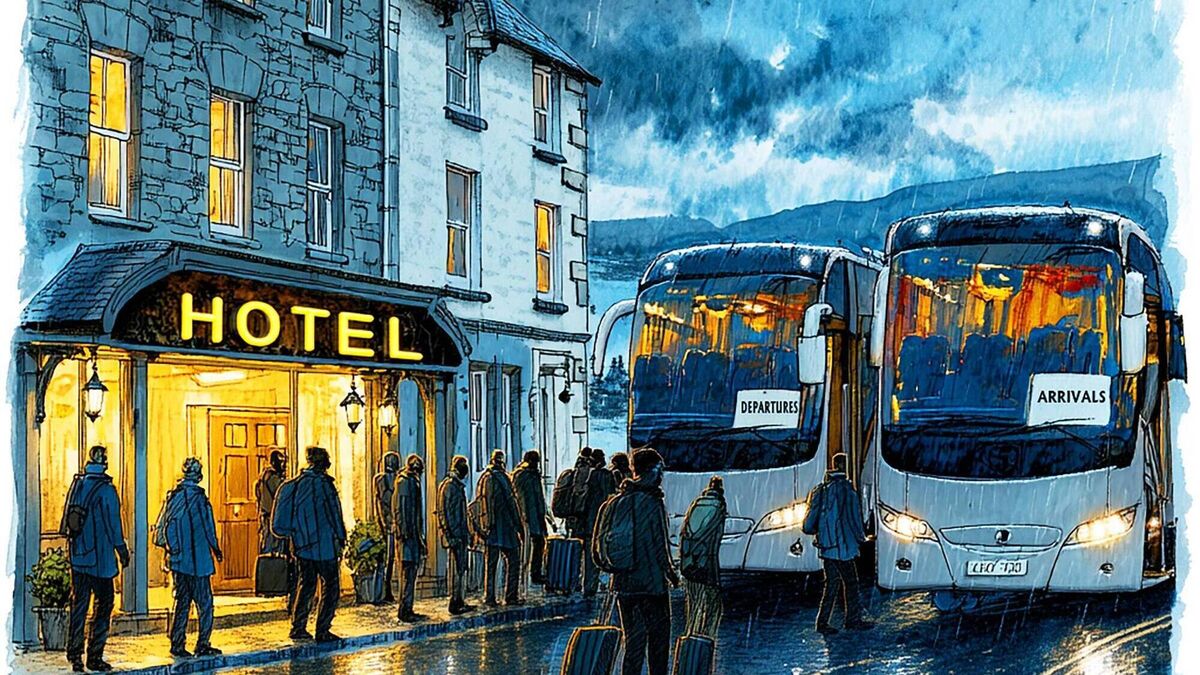
The same commercial accommodation machine that held 84,000 Europeans is being handed, bed by bed, to the asylum system. Illustration: Conor McGuire
There's a hotel on the road into every western town that hasn't hosted a wedding in four years. The car park's full. The lights are on in the evening. And not one person sleeping there picked the curtains or the carpet or the grim little kettle bolted to the tray. Since the spring of 2022 it's been home to people who arrived with a wheelie case and a phone full of a country being shelled. This autumn, the coaches come back for them.
The Government calls it a transition. Of course it does. Ministers Jim O'Callaghan and Colm Brophy stood up the other Tuesday and announced that the state will stop paying for the hotels that Ukrainians live in, starting this month and ending by the first week of March. Ninety-odd hotels handing back their guests by the end of October alone. Sixteen thousand people in the commercial places, another forty-two thousand billeted in the spare rooms of the plain decent, all of it wound down on what the press release calls a phased basis. Phased. As if the word were a mattress you could land a family on. Three months' notice, they say. Ninety days to find a house, in this country, at this rent. A courtesy in a functioning market. A countdown in ours.
Now, before we get to the part everyone wants to get to, there's a version of this story you'll hear in every second pub between here and Roscommon, and it goes like this. The Ukrainians were milking us. They were on the pig's back, the lot of them, flying home for the holidays and back for the free hotel, working for cash and drawing the dole, getting more in a week than an Irish family gets in a month.
It's a good story. It's also, in most of its particulars, a lie, and I'd rather not write a column built on one. The chart that went round showing Ukrainians raking in more than Irish families was fact-checked into the ground. The line that nine in ten of them don't work is nonsense too. The real figure is that around 29,000 of the 84,000 still here are in paid work, better than a third of the whole cohort, on about €550 a week, propping up the hotels and the hauliers and the meat plants that can't get an Irish hand to do the job. And then there is a third that counts the children, the pensioners, and the women minding both in the denominator. The weekly payment itself is €38 and change, income-tested. Nobody got rich on that.
Nobody could.
Here's the part the pub won't tell you, because it doesn't flatter the teller. The abuse was real. It just wasn't theirs. It was ours.
The people who actually gamed this scheme were the hosts and the landlords. Helping Irish Hosts, a charity set up to house the very people we're now evicting, went to the Government with a file of it. Irish hosts pocketing the €800-a-month state payment and then charging the Ukrainian in the box room a top-up. Some claiming the host payment and rent on the same bed. Tax quietly not troubled. Tenancy law quietly not consulted. A grey little market in other people's desperation, run not by the refugees but by the settled and the sharp-elbowed who saw a subsidy and did what we always do with a subsidy. And the State, waving money at the problem to make the photographs go away, handed out emergency top-ups of €400,000 to €700,000 for car repairs and tyres, and then acted wounded when anyone asked to see the receipts.
That's the scandal, and it's a more Irish one than the fantasy of the scheming foreigner. We didn't get taken for a ride by Ukrainians. We took the ride ourselves, and now we're blaming the passengers.
There's one honest criticism buried in the mess, which became a lightning rod for valid criticism. The scheme lacked adequate oversight and granted protection on a no-questions-asked basis. If you were from Ukraine, you were in. Not subject to interview or an assessment. Complete blanket cover, which is how people who were never Ukrainian at all rode in on the same ticket. That was the price of moving hastily in a genuine emergency, but the bureaucratic failures outlived the immediate crisis. So let's not pretend it was reviewed with any rigour, then act shocked at the endless revelations of abuse.
And now the quiet bit, the bit the ministers really don't want said out loud. The hotels aren't closing. They're changing tenants.
The same commercial accommodation machine that held 84,000 Europeans is being handed, bed by bed, to the asylum system. The direct-provision estate has grown from around 6,000 people in 2021 to 33,000 at the end of last year. A 450% rise. And here's the thing: it climbed even as the number of new arrivals fell by a third. Not a flood, but a blockage. They come, they wait years for a decision because we can't process a form, and almost nobody leaves. The Ukrainians were temporary by law and half of them were working. The people who are replacing them in those rooms are neither temporary nor working.
They are from further afield, too, and there's no polite way around the geography. The top nationalities claiming protection here now are Nigeria, Somalia, Pakistan, Afghanistan, and Georgia. People we cannot easily return in a system built to keep them for years, under a new EU Migration Pact that Ireland signed itself into last summer and that came into force in June. A permanent obligation, this one. No sunset clause. And the beauty of the pact, if you're a Government that would rather not house anyone, is that you can buy your way out. Ireland's share is 648 relocations a year, or €12.5 million. Pay the money, keep the moral glow, and take almost nobody.
So here's the swap, honestly told. Not Ukrainian for African in some tidy exchange the ministers can deny at the podium, because on paper they're different laws and they'll hide behind that. It is instead a cheap, temporary European welcome that half-worked and is being switched off. A dearer, more permanent, global one is being locked in by a treaty on which the populace was never consulted. And the only people who actually milked the first one were our native opportunists.
The coaches will come in the grey light some Tuesday in October and legions of Ukrainians with broken English will fold four years back into a wheelie case and try to pick up where they left off. The kettle will stay bolted to the tray for whoever's next, from wherever's next, staying however long it takes a country that can't build a house to fail to read a form. And we go back to being the friendliest people on earth. Right up until the bill.