Definition of Catholicism is changing in Ireland
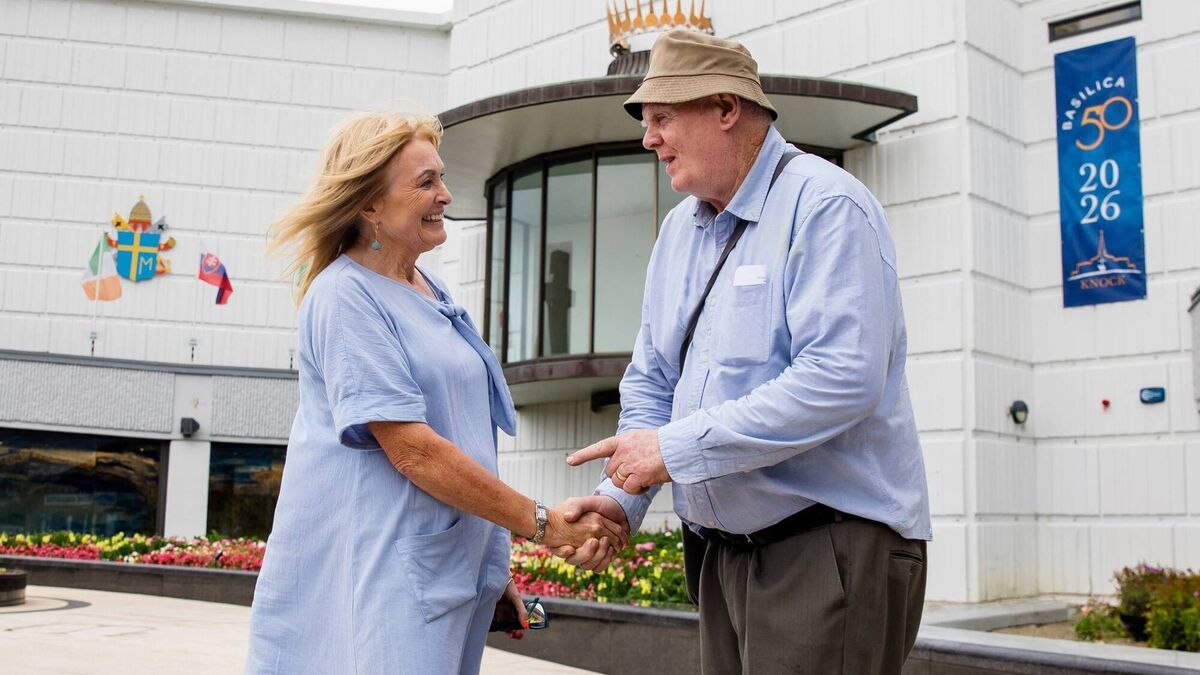
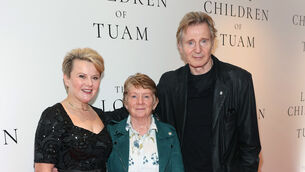
Broadcaster Mary Kennedy greets John Flynn, from Leitrim at the National Novena at Knock Shrine. Picture: The Commercial Photographer
Who (or what’s) a Catholic? Once we had no problem answering that question – and I’m old enough to remember it well. A Catholic was someone who attended Mass on Sundays and Holy days; performed their ‘Easter duty’ – in other words went to Confession and received Communion at least once a year; refrained from eating meat of Fridays; and said their morning and night prayers.
Now we’re not so sure.
For one thing, now there seems to be a variety of Catholics: common or garden Irish Catholics; Catholics; ‘Real’ Catholics; and now even excommunicated Catholics.
There are, however, two main types of Catholics today: first, the ordinary Catholics who have remained loyal to the traditional faith of their fathers (even though mainly it was Irish mothers who kept the faith alive) following the tried and trusted path that their parents and grandparents had faithfully followed before them. Ordinary Catholics usually follow a long defined path with a focus on ‘the way we were’.
Second, there are the Catholics who for a variety of reasons deflected in some measure from the tried and traditional path of institutional religion. This version of Catholicism is quite new and follows as diverse a track as the life experience of Catholics affords. Thus its variables are many and legion.
Recently at the Knock Novena, one of the speakers conceded that she was a convinced Catholic, taking and leaving different elements of traditional Catholic life but convincingly setting out her stall of respect for and commitment to fundamental Catholic values that underpin her life.
Mary Kennedy is a 71-year-old grandmother, a well-known broadcaster, RTÉ presenter and author who was raised in a Catholic home where the faith was very much part of the weather of her life to such an extent that the rosary was said every evening after tea. Her mother was a daily Mass-goer and her father a convinced Catholic who expressed his faith in practical ways like helping to found the Clondalkin Credit Union and volunteering with the St Vincent de Paul - an example Mary HAS followed in her own life. She raised her children – now in their 30s and 40s – in the Catholic faith, though now, she told Sarah MacDonald of the , that they are not weekly mass-goers – though she is happy that they live good lives.
Clearly, Mary Kennedy loves her Catholic faith, especially the ritual of the Mass which she finds ‘a very peaceful, serene, reflective time’. However, there are parts of the church that she is not too keen on – its chequered history and its male-dominated ministry. She would love, she said, ‘to see women priests’ though she doesn’t think this will change in her lifetime.
Mary Kennedy presented a realistic portrait of thousands of Irish Catholics today who for a variety of reasons find themselves in a disjointed relationship with the Catholic Church, many of them divorced as she is and many others in 'irregular' unions but she is convinced that although this does not sit well with Catholicism and the view that she shouldn’t be receiving Holy Communion, she feels that it is preferable to men and women ‘being caught in a horrible, sad, unloving situation’.
Apart from traditional and Catholics, there are too what I have called above ‘Real Catholics’, usually members of sectional groups within Catholicism who have a loyalty to a particular aspect of Catholic faith or practice and who regard everyone who disagrees with them as not being (like them) ‘Real Catholics’. An example is the members of the Latin Mass society whose focus on retrieving the earlier versions of the Latin Mass exactly as they were centuries ago is causing not just considerable irritation but is placing themselves in the ironic position of actually not being ‘real’ Catholics because of their refusal to accept the vernacular Mass introduced through the Second Vatican Council.
And finally, there’s the breakaway Catholics of St Pius X (SSPX), founded in 1970 because of objections to developments in Catholic teaching emanating from Vatican Two on religious liberty, ecumenism, the ‘new’ Mass and what they regard as discontinuities with earlier Christian teaching.
Of the ‘Catholics’ of the varied groups mentioned above, the two categories that prioritise the attention of the Church – the traditional Catholics and the Catholics – between them make up the vast majority of Catholic families. In numerical comparison the different sects of ‘real’ Catholics are minimal, though they make a lot more noise. As Irish society changes and the definition of Catholicism broadens, the space between traditional Catholics and Catholics narrows.
Once it was accepted that all marriages of baptised Catholics were in the Catholic church – not anymore. Once it was presumed that every baby of even nominal Catholics would be baptised (if only to satisfy grandparents) – not anymore. Once it was presumed that any form of blessing of LGBT couples was automatically disallowed. In truth, now many if not most Irish families reflect a blend if not a fusion of the two main groups.
Of course, the change is reflective not just of a changing society but of a changing church. That change was first mooted in the Second Vatican Council (1962-65) when a series of documents were agreed between the pope(s) and the bishops of the world – the highest teaching authority of the Catholic Church.
Subsequent popes, uncomfortable with some of the implications of the documents succeeded in temporarily shuffling the reform to the sideline but Pope Francis and now Pope Leo are giving the reform a fair wind.
Interestingly, some of the ‘Real Catholic’ groupings refuse to recognise the reforms of the Second Vatican Council and by so doing effectively place themselves outside the Catholic fold, as with the SSPX who imagine that they are the 'Real Catholics' when, in effect, after their recent excommunication, they are not Catholics at all.