Ireland is experiencing a cultural reawakening
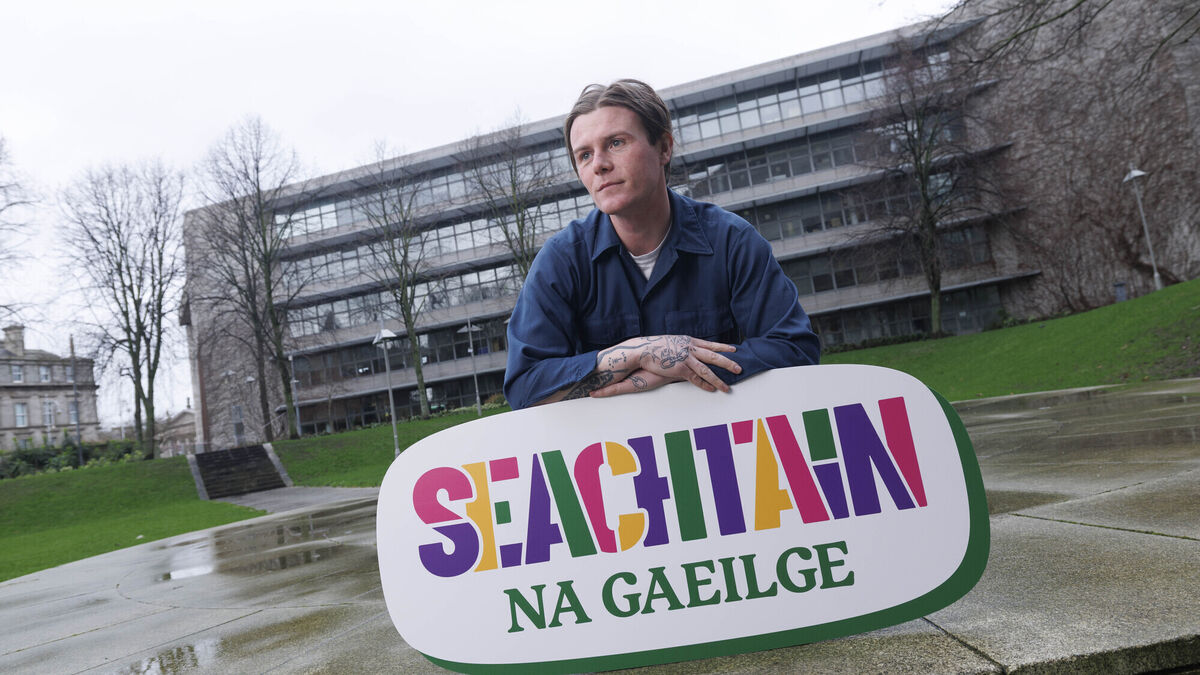
Pictured at the official launch of Seachtain na Gaeilge 2026 earlier this year was Conor Curley, lead guitarist with Fontaines D.C. Picture Conor McCabe Photography
Immediately following my experience of , the Oscar-winning, Gothic horror film by Ryan Coogler, I emerged into the Los Angeles summer’s evening with my heart thumping and eyes wide (and not just because of cost of the cinema ticket). Beneath the vampires and violence set in the American Deep South of 1932, really is about something far more interesting: memory, identity, music, colonisation and the way cultures consume and reshape one another over time. I loved it.
What struck me most was not the horror itself (which was brilliantly exquisite), but the film’s subtle understanding that history is rarely as simple as modern politics makes it out to be. Written and directed by Coogler (the genius best known for and ), became one of the most acclaimed films of 2025, with a record 16 Oscar nominations and four Oscars including Best Actor for the mesmerising Michael B. Jordan. has always been a favourite song of mine but the way Coogler enmeshes it into a pivotal scene is some of the most engaging storytelling in film I have ever witnessed.
The film’s principal protagonist is Irish, played hauntingly by Jack O’Connell. His character Remmick is the mysterious, ancient Irish vampire who becomes central to the film’s deeper themes about cultural memory, conquest, religion and identity.
In lesser hands that detail would have been meaningless. In , however, it is deliberate, and feels deliberate. Coogler has spoken of his deep interest in Irish history. Thus, his deliberately-chosen Irish character is not presented simply as a representative of generic “white oppression”, but as someone carrying the scars of another colonised culture, another people whose language, religion, customs and identity were hollowed out over centuries through conquest, plantation and ultimately control.
Some Black-American online commentators I watched seem to miss this entirely, reducing the film once again to the simplistic racial binaries that increasingly dominate modern discourse. Yet, as Coogler has explained, the film is making a far more nuanced point: oppressed peoples often recognise fragments of themselves in one another. Cultures overlap. Histories intertwine. Human suffering rarely fits neatly into ideological boxes.
Recently, I found myself watching something blow up online that touched on this same idea of Coogler’s, featuring clips of a speech by Thomas Gould, the Sinn Féin TD from Knocknaheeny, on Cork’s northside. He went unexpectedly viral across Jamaica and parts of the Caribbean after speaking passionately in the Dáil about Ireland’s housing crisis. Yet it was not the politics that fascinated viewers abroad. It was his accent.
Thousands of Jamaicans joined the online conversation that the Cork politician sounded remarkably like people they knew at home. Some initially assumed the video was a joke. Others became genuinely curious. How could a white Irish politician from Cork sound, to Jamaican ears, Jamaican?
Soon social media did what institutions and classrooms often fail to do: it started a global conversation and reminded us of the power of sharing ideas.
Reaction videos appeared. Amateur historians weighed in. People began discussing Ireland’s connections to the Caribbean through the British Empire. Viewers rediscovered the history of Irish indentured servants, labourers, soldiers and migrants who were sent to Jamaica and other colonies centuries ago. Others explored how accents evolve when populations mix and interact over generations.
Linguists, quite rightly, caution against simplistic conclusions. Jamaican patois or creole did not simply “come from” Irish accents. Jamaican English developed through a complex interaction between West African languages and multiple British and Irish dialects over centuries. History is rarely tidy.
Yet culturally, the viral moment touched something deeper.
For many viewers abroad, particularly younger people in America, Africa and the Caribbean, it complicated a worldview they had inherited. A simplistic understanding that often reduces social history or everyday interactions into a neat division between privileged white people and everyone else.
Ireland does not fit comfortably into that framework.
Ireland is West-European. Ireland is English-speaking. Ireland is white. But Ireland was also colonised, partitioned, dispossessed, impoverished and culturally suppressed over centuries. The Penal Laws, plantation policies, famine, mass emigration and religious discrimination all left scars which still shape the country today. Not least in being the only European country to have less of a population size than it had two hundred years ago.
And increasingly, people around post-colonial societies are beginning to recognise echoes of their own histories within ours.
Indians see parallels in famine and oppressive British rule. Africans recognise the familiar machinery of imperial administration. Palestinians identify with partition and occupation. Black Americans rediscover the solidarity shown by figures like Daniel O’Connell and Frederick Douglass. Douglass was an escaped slave who became one of the most influential abolitionists, writers and civil rights advocates in nineteenth-century America. Travelling through Famine-era Ireland he recognised parallels in the suffering he witnessed with the oppression of the enslaved people in the United States.
None of these experiences are identical, nor should they be forced into sameness. The horrors of slavery in the American South were brutal in scale and structure. A mature understanding of history should acknowledge that clearly. As Douglas himself observed: “Far be it from me to underrate the sufferings of the Irish people. They have been long oppressed; and the same heart that prompts me to plead the cause of the American bondman, makes it impossible for me not to sympathise with the oppressed of all lands. Yet […] The Irishman is poor, but he is not a slave. He may be in rags, but he is not a slave. He is still the master of his own body…”
But in accepting the uniqueness of slavery in America, history became poorer when all Europeans were flattened into one homogeneous category of historical oppressors. Human history is more complicated than that. Europe itself is full of conquered peoples, erased languages, occupied territories and long memories of empire. Ireland is the evident example.
What fascinates me is that this rediscovery of Ireland is not happening through government campaigns, academic conferences or official tourism strategies. It is happening organically, from the ground up, through art, music, film, podcasts, memes, TikTok clips and online conversations.
In many ways, this mirrors what is happening within Ireland itself.
Ireland is experiencing a visible cultural reawakening, particularly among young people. Interest in the Irish language has grown in a way that feels authentic rather than forced. Young people are embracing Irish not simply as a school subject but as something rebellious, living and deeply connected to identity. Even many immigrants arriving into Ireland are enthusiastically learning the language and participating in Irish cultural life.
At the same time, Irish music and art are becoming more politically and culturally confident. Groups like Kneecap, Chasing Abbey, Lankum, Fontaines D.C. and The Mary Wallopers are only the most visible examples of a wider movement of artists engaging unapologetically with Irish history, Irish frustration and Irish identity.
Not everyone likes the tone of this new cultural confidence. Some find it abrasive or confrontational. Yet cultural revivals are rarely tidy affairs. The Gaelic Revival of the late nineteenth century was not simply about preserving folklore; it fundamentally reshaped Irish political consciousness. Before political change often comes cultural rediscovery.
Perhaps that is what we are witnessing again, not only in Ireland, but globally. In a reaction to Gould’s viral clip, popular African content-creator, The Merc, is now encouraging his almost quarter-million YouTube fans to learn Irish history (while asking Irish people to learn African history), as he insists they both share much more in common than each ever knew. A large African and diaspora audience is now actively engaging Ireland voluntarily, not through school systems or missionary zeal, but through native creators like him who package history in bite-sized social media narratives.
What , Kneecap and Thomas Gould’s viral-video reveal is that many are increasingly dissatisfied with rigid ideological categories that divide humanity into simplistic tribes. Some movements seek to define people primarily by race. Others by religion, nationalism or inherited guilt. Yet ordinary people often instinctively search instead for points of recognition, of shared experiences of displacement, injustice, resilience and survival.
Art can sometimes reveal those connections more honestly than politics ever could.
A film about Irish vampires in Mississippi. A Cork accent passing as Jamaican patois in Kingston. A comments section filled with Africans discussing Irish history. These are small moments, perhaps, but they point towards something larger happening beneath the surface.
For all the noise and vapidness of social media, it is also creating unexpected conversations between peoples who previously knew almost nothing about one another. And in doing so, it may be helping us rediscover something modern politics often forgets: that history is complicated, identity is fluid, and human beings have far more in common than the tribes we increasingly place ourselves in or indeed, are divided into.