Modern scammers prey on our age-old vulnerabilities
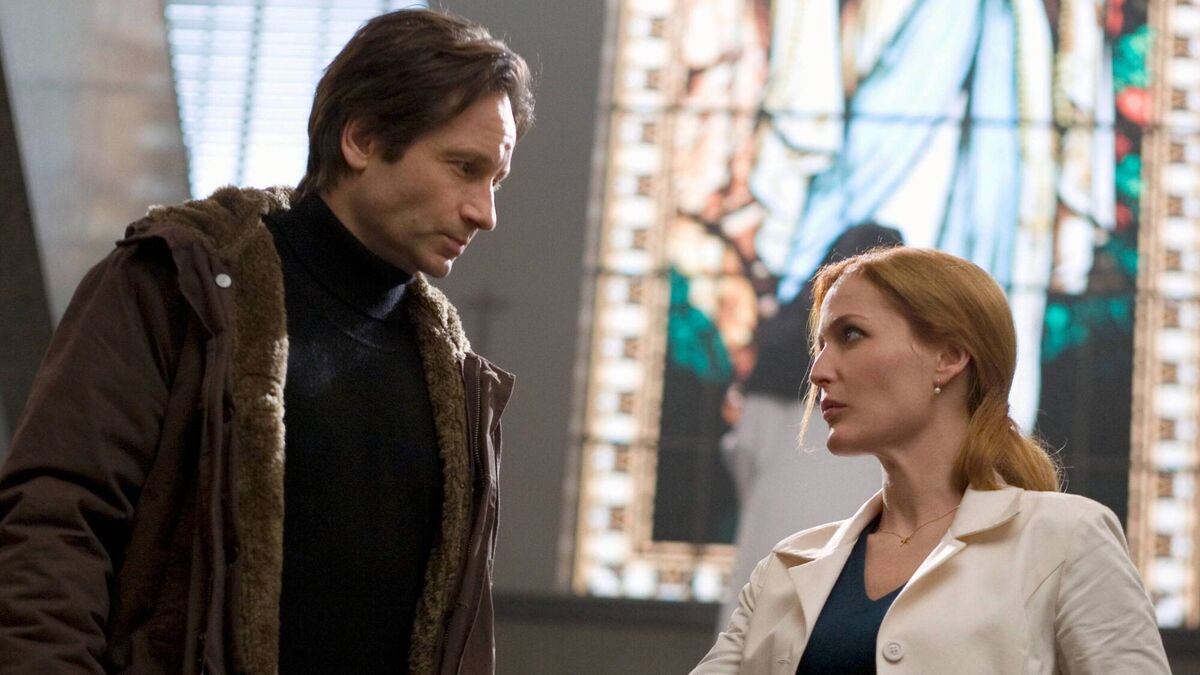
Gillian Anderson and David Duchovny as Mulder and Scully in 'The X-Files'. Picture: AP Photo/Fox, Diyah Pera
Anyone who grew up watching the cult television series will remember that its mysteries came wrapped in the supernatural: extraterrestrials, unexplained phenomena, otherworldly entities.
“The Truth is out there” was its tagline, appearing in the opening credits of each episode and became the motto of conspiracy theorists all over the world (not just me) seeing government and deep state as conspiring to hide the truth from the citizens.
But one episode stayed with me for a different reason. In it, FBI agents, Fox Mulder and Dana Scully, track down a serial killer, expecting (or hoping almost) for some hidden, supernatural explanation.
There wasn’t one. This was the only episode I remember with a mundane human protagonist. No aliens. No mystery. Just an ordinary man. A killer yes, but a man.
Once the hidden mystery turned out to have a very human cause, Scully stated that it was their most frightening case of all. Because it meant the threat wasn’t “out there”. It was simply the awful reality of an ordinary, everyday human, luring his victims with fantastical promises of supernatural healing, to then kill them.
And that brings us, perhaps unexpectedly, to the modern phenomenon of catfishing.
There are worse ways to waste an evening than watching internet scammers being hunted down like badly dressed villains in a low-budget crime drama.
One of my own guilty pleasures is binge-watching the hit, scam-busting YouTube channel Trilogy Media founded by Ashton Bingham and Art Kulik in Los Angeles a decade ago. It’s the sort of thing I put on intending to watch one video and, two hours later, I’m emotionally invested in whether a heavily-accented man in Lagos pretending to be a four-star general from Ohio can be coaxed into clicking an unmasking link.
Aside from the human drama, the appeal, I suspect, lies also in the pairing. While Art has the tall, charismatic, don’t-mess-with-me persona, Ashton has the air of someone who apologises if he bumped into a chair, yet transforms - almost alarmingly - into a digital vigilante when faced with a scammer. There’s something quietly satisfying about watching his bespeckled politeness give way to the brave, forthrightness of a morally-outraged man with a pot-belly, seeking redress for helpless victims.
On this particular evening, the target was a romance scammer operating out of Nigeria, in the now depressingly familiar West African epicentre of this particular trade. That, in itself, is a story for another day: how entire informal economies have grown up around deception, and how technology allows them to scale with unsettling efficiency.
What caught my attention, however, wasn’t the scam itself, but what happened next.
The scammer was deluding an elderly woman into parting with her savings with a pretend online romance. Claiming he was the victim, through a mixture of bluff and luck, Bingham managed to convince the scammer to jump on a live video call. A small victory in itself as these operations rely on distance, anonymity, and the careful maintenance of illusion. Strip that away, and the whole thing begins to wobble.
There was only one problem. The scammer believed he was speaking to a woman.
And so, in a moment of mild domestic chaos, Bingham disappeared off-screen and returned with his wife, hastily briefed and placed in front of the laptop like an emergency understudy thrown on stage without rehearsal.
I nearly fell off the couch.
Because the woman now calmly engaging a romance scammer somewhere in West Africa was not just any reluctant participant, she was Amy McDonagh, a musician from County Mayo whose work I had followed entirely separately.
Two completely unrelated corners of the internet were colliding in the most unexpected but satisfying way.
It was, for a moment, almost funny and it worked, the Nigerian did not discern the Mayo accent. But the humour doesn’t last very long and Trilogy Media confronted the con-artist who had likely defrauded many victims out of tens of thousands of dollars. But because he lived in Nigeria, and had likely moved his ill-gotten money thorough untraceable gifts cards and cryptocurrency, he was effectively beyond reach.
It is tempting, because of the sheer number of videos posted by Trilogy Media (now with 1.8 million subscribers) and their collaborators, to wonder how so many people are lured in by what seems to be ridiculous, see-through catfishing or romance scams.
The easy answer, the lazy answer, is to say that the victims are foolish. That this is an American problem. That no sensible person in their right mind would believe that Johnny Depp or a decorated general had, quite suddenly, fallen madly in love with an 70-year old grandmother in small-town Minnesota, via Facebook Messenger.
But that explanation doesn’t survive much scrutiny and I was reminded of something closer to home. Some years ago, while on a theatrical tour in Letterkenny, I returned to our hotel after rehearsals to find the lobby unusually full. Not tourists. Not a wedding. Something else.
A single poster-sign at reception, which looked at first glance as if it was announcing an upcoming gig for a local country music star, pointed to a conference room upstairs. A “special clinic”, it said.
Curiosity got the better of me. Inside, there was a queue, long, quiet, and patient. Mostly older people. Some accompanied by family members. A number clearly dealing with serious physical or mental conditions. In a room off the corridor was a man offering healing. Not medical treatment. Not therapy. Healing. A faith healer who attended here one day each month. His assistant chaperoning a line of customers in.
What struck me was the unsettling number of people willing to sit, wait, and hope in that corridor. The mixture of desperation and belief. The sense that, whatever doubts they might have had, they were prepared, at least for a moment, to set them aside. Many were returning, with knowing hellos for each other. A gentle, older couple in their 80s, sat patiently beside their 50-something son, whose rocking over and back betrayed some deep-seated mental issue.
“How are ye?” greeted another old man, limping by with a cane.
“Not too bad, not too bad” returned the father, “you know yerself” and motioned to his boy and then to the closed door in the corridor, ‘waiting again for himself”. The man with the limp nodded. Nothing more needed to be said.
I remember thinking at the time that it was extraordinary, but I’m not so sure anymore. Because the longer you watch these online scams unfold, the more you realise that they are not built on stupidity and/or egos, though they help for sure. They are built on something far more universal. A willingness, or even a need, to suspend disbelief.
In , Mulder had a poster on his office wall that read “I want to believe”. That instinct hasn’t gone anywhere. If anything, it has found new and more dangerous outlets. As humans, if the yearning is great enough we will all become stupid.
Whether it’s a daily message from a stranger online asking if you’ve eaten (a small but telling cultural cue that your 24-year-old blond bombshell in L.A. is really a 40-year-old chain-smoking man in Ghana), or a loving, online romance with your future-husband who looks suspiciously like Russell Crowe, the mechanism is the same. Eventually, inevitably, they will ask for money and eventually, inevitably, you will give it.
We suspend judgment because we want the thing to be true, need it to be true. And once that suspension happens, almost anything can follow.
That is why the work being done by Trilogy Media matters. Because in an age where artificial intelligence can mimic voices, generate faces, have Zoom conversations and construct entire identities out of thin air, the line between truth and fiction is becoming increasingly difficult to see.
The scammers will get better. The tools will get sharper. And the stories will become more convincing. But the underlying vulnerability will remain exactly the same. When those who are seeking to manipulate us by making us feel special, loved and unique, we want to believe.