Women offer our Church a way out of crisis
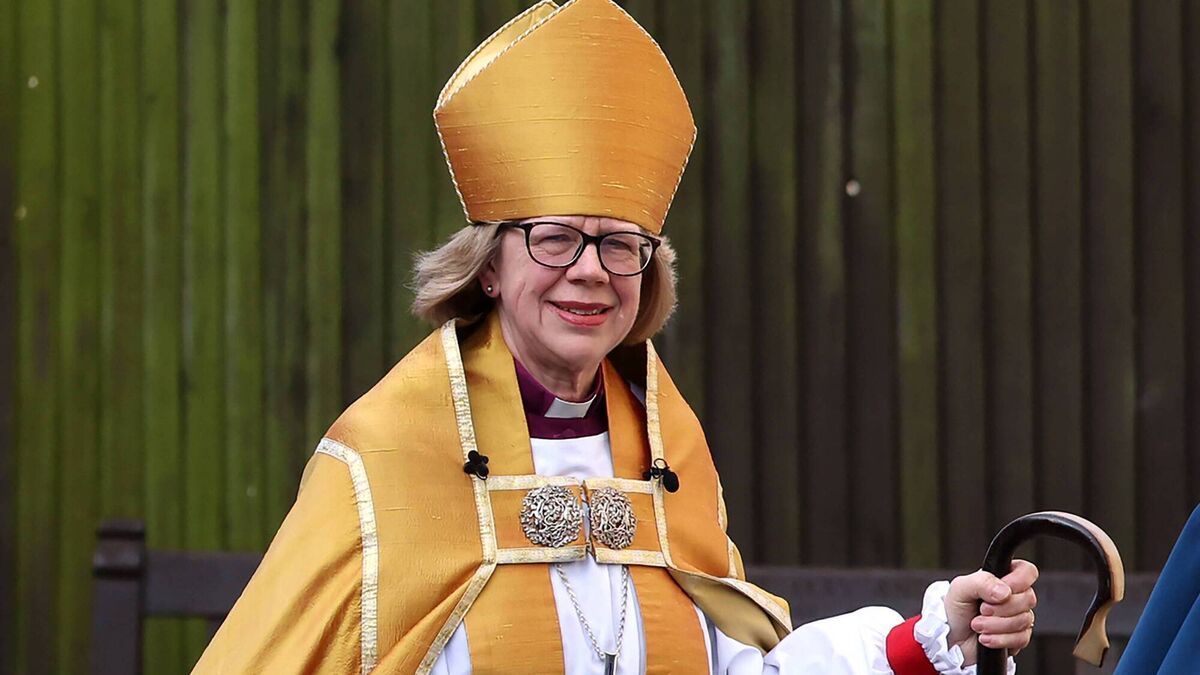
Sarah Mullally arrives at Canterbury Cathedral on March 25th last before her installation as the first ever female leader of the Church of England. Picture: Dan Kitwood/Getty Images
For Roman Catholics, it’s particularly gratifying that the first official visit of the newly enthroned Archbishop of Canterbury, Sarah Mullally, was to Rome, when on Monday, April 27 last she visited Pope Leo as they met for the first time and prayed together in the Urban VIII Chapel.
Leo shared his joy in welcoming Archbishop Mullally during the Easter season as well as sharing his Easter-tide peace-greeting of Christ to all Christians.
"Among Christians," he added, "divisions weaken our ability to effectively bear Christ’s peace to the world."
It would, he said, be "a scandal if we did not continue to work towards overcoming our differences, no matter how intractable they may appear".
The visit represents once again how much in common the two world-wide churches share and the promise involved in moving forward together recognising, on the one hand, the progress made in the movement towards unity since the Second Vatican Council (1962-5) and, on the other, the difficult challenges on the road ahead.
There was too the not inconsiderable impact of the character of the meeting between the 267th pope and the first woman archbishop of Canterbury. In the visit of Sarah Mullally, there was at once a sense of promise when on the road to unity a convergence develops as the two roads meet and with it as well a sense of divergence when progress is uneven as one church moves forward and the other fails to keep pace. The gap narrows and the gap widens, one step in and one step out again, as the dance towards church unity continues.
A picture can paint a thousand words and in the photographs of the visit, the difficulty of that bitter-sweet reality is clear for all to see. There was no doubting how far the road to be travelled still extends and yet how difficult it is to sustain the dream of church unity.
There was too a definitive symbolism in a male pope clad as always in the uniform ‘uniform’ of past centuries, casting an aura of an immutable and unwavering loyalty to static traditions and a woman archbishop of Canterbury deferring to past centuries but open to possibilities represented not least by her gender. Respective histories were resolute but wary of impermanence, with the question that hovered over the proceedings as always: where do we go from here?
Sixty years ago, back in 1966, the year after the Second Vatican Council, when anything or almost everything seemed possible, Pope Paul VI and Archbishop Michael Ramsey met to begin the softening process as the historic division that kept the dream of unity alive seemed for so long so impervious to real movement. Possibilities of co-operation were explored; difficult even intransigent theological divisions were given time and space; and real possibilities for hope hovered on the horizons of history, moderated by the interest (and sometimes) lack of interest of the heads of the two churches.
There is a growing sense that the agendas and the issues that underpin ecumenical dialogue have narrowed - towards safer issues like climate change rather than a shared eucharist, or towards a safer shared agenda like war, peace and migration rather than seeking a unified response to church unity.
There’s a sense too of giving more attention than is warranted to the limited agenda of denominational fixations than to tackling the core issues including the very scandal (as Leo put it) of disunity - the Anglican Church nervous of being overwhelmed by numbers, the Roman Catholic Church unnerved by possibilities of schism or whatever. And again the age-old question hanging like a dead weight over progress towards church unity remains: have the leaders and the church faithful they represent the courage to dream the dream of church unity? Or will ecumenism continue to remain little more than respectful PR meetings on the sidelines of history filled with limited intentions on the road to nowhere? More particularly, apart from polite meaningless words what status (and focus) will Pope Leo and Archbishop Sarah bring to serious ecumenical dialogue?
The greater challenge, it seems, is to the Catholic Church, not least with the gender focus given by the person of the Archbishop of Canterbury, setting in due perspective the dismal failures of the Catholic Church to respond to the promise and purpose available to our church by the presence, ability and expertise of committed women. The wonder is not that so many women have walked away but that so many are still grimly hanging to their membership of the Church even though they are being marginalised, patronised and systematically and embarrassingly excluded from roles commensurate to their gifts.
What is it about women, a friend of mine asked recently, that the Catholic Church doesn’t get? On the one hand, there are effectively no vocations anymore to priesthood and the religious life while statistics indicate that within little more than a decade there will be no priests and no Mass and no Eucharist? And no discussion about it by those who are responsible for the availability of priests and Masses and the Eucharist.
On the other hand, there chatting to Pope Leo is Sarah Mullally, a married woman, and at present the Archbishop of Canterbury no less. And the sky hasn’t fallen in and the Church of Ireland goes on about its business ordaining women to fill whatever gap emerges in every available parish.
Meanwhile in the Catholic Church, seminaries are either almost empty or completely closed and we’re importing priests from India, Africa and western Europe imagining that a sticking-plaster solution can somehow fill the ever-expanding gap. And that, as surely as night follows day, as things stand, in little over a decade we will experience the virtual disappearance of the last priests in Ireland. Again it posits the inevitable questions: who’s in charge of the store? Why is this crisis not up for discussion? And can they not see that the present redundant dispensation, condemning the gifts of Catholic women to a fate somewhere between condescension and misogyny, is in present circumstances a counsel of despair.
We can be better than this.
While not every Catholic and every Protestant will be excited by the meeting, there is no doubting its symbolic nature in the troubled history of the Roman Catholic and Anglican Churches over the last five hundred years.