Everyone has a plan until they get punched in the mouth
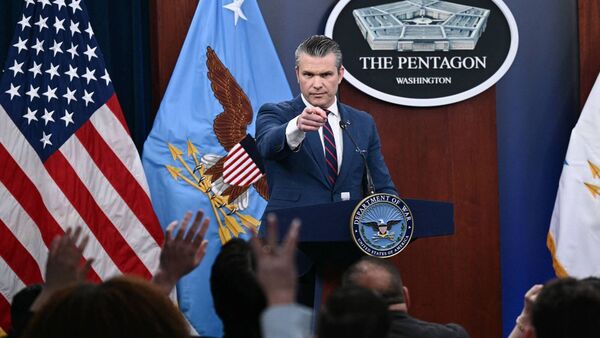
US Defense Secretary Pete Hegseth speaks during a press conference on US military action in Iran. Picture: Brendan Smialowski/AFP via Getty Images
features Rowan Atkinson as Captain Blackadder in this brilliant and darkly comedic TV series about British soldiers trapped in the absurdity and futility of trench warfare during World War I. In Episode 1 (entitled ), Blackadder explains to Hugh Laurie (Lieutenant George) and Tony Robinson (Private Baldrick) how European powers had created an intricate web of alliances to prevent the war breaking out.
Baldrick: “But this is a sort of a war, isn’t it sir?”
Blackadder: “Yes, that’s right. You see, there was a tiny flaw in the plan.”
Lieutenant George: “What was that sir?”
Blackadder: “It was bollocks”.
Thus, in the summer of 1914, Archduke Franz Ferdinand was assassinated in Sarajevo. Europe was already a continent on edge. Rival empires had formed competing alliances, military spending was rising and nationalist tensions simmered beneath the surface. Yet few people believed that the murder of a single archduke would ignite a catastrophe.
Within weeks, however, the alliances had locked into place and mobilisations began. Diplomats assumed the crisis could be contained. Instead it spiralled rapidly into World War I and a conflict that reshaped the world for the next century and cost millions of lives.
Looking back, historians can trace the causes and the sequence of decisions that led to war. But at the time, events moved quickly and often unpredictably.
The Prussian strategist Helmuth von Moltke the Elder would not have been surprised by Blackadder’s pithy commentary. After studying countless battles, he came to believe: “No plan of operations extends with any certainty beyond the first encounter with the main enemy forces."
From Sarajevo of 1914 to the Middle East of 2026, history shows how wars quickly escape the control of those who start them.
That’s the problem with plans as recognised by former world champion boxer Mike Tyson. The modern-day philosopher is remembered for his blunt assessment of an opponent’s lofty claims of having a plan to take him down: “Everyone has a plan until they get punched in the mouth."
Every sporting manager understands this. You can spend all week planning tactics, studying the opposition and drawing arrows on a whiteboard. But once the whistle blows, the game takes on a life of its own and the backroom team can do little about it. Ask Steve Borthwick.
Thus, war plans are both necessary and pointless. In 1957, the American president Dwight D. Eisenhower addressed the National Defence Executive Reserve Conference in Washington and reflected on his years as a military commander.
“Plans are worthless,” he said, “but planning is everything.”
Eisenhower explained that when a real crisis begins, the first thing commanders often have to do is take the carefully prepared plans from the shelf and throw them out the window. The plans themselves rarely survive contact with reality. What matters is the preparation, the thinking that allows leaders to respond when events begin to move faster than expected. But Eisenhower presumed there was planning, at the very least, when hostilities break out.
Worryingly, various Trump administration spokespeople cannot align on exactly why Iran was attacked. Or the preferred eventual outcome.
Except of course, as Donald Trump’s administration insists, 'Operation Epic Fury' is not officially a war but a “major combat operation”. Because, of course, America has not officially been in a war since the Japan surrendered in 1945. Though thousands of dead Vietnamese, Koreans, Iraqis and Afghanis would likely beg to differ. If they could.
Besides, under the United States Constitution, Congress is supposed to authorise war and there are many Democrats and Republicans there who oppose Trump’s military intervention in Iran. As the bombs keep falling, they are likely to become more vocal.
Still, it is nice to see Trump take his cue from Vladimir Putin who has not deviated from calling his own invasion of Ukraine a “special military operation” rather than a war, which has already claimed an estimated 1.27 million Russian troops since February 22, 2022.
In any case, whether a war or special (military) operation, 'Epic Fury' has opened a pandora’s box.
The Middle East is once again at the centre of global attention. Israel has already expanded its military operations across several fronts from fighting Hamas in Gaza to confronting Hezbollah in Lebanon and carrying out strikes linked to Iranian interests in Syria. Now the confrontation has widened further by Israel leveraging its alliance with the United States to attack Iran and decapitate the regime leadership there.
So, whatever plans may have existed before these operations began, once the first wave of missiles were fired, the logic of escalation took hold.
Already there are signs of how quickly situations can intensify. Reports have emerged of an Iranian warship being sunk by a United States submarine in the Indian ocean in an incident that illustrates how easily military encounters can push a conflict into new territory.
At the same time, other wars and tensions continue across the globe.
The war resulting from the Russian invasion of Ukraine remains unresolved, with Russia (and China) watching developments in the Middle East closely. Iran has been an important strategic partner for Moscow, and any weakening of Tehran inevitably has implications far beyond the region.
Modern warfare adds further layers of unpredictability. Drones, long-range missiles and cyber capabilities mean that attacks can occur suddenly and sometimes with unclear origins.
During the war in Ukraine, missiles and drones have already landed in neighbouring countries, including Poland, a member of NATO, briefly raising fears that the conflict could widen beyond Ukraine’s borders.
In a world where dozens of actors possess sophisticated weapons systems, even a single accident or miscalculation could drag additional countries into a confrontation.
Then there are the complicated alliances and rivalries that shape every modern conflict. Some policymakers have discussed strengthening Kurdish forces in the region as a way of applying additional pressure on Iran. Yet such a move would almost certainly provoke strong opposition from Turkey, which has long viewed Kurdish militant groups as a direct threat to its national security.
Meanwhile, extremist organisations linked to al-Qaeda and the so-called Islamic State still maintain remnants within Syria, waiting for opportunities created by chaos.
Across the world we are witnessing what increasingly looks like a broader reordering of the international system. Countries that once seemed stable or predictable have been profoundly reshaped by war and political upheaval. Even the United States itself now faces deep internal debate about its role in the world.
The question hanging over all of this is not simply how individual wars will end, but what kind of global order will emerge afterwards.
But there is one more thing that history and sport can teach us. Back in 2015, Kilkenny hurling supremo Brian Cody took issue with those who claimed winning was all about willing to make the ultimate sacrifice.
“You should never say you’re prepared to die to win a game," he said. "You should always be prepared to kill to win.”
It may well be that which dictates how this special military operation, unleashed by Donald Trump and Benjamin Netanyahu on Iran, ends and something else begins.
Though, either way in the end, it’s all bollocks.