Dolly's good deeds are an example to us all
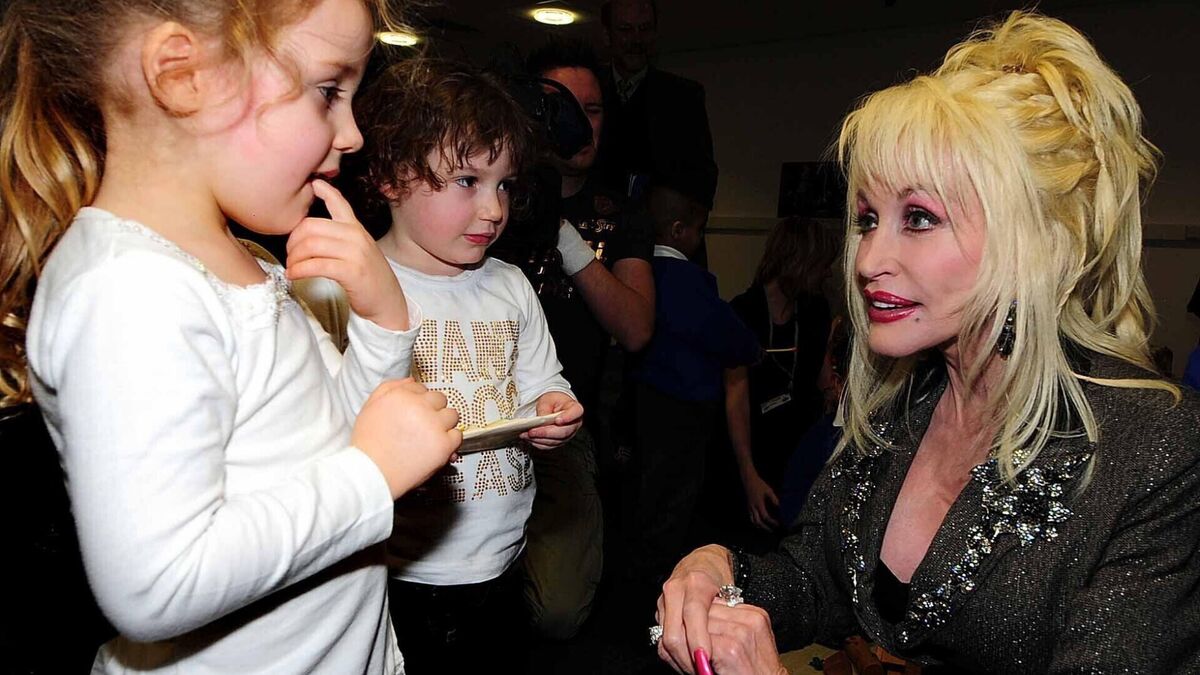
Dolly Parton launches the Imagination Library, her children's literacy scheme, at the Magna Science Adventure Centre in Rotherham, South Yorkshire in 2007. Picture: Rui Vieira/PA Wire
Some years ago I remember as a teacher being part of a school discussion about memories with a group of teenagers. Part of it was about what we remembered and why we remembered it. When it came to my turn to share a memory and to explain why it was important to me I said that I was ordained in 1973 and the memory of that day always remained with me. One girl was amazed with my revelation because, as she went on to explain, 1973 was an important year for her too – it was the year that Dolly Parton had her first hit with and she never forgot it: was her all-time favourite song.
Strangely, even though at the time I didn’t know who Dolly Parton was, when occasionally in later years I would hear it on the radio, I would ask people if they knew that Dolly Parton had a hit with in 1973. At the time it earned me some ‘street cred’ - as teenagers used to say.
Over the 50-plus years since, I can’t say became a significant memory or Dolly a favourite singer but I was soon impressed by her uncanny ability to communicate a wide range of emotions in her songs. Not so much by with whom she keeps pleading with a rival ‘not to take my man’ but more so with songs like where she transformed difficult memories of poverty in her own life into a memorable witnessing to hope and gratitude. In songs too like , which she wrote herself and which, despite the interests of other more established singers, including Elvis Presley, she grimly held on to for the rest of her life.
Dolly was born in 1946 in East Tennessee, one of a family of 12, where she grew up in abject poverty. Her redemption was her faith and her music with both of which she converged on her local Baptist Church, the focal point of her life. God, for her, was in the bits and pieces of her every day and in gratitude for his gifts in different forms. It is said that she was happy to explain her life’s priorities in the simple phrase, ‘God first, me second’. ‘God’, she said, ‘gave me a gift (for songwriting) and I want to write and create (songs) that spread joy and spread the message (love).’ Sometimes she described God as her ‘co-writer and co-pilot’.
Dolly once explained that she believed God had given her a talent for music and song and that she therefore had a responsibility to respect it, develop it and use it. In an 2014 interview with Dan Rather, of CBS Evening News, when he praised her enormous talent, Dolly replied that she had always believed these were ‘the gifts God gave me' and that she wanted to make the most of them. She was also well known for phases in her life when she felt almost the absence of God and she explained that she revived her depleted spirit and by extension spirituality by returning to the ‘God core’ of her life through prayer, faith, hope, love, friends and family. Her resilient personal faith always (from her own testament) helped her to ‘return to the light’.
Another beacon in Dolly’s life was her husband Carl. They met in 1964 outside a laundromat where Dolly, on her first day in Nashville, was waiting to wash her clothes. She was just 18 and Carl was 21. They started chatting and, as we say one word borrowed another, and they married in 1966, when she was 20 and he was 23. It was a small, almost tiny wedding in a small Baptist Church at the behest of her record company’s concern that news of her wedding might compromise her singing career. Present were the officiating pastor and his wife, Dolly’s mother who had made her simple wedding dress and finally Carl and Dolly who carried a bible in her hand. Even in the greatest day of her life, it was an example of her religious focus: ‘God first, me second.’
That template, ‘God first, me second’, which is now ignored by more and more couples getting married, flowed naturally into Dolly’s musical life. She became an extraordinary success and her committed philanthropy – giving generously to good causes – was another expression of ‘God first, me second’ philosophy of life.
In 1995, she set up Dolly Parton’s Imagination Library, in her native Tennessee. The inspiration for the library was her father who couldn’t read or write and the intention was (in his memory) to send a free, carefully selected book every month to children from birth to age five, regardless of family income.
Gradually the reach of Dolly’s Library extended beyond the USA to Canada, Australia and the UK, with Ireland joining in 2019. Dolly, who discovered early on that she couldn’t have children due to a medical condition, reached no fewer than an estimated 300 million children who received individual books and which cost her millions to supply. Other examples of her philanthropy were children’s education, healthcare and the arts. Her generosity also extended to supporting disaster relief, hospitals and medical research as well as donating a million dollars towards Covid-19 vaccine research.
As is clear from the above, for Dolly Parton, ‘God first, me second’ was more than a mantra. It was a clear and calculated summary of what for her was involved in prioritising her Christian faith and how she sought to implement it.
There are three prime tests of living a Christian life: one, gratitude for the gifts God has given us; two, generosity to those in need, like the poor; and three, what we do with our money.
Dolly Parton, to an extraordinary degree, ticks all the boxes which represent the best of what a follower of Jesus Christ can be. She wasn’t just a beautiful singer or a lovely human being but an example to us all. Especially to her fellow citizens in the United States many of whom, including many Catholics, seem to be afflicted with the Great American heresy that accumulating lots of money is a mark of God’s blessing.
Saints were canonised for far less.