The life of the robin is not what you think
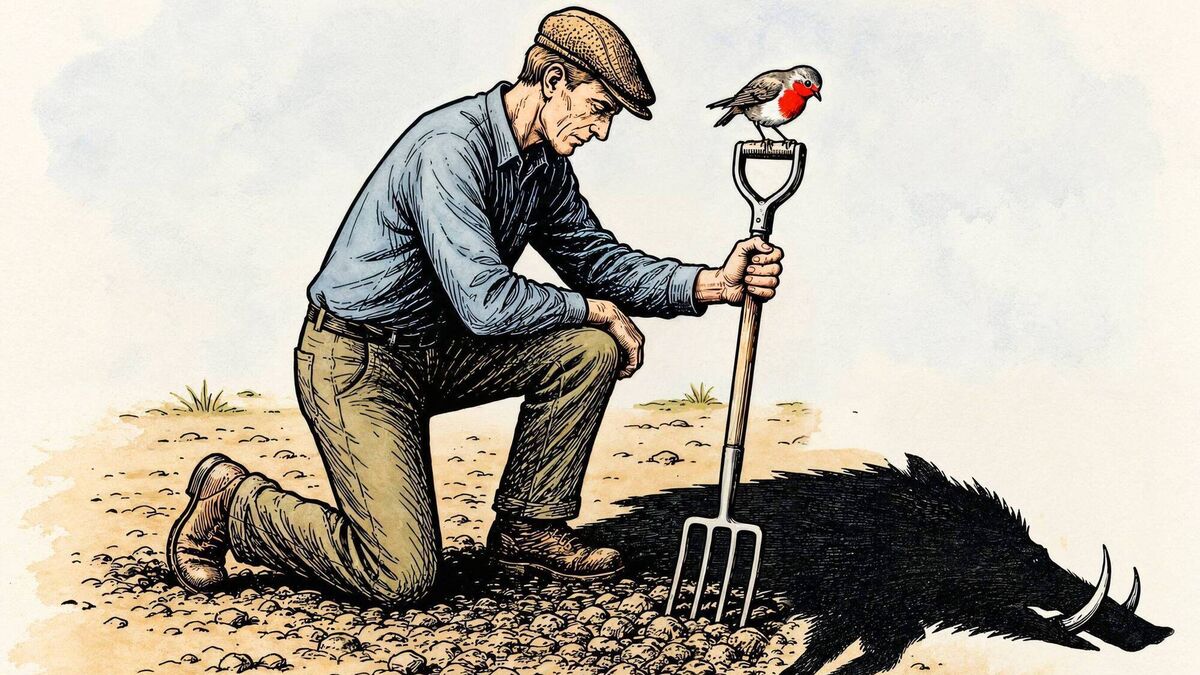
You put a fork in the ground and within about ninety seconds there's a robin sitting a yard away with the frank expectancy of a dog at a table. Illustration: Conor McGuire
I've written about the robin before, at Christmas, and I made a hames of it.
Not in the small ways, though there were those as well. Wrong in the way that counts. I had the bird down as a sort of mystic emissary, a scarlet ember of pagan vitality smouldering away in the winter murk, and I piled on the Druids and the Crown of Thorns and a fair quantity of purple about regenerative energies. Reading it back is a specific kind of cold. I wasn't writing about a bird at all. I was writing about myself in a good mood, in December, near a window.
So I went and read what the ornithologists have actually established, some of it going back the guts of ninety years, and the real bird turns out to be much poorer company and much better copy.
Start here. Pin a bundle of red feathers to a branch inside a robin's territory. Not a model bird. No head, no wings, no eyes, nothing that resembles a bird. Just a tuft of red on a twig.
The robin will attack it.
One David Lack worked this out in the late 1930s, ringing individual birds and watching them for four years, and it remains one of the more disquieting facts in our island's natural history. There is nothing there. The bird cannot tell. It sees red, at roughly the right height, in the wrong place, and something old and stupid comes down over its brain like a shutter.
That's the fellow on your Christmas card.
Lack finished the manuscript in 1942 and came out the following year, a period when the species was not the only one engaging in territorial disputes with little regard for the merits. He found that male robins fight. Not the puffed-up posturing of the nature documentary, though there's plenty of that too, but occasionally the real thing, and occasionally to the death. Two birds the weight of a pound coin, going at each other over a hedge and a patch of dug earth, until one of them stops.
There is exactly one red breast a cock robin will not attack, and it belongs to his mate. So the recognition is in there somewhere. It's just very narrow, and everything outside it is an enemy.
Then there's the arithmetic, which nobody puts on a card. A robin lives about thirteen months on average. More than seven in ten are dead before their first birthday. The robin on your fork handle last December is not the one you'll see this December. It's a different bird on the same few square yards, and the one you were fond of is dead in a ditch, quite possibly killed by a neighbour over the boundary.
None of which is why I want to write about it.
Here's what turned the bird over for me. Go looking for a robin in France or Poland, and you'll have some trouble, because over there they're skulkers. Furtive, hedge-bound, gone the moment you look at them. Small birds on the continent were trapped and eaten for centuries, and the ones that stayed shy are the ones that got to have children.
Ours land on the spade.
Every gardener in this country knows it. You put a fork in the ground and within about ninety seconds there's a robin sitting a yard away with the frank expectancy of a dog at a table. We take this personally. We think it likes us.
It doesn't. The best explanation anyone has is that robins evolved following pigs. Wild boar root through the woodland floor with their tusks and turn up worms and grubs, and a small bird that learns to work behind a boar eats very well for very little effort. Continental robins still do it. Ours can't, because there are no boars. In Ireland it seems we brought the pig here ourselves, some time after we arrived nine and a half thousand years ago, and then we hunted it out and felled the oakwoods it fed in, and it was gone perhaps five thousand years back.
So the robin looked around for the next large animal that disturbs soil.
That's you. Kneeling in the drill in a wet March with a fork, being assessed by a small bird as an adequate substitute for a pig that your ancestors ate. It has been waiting for the pig for five thousand years. It settled.
I find this improves the bird enormously.
And it gets better. The robin has a further trick that ought to be far more famous than the Crown of Thorns business. It can, in some sense, see magnetism. There's a molecule called cryptochrome in the photoreceptors of its eye, and when blue-green light strikes it, out come a pair of radicals whose behaviour is nudged by the Earth's magnetic field.
Wolfgang Wiltschko is an academic researcher from Goethe University Frankfurt. He showed decades ago that the compass sits in the eye and needs light to work. Nobody knows what the bird experiences. Best guess is a pattern laid over the ordinary visual world, brightening and dimming as it turns its head.
Hold the two facts together. Here is an animal running quantum mechanics in its eyeball to find north, and it cannot distinguish a rival from a bit of red fluff stuck on a branch. That's not a contradiction. That's just what evolution produces when you leave it alone for long enough, and there's more of us in it than we'd care to admit.
Which brings me back to my own bit of nonsense, because I was only doing what everybody has always done with this bird. The legend has the robin tearing at the thorns on Christ's head and taking the blood on its breast, which is a lovely story and explains nothing at all. Closer to home, the folklore didn't bother with lovely. In Ireland it was held that if you killed a robin you'd get a growth on your hand so large you couldn't work again. In parts of England the hand would shake forever, or come up in weals, or fall off.
Notice what that is, and it turns our cloying Christmas card depiction of the robin on its head. It’s not sentiment, not affection for a plucky little pal. A curse, aimed squarely at a man's ability to earn, calibrated for people who lived by their hands. We protected the robin by frightening ourselves. And in the same week of the year, on the twenty-sixth of December, people took the wren out of the hedge and killed it and tied it to a pole and paraded it around the village. Same size, same hedge, same season. One was sacred, and one was fair game, and the birds had no say in which.
The irrepressible robin tops the BirdWatch Ireland garden survey year in year out. It's our unacknowledged national bird by consensus rather than by any decree, which is very Irish, and it sells more cards and biscuit tins than any creature in the country. We've given it compassion, sacrifice, home, and the whole freight of Christmas.
It doesn't want any of that. It wants worms, and it wants the other robin dead, and it wants a pig.
Something to consider this winter, when the small red thing lands on the handle and cocks its head and looks at you with what appears to be recognition. It isn't. It's a calculation, and it's five thousand years old, and it has weighed you up and found you nearly as good as a pig.
Go on, you beast. Turn the soil.