Billy's book captures essence of rural Ireland
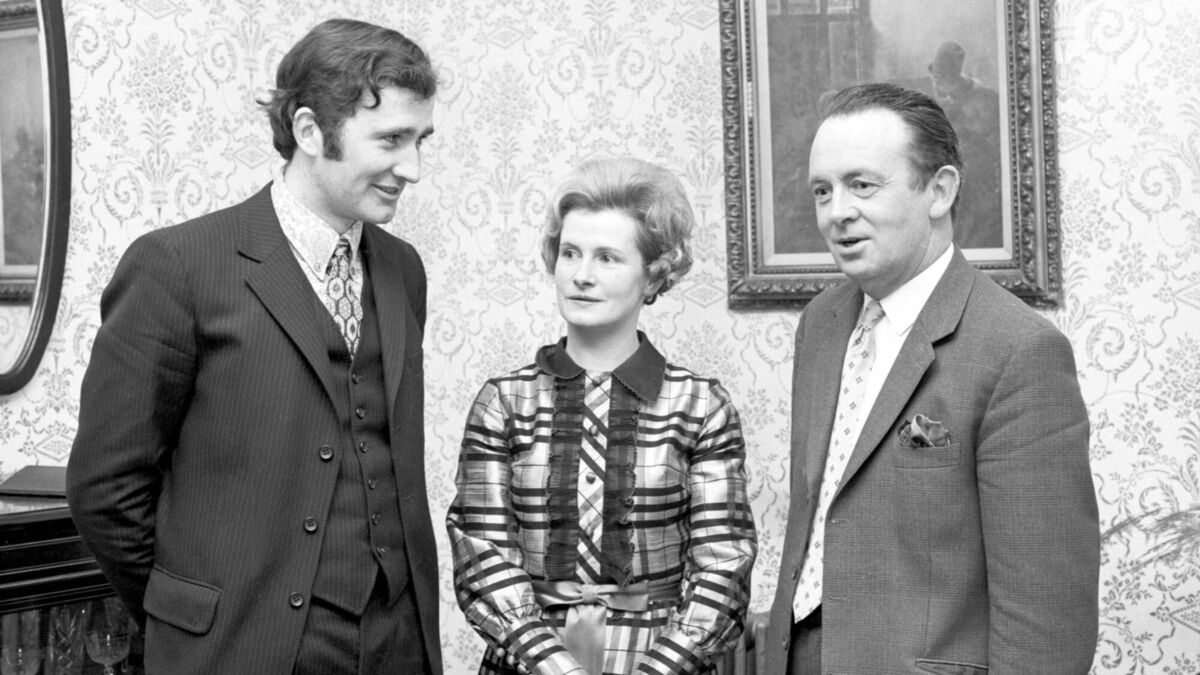
Pictured attending the Palmerstown Co-Op Society's fifth annual dinner in the Downhill Hotel, Ballina, in 1972 were, from left: Billy Heffron, Chairman, and Mr and Mrs L. Barrett, Castlebar. Picture: Western People Archives
Your humble scribe was among the multitudes that turned out for the launch of Billy Heffron’s book, , on August 21 in the Ox Suite of the Great National Hotel in Ballina. I arrived at the appointed time of 7pm as I was to perform the launch but was somewhat taken aback to see the place almost empty. You know how you are conditioned to think the worst. I feared that there would be a small crowd, but I was mistaken.
The Moygownagh people, it would seem to me, like to arrive fashionably late. So while the man of the moment was busy signing autographed copies of his book, the venue quickly filled up, such that there was standing room only when the launch got under way. Mary Sheehan (Heffron), looking fit and fine, much as I remembered her when last I saw her probably thirty years ago, was there to proffer a welcome.
There also was Annie May with her mayoral chain as the leading citizen and Cathaoirleach of the Ballina Municipal District. As usual, Annie May was resplendent (I can say things like that now without being accused of being sexist and, in any event, Annie May is not into that sort of nonsense) and we happily conversed about the past and the occasion.
Billy Heffron had been a member of Dev’s Party from his early years but underwent a cathartic moment in 2002 when he jumped ship and joined the Progressive Democrats. Not only did he join them but he ran for the party in that General Election. To say that his venture into elective politics was a bit of a disaster is an understatement. I’m not sure, but his 919 votes, may not have saved his deposit.
I was never a fan of the PDs myself. I thought Des O’Malley jumped on the coattails of his far more illustrious uncle Donagh who introduced secondary education for all in a sweeping move that caught many, if not all, of the government off guard. Des was always in Donogh’s shadow and, in any event, lacked the flamboyance of his uncle.
Annie May has a correct sense of duty and posed for photographs but, apart from Senator Mark Duffy, the local politicians were conspicuous by their absence. The Fianna Failures have elephantine memories. Senator Duffy has staying power and it looks likely that he will advance to the Dáil when the next election comes around. There, also, was Laura and Seán Lynch. Laura is responsible for the design and bringing the book to an elegant publication. Seán, who is a dab hand himself when it comes to book production, took a back seat on this occasion.
The Fear a Tí was that man of many parts Edwin McGreal, who was given credit by Billy Heffron for providing a bit of polish, where needed, to the text. Following the formal launch, Edwin interviewed Billy, prompting elucidation on some of the stories recorded in . Billy is an able story teller and is not averse to telling a story even when it rebounds to tarnish himself.
He told Edwin about his experience after the 2002 election count when he received a number of phone calls. On answering the call he was asked “is that 919?” Naturally, he said no and the caller put down the phone. Later there was another call and the same question “Is that 919?” Billy was perplexed but then it dawned on him that his callers were taking the mickey. The 919 was the number of votes he got in the election. What could he do but laugh.
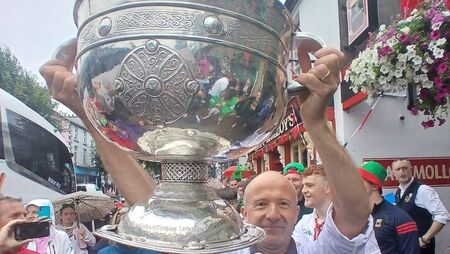
The scenes we witnessed in Croke Park a couple of weeks ago are, in essence, what is all about. It is about GAA; it is about family; it is about community; it is about parish; it is about farming; it is about agrarian struggle; it is about commitment; it is about development or lack thereof; it is about courage; it is about pain, it is about separation.
It is about government policy; it is about migration. It is about the flight from the land. It is about failure and about fighting back, it is about diaspora and, ultimately, it is about tenacity, about pride of place and overcoming adversity. It is local history. It is Mayo history. It is Irish history.
Billy Heffron has written a memoir that is simple, is easy to read and is intensely honest. He bares his soul in a way that few in post-Catholic Ireland could do. He confesses that he attends Mass, something that not too many nowadays can admit. He is committed to Mary Sheehan and gives her credit. When he sees something that needs doing, he goes and does it. He is critical of clergy when he feels he needs to be. He takes pride in his family. He calls out failed political parties.
He won’t win any Booker prize but he has written an account of a life in rural Ireland, in a forgotten corner of Mayo - forgotten, that is, by successive administrations. Billy has written an important book that goes beyond simply being a memoir. Without the Billy Heffrons of this world the scenes in the county following Mayo’s glorious victory in Croke Park could never have happened.
There would be no Andy Moran, no Kobe McDonald, no Ryan O’Donoghue, no Jack Coyne, no Rob Finnerty, no countless others. In the absence of the grit, determination and community spirit that was harnessed in Moygownagh by Billy Heffron, Tony Finnerty, Helen Finnerty, Seán Mitchell, Mary Sheehan and many others, including the school children shoehorned into stone picking on the Moygownagh pitch by Pat Dowling, there would be no Moygownagh GAA.
There would be no Pat Holmes, there would be no North Mayo junior title, there would be no Anthony Finnerty and no epic All-Ireland final in 1989. There may have been a final in ’89 but it seems Mayo always bring the epic dimension to games as we did very recently – during the James Horan era and now during the Andy Moran era. Far from being cursed, Mayo is blessed.
Billy Heffron never went to third level. That’s according to himself. But he had the GAA and Macra na Feirme and amateur drama. Those organisations, in a very enlightening and enduring way, are, for many, the University of Life.
Their influence on Billy Heffron, no more than his influence on them, were and are critical to personal education. They may not award degrees but they equip people for life. In , Billy Heffron acknowledges that he found his voice in Macra - a voice that he used to great effect. There would be some out there who would wish Billy Heffron had not been given such a strong and voluble voice.
He played significant roles (no pun) in amateur drama and in Macra na Feirme, rising to become national secretary of that organisation in 1989, and in North Connacht Farmers (NCF) during a period of turmoil within the co-operative movement. Both Macra and NCF opened up new horizons with opportunities to visit Europe and to learn from farming folk on the continent. One of the great innovations of that period was the launch of Connacht Gold. Billy Heffron was observant and, on a visit to the continent, saw that there were opportunities to develop when he returned home. He has quit farming and has settled for a role as owner of Heffron Business Services based in Ballina. He could probably retire comfortably but he keeps forging ahead.
“The more you read, the more things you will know. The more that you learn, the more places you will go.”