Local notes: Electrical connections delaying clinic completion
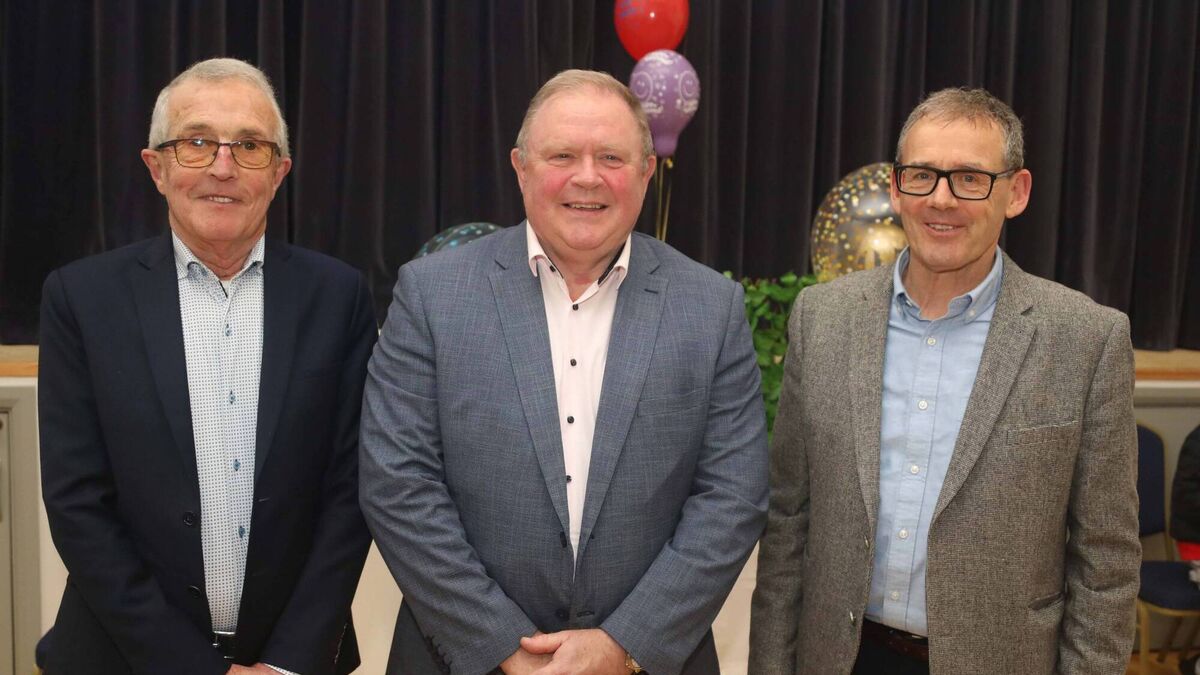
Past, outgoing and incoming principals of Scoil Iosa. from left: Jim Lundon (1975-2009), Kenneth Dennedy (2009-2025) and Kevin Henry, who will take up the role in January 2026.
Delays in the connection of the mains electricity supply is delaying the completion and opening of the primary care centre in Ballyhaunis, according to the Health Service Executive (HSE).
“Construction is ongoing and the developer has confirmed main building works will be completed by the end of 2025,” the HSE said in a statement to this column. “Handover to the HSE is likely to be delayed as the building is not connected to the mains electricity supply and the ESB is yet to confirm a date for the connection works.”
The statement added: “Testing and commissioning of the building mechanical and electrical systems cannot be completed without mains power. The HSE can commence fit out/equipping once the main building works are completed with orders to be placed late 2025 into early 2026. It is therefore expected there will be some overlap in the fit out and testing/commissioning with the aim to open the centre in the first quarter of 2026.”
Builders at the site recently told the that two months’ work remain on the project.
The annual general meeting of the Johnstown, Lavallyroe Group Water Scheme will take place on Tuesday, December 16 in Cloonfad Community Centre, starting at 9pm.
The scheme was recently connected to the Irish Water network but will remain in situ as an organisation, explained the secretary, Gerry Coffey. “All of the users of the scheme are now receiving water from Lough Mask which is as good or better than Ballygowan water,” he explained.
Much of the original pipework installed by the scheme remains intact and will be monitored by scheme officers, said Coffey.
"Adoption isn’t just for Christmas – it’s for life." That’s the mantra which the Ballyhaunis-based Mayo Society for the Prevention of Cruelty to Animals (SPCA) wants to promote this Christmas season.
"Adopting a pet is a lifelong commitment, not just a Christmas wish," says Marian Biesty, director of the shelter and recent recipient of a Mayo People of the Year award. “Christmas often sees a rise in impulsive pet adoptions, with well-meaning intentions. However, many pets are abandoned when the excitement fades. Animals need care and love every day of the year, not just during the holidays,” she said.
Marian said MSPCA every year sees puppies and kittens adopted as gifts, only to be surrendered when owners realise the responsibility they’ve taken on. “It’s heartbreaking when these animals – full of hope at first – are abandoned just weeks after Christmas," Marian explains. "We want people to understand that adoption is a year-round commitment."
Those wishing to adopt a pet or to support the shelter can contact Mayo SPCA at info@mayospca.ie or 087-4477113.
Retiring principal of Scoil Iosa Kenneth Dennedy told a gathering at the Community Hall on November 28 that he is leaving the school in good hands with the promotion of Kevin Henry to the principal’s role. A presentation to the principal by local parishioners followed a mass in St Patrick’s Church to mark the 50th anniversary of the establishment of Catholic boards of management in Irish schools.
Referencing the presence of his predecessor as principal Jim Lundon, he recalled the words of his good friend, deceased former Fianna Fail TD John Carty, 16 years ago when he took up the position: “You are starting the sprint but the marathon was run by Jim Lundon,” a reference to the school’s former principal who served several decades in the role.
Dennedy, who is planning to move to Abu Dhabi to work as an inspector of schools, was full of praise for local politicians who helped expedite various building projects at the school in recent years, including local councillor Alma Gallagher who, he said, had been very helpful “though we wouldn’t be on the same team politically.”
Local parish priest Stephen Farragher said Dennedy “leaves a legacy defined by kindness, leadership, and unwavering dedication to the children and families of Ballyhaunis.”
“From the moment he first stepped through the doors of Scoil Íosa, Kenneth brought with him a kindness that put children instantly at ease and an approachability that made every parent feel supported and heard.”
Fr Farragher explained that the establishment of boards of management in Irish Catholic primary schools in October 1975 “marked a shift in the management of our schools, moving from an exclusively clerical model to a more inclusive structure involving parents and teachers.”
“This development resulted from complex negotiations influenced by historical church-state relations, Vatican II’s emphasis on lay involvement, and changing societal expectations regarding educational authority and participation.”
Fr Farragher encouraged parents to participate in a survey being conducted by the Department of Education on the future patronage of primary schools. “Archbishop Francis wrote to parishes and asked that the letter be published in parish newsletters. He stressed that the Church has no desire to have a monopoly on primary education.
“It is important that those who wish for a change in patronage would have their voices heard. It is equally important that those who are already satisfied with the current patronage model and who wish for a Catholic Education for their children, including sacramental preparation within school, would have their voices heard also.”
The lack of new housing supply is pitting estate agents as well as buyers against each other, according to Ballyhaunis auctioneer and realtor Kevin Kirrane. “There is a big fight for what comes to the market. Generally, estate agents stuck to their own areas but due to the shortage of supply estate agents are looking for sales beyond their traditional areas.” House prices meanwhile are “sneaking away from us,” said Kirrane, pointing to a recent sale of a two bed home in Knock for €280,000: this modern, well-insulated property was offered for sale at €195,000.
Kirrane sees a continued shortage of properties for agents to sell as home building becomes the preserve of state agencies building social housing. Builders remain reluctant to build private housing schemes, he explained, due to worries about profitability. Kirrane who pointed to a 150-house scheme announced for Castlebar of which 50 houses are required to be sold as social housing. “The way the builder looks at it this could reduce the price of the remaining houses in the scheme.” Kirrane said he has a waiting list of 30 people seeking rental properties in Ballyhaunis.
There is however an exit of landlords due to new regulations coming into place in March that require landlords to grant a minimum six year rather than a four-year tenancy as is currently the case.
“From March 1 all new tenancies will become tenancies of minimum duration of a minimum six years. New regulations will also limit a landlord’s ability to sell a property: a landlord with more than four properties will only be able to evict a tenant if they fail to pay rent and won’t be able to evict in order to sell or move their family members into the property. Landlords with less than four properties will be able to sell during the six year period if they’re experiencing financial hardship but will be able to evict after the initial six-year tenancy if they wish to sell or renovate the property.”
The new rules are prompting some landlords to exit the market, said Kirrane. “The new regulations will tie people in. You have very little control of your own destiny.”
As the rental market tightens Kirrane meanwhile sees the Government encouraging the building of “loads of apartments in cities” like Galway and Dublin with no rent pressure zones applying to these buildings. “The government is incentivising developers to build apartments as a way to solve the housing shortage,” said Kirrane.
In smaller towns demand from local authorities for social housing will continue to drive redevelopment of commercial properties, Kirrane believes. He notes however that some developments are on hold over speculation that government grants of up to €140,000 will become available to promote the refurbishment of over-the-shop living spaces.
“Developers in some cases are adopting a wait and see approach until the situation becomes clearer.”
Estate agents face a lean 2026, predicts Kirrane who pointed to Claremorris as symptomatic of the situation: “there are 38 properties listed for Claremorris on Daft.ie but of these only ten are actual houses in the town – the rest are sites for sale or derelict properties in the wider Claremorris area.”
Demand remains strong for derelict rural properties, one of the few categories of property that continues to come to market, said Kirrane. “These homes are selling for €60,000 and are eligible for up to €70,000 grants as well as €30,000 from the SEAI for insulation.” Buyers, however, need to meet all the requirements and complete the works before claiming the funds back.
“Planning permission isn’t required for buildings built prior to 1963 as the system of planning wasn’t in place then.”