Mayo's trials through the Three Caminos
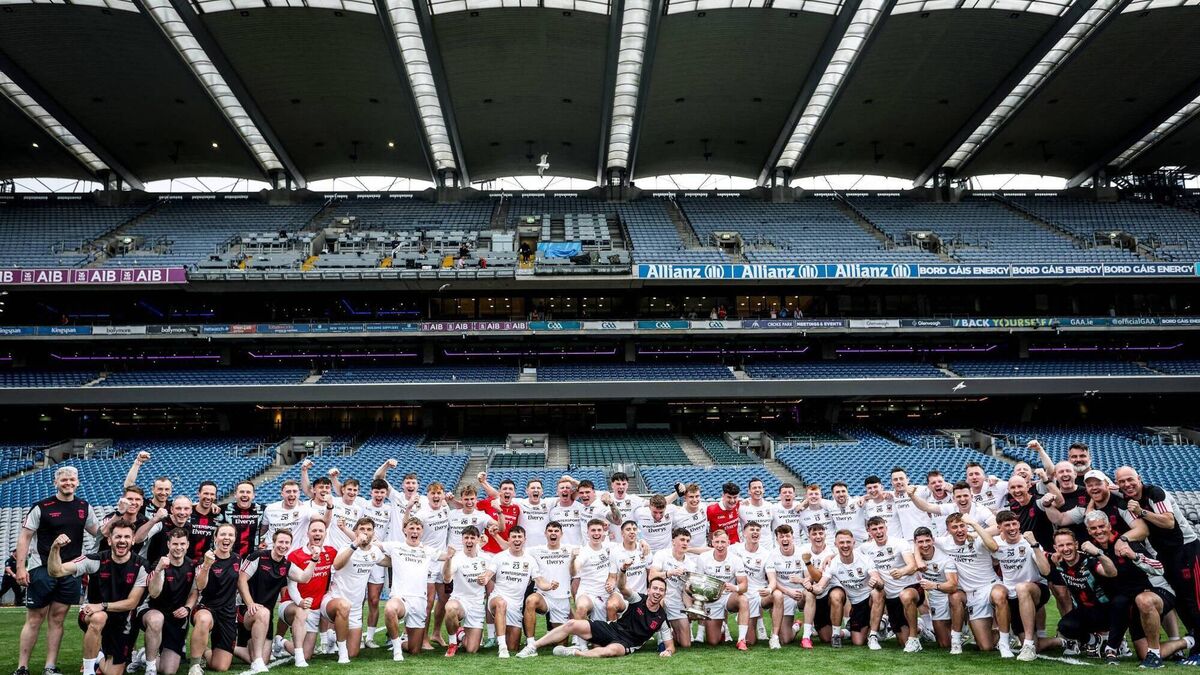
The Mayo staff and players celebrate with the Sam Maguire Cup after their victory over Kerry in the All-Ireland SFC. Picture: INPHO/Tom Maher
Three Camino’s. The first Camino spread over seventy-five years. The second Camino one hundred and fifteen kilometres and the third Camino, a joust with health. All three merging and meeting into a maelstrom of emotion in late July, early August 2026. I’ve just finished the Sarria to Santiago de Compestela where I got the chance to tie the three strands together. So let’s take a walk.
Starting with the Spanish Camino. Apparently there are over 200 Caminos leading to Santiago de Compestela but that’s been whittled down to about twelve official routes. The one I chose was the Sarria to Santiago route, 116 kilometres long spread over five days, averaging around 23km a day.
So how was it for me? Actually not a bother, even at 74. The heat didn’t really affect us as we started early and by the time the sun burned off the morning mist, we had around 10K in the bag and the back of it broken. I was comfortable all the way.
A friend asked me if I found it spiritual? Another asked did I find myself? Like the dog that chases the moving car, snapping at the tyres, and then when the car stops the dog merely wags its tail uncertain what the chase was all about, I find the quest to spirituality and finding oneself similar. I wasn’t trying to find myself nor be spiritual. I was seeing if I could walk of 116Ks over five days. I could. But I enjoyed the company. I also enjoyed my own company on the route as well. Most of the walk was ephemeral, thoughts fleeting in and out and not in the order you’d think.
I met strangers where I stopped for a coffee and cake. Lost in translation initially over who the table or seat initially belonged to, a smile and an apology along the lines of ‘I’m sorry I don’t speak your language, I’m Irish’ generally had a positive effect. One such encounter that began frostily with a guy around my own vintage caught fire when on me finding out that he was Italian I asked what team he followed. ‘Juventus’ he said. My inner nerd came to the front. ‘Do you remember Tancredi, Cuccureddu, Capello, Haller, Anastasi from the 1971 squad?” His eyes lit up. We parted with hugs, clenched hands and tears in eyes. Maybe I did find something after all.
The Camino has come between two massive events in my life. Mayo finally surfacing for air after 75 years of pain and my preparation for treatment for cancer. I didn’t dwell too much on either on the Camino to be honest. Mayo’s win has lifted that weight from my shoulders. Hopefully inside the next months the medical people will do what they must for my health. I never felt better, weight good, walking like a French Foreign Legion recruit. But looking under the bonnet before a car NCT examination, the lights that came on in the dashboard need checking. The Camino hopefully has planted that stoic that’s required to cross this bridge.
So to that long 75-year-old Mayo Camino. Mayo played their first All-Ireland final since 1951 on September 17, 1989. It had been 38 years since that famous ’51 victory. I happened to be 37 years old in 1989, born in August ’52, missing that ’51 victory by eleven months. That eleven months felt a chasm. The 37 years merely added to its breadth. Little was I to know that another 37 years would stretch ahead of me until July 2026 and Redemption Day. A grand total of 75 years, a veritable famine.
My daughter was born in February 1989. We have a family picture of her sitting on my shoulder the morning of September ’89 with a Mayo flag flying from our window. She was eight months old. She went on to be my companion over the various decades of these Mayo rosarys, Sorrowful and joyous eleven finals, two replays, before we finally hit pay dirt and gold and banished that pain. To land Sam it took fourteen attempts. Dog days and afternoons. Scorn and sneer at times. However, within that narrative was envy and wish it was us from other counties. We were always contenders, they would never be unless they were Kerry, Dublin, Tyrone, or occasionally Galway and Meath.
There was a recognition that apart from the lazy punditry of some notable shit stirrers, that there was a grittiness about Mayo and its people not what was portrayed on late September morning newspapers after All-Ireland final Sunday. We were more than that. We were survivors. The survivors of the county that suffered most during the Gorta Mòr famine, as deeply entrenched in our psyche as the lazy beds still viable on our hillsides. A catastrophe and calamity never dealt with by successive generations, merely unspoken as our county population fell by two thirds since 1850, never to recover. Yet we survived.
Many emigrated, many clung on, railway lines ripped up, bus routes cut back, shops, post offices, Garda stations, fishing industry curtailed and closed but Mayo people clung in and on. It still fights. No tea, coffee or a biscuit on the Westport to Dublin train today. As a child going to my uncles wedding in Dublin in 1960 we all sat in the dining carriage of that same Westport to Dublin train and ate a fully cooked Irish breakfast on the way. Watching Jack Coyne lift THAT CUP, it was despite the like of Michèal Martin and his coalitions support for the west, not because of them. Winning Sam wasn’t a football achievement. It was a statement of arrival, belatedly into the nations subconscious and then some.
So why did it take so long? Who knows. Apathy, arrogance, and ‘is cuma liom’ attitude, emigration, infrastructure, poor county boards, managers not at the required level, players not good enough? Let’s discount the last one. We have always had the players. Taking a straight line from the 1954 League winning team we had Dan O’Neill, Seamus O’Donnell, John Nallen, in the 1960s Joe Corcoran, Carey, Morley, Gibbons, Fitzgerald, Prendergast, massive U21 and Minor teams in the 1970s. We didn’t lack players. We lacked leadership.
Charting to JJ Costelloe many years ago, fine goalkeeper by the way, I got an insight into the psyche of the Mayo county player of that era. He opinionated that the then county player regarded their Connacht opponents as snuff, chaff, something to be blown away when crossed. Hinting at an inbuilt sense of superiority within the then Mayo psyche. True we had the players but not the steel perhaps would be my reading, the Roscommon 1977/80 team scorched us many times even though we had players their equals. We hadn’t their hunger, organisation or steel.
That great corner forward JJ Cribben, a career more or less curtailed by his joining the priesthood, Cribben by the way was the Darragh Beirne of his day, had this to say. “I never did the training in Mayo that I did when playing in St Jarlaths. When we left Jarlaths we were super fit.” Startling, shocking and true. We were Galway’s equals in many ways during the 1960s except when it mattered, final day, they had that Jarlaths tradition and that coaxed out by ‘Tull’ Dunne. Cribben gave us an insight, we had the players, not the application. It’s accepted that St Jarlath’s four greatest players ever were Mayo’s Peter Solon, John Morley, Padraig Brogan and Galway’s Sean Purcell. Only Purcell and Solon found that final holy grail.
That seventy-five year Camino forced us as a county to face long winters on occasion, hopeful springs and warm summers with chilly autumns and mainly barren final harvests. It’s the one thing all of those Garden of Gethsemane days did for us was reenforce our capacity for pain, acceptance, fortitude and believe it or not, never, ever saying die. We refused to die, sure we were buried multiple times, last rites read and holy water sprinkled but we never were lidded in that coffin many wanted us buried in. We refused to die. We believed. Though we were tested, often beyond pain and suffering. Long winters always ended in Mayo with the first day of spring. We would go again.
Amid the cheap shots and sneers of often lay recognition. Keith Duggan and his House of Pain stood four square behind us over the years. The Saw Doctors were our musical tracks. Dessie O’Halloran, ironically like the Saws, a Galway man, kept Moonlight In Mayo alive. Darragh Ò Sé, six times an All-Ireland winner himself, had this to say in the Irish Times regarding Dublin at their peak in 2017. Ó Sé noted: “That’s what top level of inter-county football is all about. You made a balls of last year? Fine. Go and fix it. What’s the alternative? Shrugging your shoulders and telling yourself that the Dubs are superhuman and can’t be touched? No way. You’re good enough, go show it. Mayo don’t buy into all this carry-on of the Dubs being some type of alien force that can’t be got at’. Thanks Darragh.
We never went away. The pain and trauma of thirteen finals past were wiped, erased, and positioned properly this July. That was always the way. That was always writ. Around 2021 when the Irish soccer public were getting tired of Stephen Kenny’s international management and his uttering to the press, a journalist wrote: “You wonder what the people of Mayo GAA think. Every day they roll that stone up the hill, while simultaneously having their liver pecked out by birds, and being forced to watch as their son’s wax wings melt and plummets thousands of feet to crash into the ocean. And the next day they do it all over again, because that understand that football is all about suffering.”
That’s us. We understand what suffering is all about. And when that klaxon, that foghorn of final hope sounded on that Sunday, July 26, 2026, that pain dissolved onto what it should be. Hope, pride and arrival.
The Camino by its nature is a walk. Rarely smooth, seldom straight, strewn with stones and thorns, bright and dog days equally mixed. But to get to the end of it, you gotta start somewhere. Some Camino’s take seventy-five years, some 116 kilometres and some a doctors skill. All must be endured. Stick your schists out and be proud to be from Mayo.