Turf cutters deserve better than directives
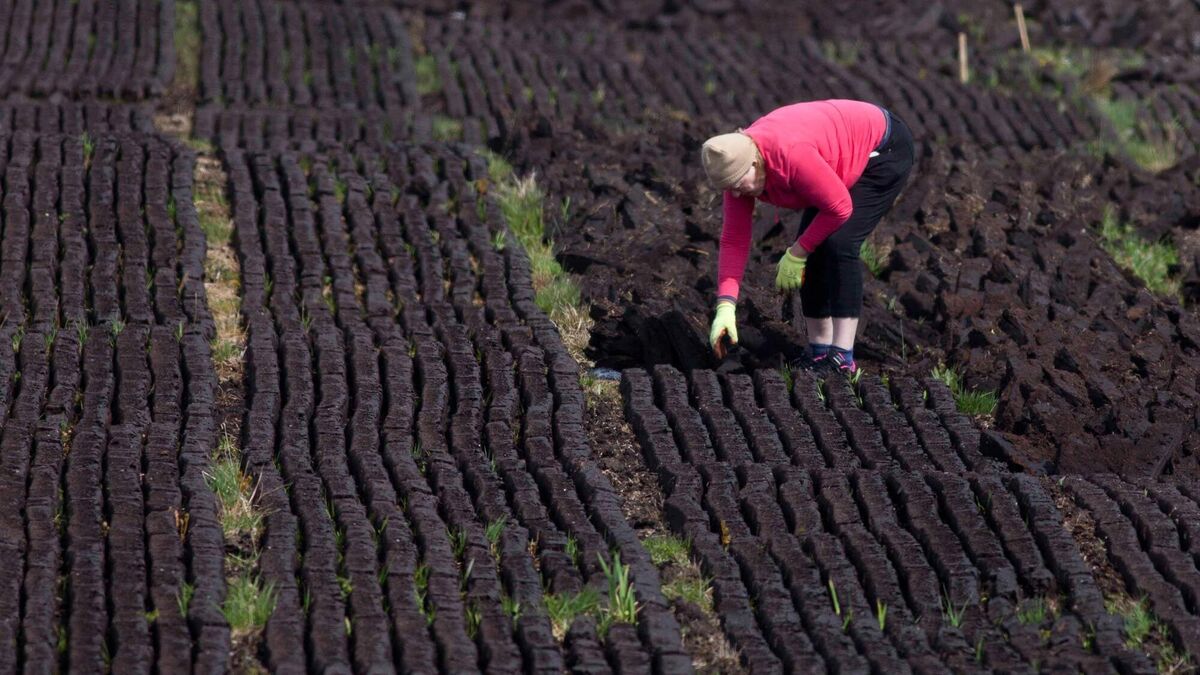
A man harvesting turf on his own bog must follow the same rules as companies with expensive machinery that are stripping bogland for profit. Picture: Eamonn Farrell/RollingNews.ie
We own a small patch of bog. It’s there on the land deed, matter-of-fact as a boundary wall - a stretch of cutaway outside Castlebar that came with the land, the way a bad roof or a draughty outhouse might. Except it isn’t a liability. It’s an inheritance. And someone, somewhere in the layered sediment of EU directives, Irish statutory instruments and National Parks and Wildlife Service designations, has made it almost impossible to know whether we're legally permitted to use it.
Almost. That word is doing a lot of work out here.
Because here’s the thing they don’t tell you - and by “they” I mean anyone from a government minister to the local county council to the well-meaning person in the anorak from Birdwatch Ireland. There is, technically, no single national ban on a private individual cutting turf in Ireland. It depends. It always depends. It depends on where your bog is, whether it sits within a Special Area of Conservation or a Natural Heritage Area, whether you hold valid turbary rights, whether the cutting requires an Appropriate Assessment, a Ministerial consent, a planning application, or simply a phone call to the National Parks and Wildlife Service (NWPS) that nobody ever told you to make. It is a bureaucratic ecosystem of almost baroque complexity - and it has been visited upon people whose relationship with paperwork traditionally begins and ends with the cattle passbook.
The right of turbary, for the record, still exists in Irish law. The 2022 Solid Fuels Regulations - the ones that arrived in October of that year, like a letter no one wanted - actually defines it explicitly: the right to dig, cut, take away, prepare and store turf from bogland for use as fuel. So the right lives. It breathes. It now has so many conditions attached that exercising it requires the kind of legal due diligence normally associated with a commercial property transaction. You may cut for domestic use - provided the land isn’t designated, isn’t protected, isn’t subject to a Ministerial direction, isn’t within or adjacent to a Natura 2000 site, and isn’t covered by the EU Habitats Directive as implemented through Irish law. Which, given that Ireland nominated 53 raised bog Special Areas of Conservation between 1997 and 2002 and designated 75 Natural Heritage Areas in 2004, is a fairly significant set of provisos if you happen to live in Mayo and can see a bog from your kitchen window.
Which many of our country dwellers can.
My late father-in-law Paddy Philbin cut turf before I was born. Not as a hobby, not as some performative act of rural nostalgia - the way a Dublin food writer might spend a weekend in Westmeath learning to make brown bread - but because this is how the house got warm. The process is unhurried and entirely specific. He marked his section, cut with the sleán, and left the wet sods in long dark rows to catch whatever pale sun Mayo could manage. Then he came back to foot them - stacking them upright in small pyramids, three or four sods leaning together for the wind to move through. Patient, conditional, seasonal. A conversation with the weather rather than a battle with it. Later in summer, when they had dried enough, he drew them home and stacked them in the shed, and there’s a satisfaction to that stack - the same satisfaction, I imagine, a medieval stonemason felt looking at a completed arch. Order imposed on raw material. Winter was anticipated and defeated.
You can’t enter that on a grant application form. There isn’t a box for it.
Here’s what the committee rooms don’t know and probably couldn’t be told. The bog is not empty land. It never was. It is a repository that has been swallowing time itself for millennia — preserving bodies, medieval artefacts, even whole ancient forests, locked beneath layers of peat. In 2003, turf workers cutting commercially in County Offaly pulled a man out of the ground who had been there since somewhere between 362 and 175BC. Old Croghan Man, as he became known, was so perfectly preserved that his discovery triggered a police murder investigation before anyone thought to call an archaeologist. His fingernails were manicured. He wore a leather armband and a bronze amulet. Two thousand years in the peat and he emerged looking like someone who’d partied too hard and met an untimely end. The bog had held him, cold and patient, in a kind of dark suspension.
The bog does that. It keeps things. We Irish have always understood bogs as liminal spaces - the membrane between the living world and whatever waited beyond it. Which makes a certain sense, standing on one on a grey Mayo morning, the ground giving slightly underfoot, the horizon dissolving into low cloud. You’re not entirely sure, at moments like that, which side of the membrane you’re on.
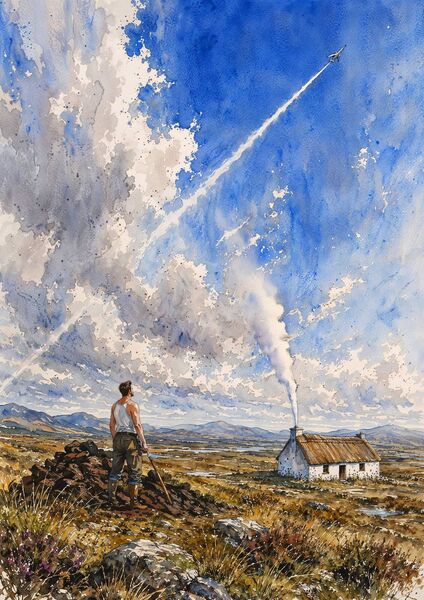
The poet Seamus Heaney knew this better than anyone. His grandfather cut more turf in a day than any other man on Toner’s bog, and Heaney made that the opening image of his entire life’s work - the turf spade as template for the poet’s pen, both instruments of the same downward digging. The bog, for Heaney, wasn’t romantic. It was caloric. It was the difference between January being survivable and January being a genuine threat. That knowledge is still embedded in the people who still cut. My father-in-law didn’t romanticise it. He did it because it’s what you do, the way his father did, the way his father’s father did. The turf cutter, the person placing sods on the bank, the person loading the trailer - always a communal act, a family act, each person playing their role in a ritual considerably older than the state now tangled in the question of its legality.
And the state is very much tangled. In March 2024, the European Commission referred Ireland to the Court of Justice of the EU for failing to properly protect its raised and blanket bog sites from - among other things - turf cutting. The Commission’s position is that Ireland hasn’t put in place an effective protection regime, that bogs continue to be degraded, and that the Habitats Directive is not being properly implemented. So in the same legal moment, a Mayo farmer can be told his traditional cutting may require Ministerial consent and face potential prosecution, while Ireland itself stands in the dock in Luxembourg for not having stopped him firmly enough.
None of this, incidentally, is aimed at stopping the people actually doing serious damage. Bord na Móna - the semi-state behemoth that spent decades mechanically stripping the Midland bogs on an industrial scale - quietly wound down its harvesting operations in 2021, with its last briquette factory closing in 2024 and its workforce reassigned to bog rehabilitation. Grand. Except that in June 2025, the Environmental Protection Agency published a report identifying 38 sites across seven counties where large scale commercial peat extraction is ongoing, entirely without authorisation, feeding an export trade of 300,000 tonnes annually, worth almost €40 million.
Illegal operators with expensive machinery, complex drainage systems and, in some cases, large warehouses are stripping protected bogland for profit while enforcement agencies pursue them slowly through the District and High Courts. Meanwhile, a man with a sleán and a turbary right outside Castlebar is required to cross-reference the NPWS designated sites map before cutting what his grandfather cut without a second thought. The law, in its magnificent impartiality, bears down on both equally. Harder, if anything, on the man with the sleán - because he has a fixed address.
No sane person is arguing that we burn the planet for the sake of sentiment. The carbon sequestration argument for intact bog is real - a properly managed, rewetted raised bog locks away more carbon than any domestic fire releases, and that matters. But that argument was never made to the turf cutters. There was no conversation, no negotiation, no attempt to bring the people of Connacht along as participants in a shared environmental project. There was a directive. Then there was a compensation scheme nobody told you about until the deadline had passed. Then there was a referral to the Court of Justice of the European Union.
On a recent unseasonably cold May evening, I sat by the fire and watched the turf burn - that particular dense, ancient glow that has no equivalent in a gas flame or a heat-pump radiator. The smell of it is irreplaceable: peaty, dark, primordial, like the earth quietly digesting its own long history. Outside, the wind arrived off the Atlantic with the kind of purposeful intent that reminds you the West of Ireland is not a lifestyle choice but a geographical condition. The land deed is somewhere in a folder in a spare room. On it, the bog - ours, by law, in the land registry, in the logic of inheritance - sits waiting for us to check it against the NPWS designated sites map before we do anything as outrageously ancestral as cutting it.
It was, for all that, a very fine fire.