Mayo ministers facing profound EU challenges
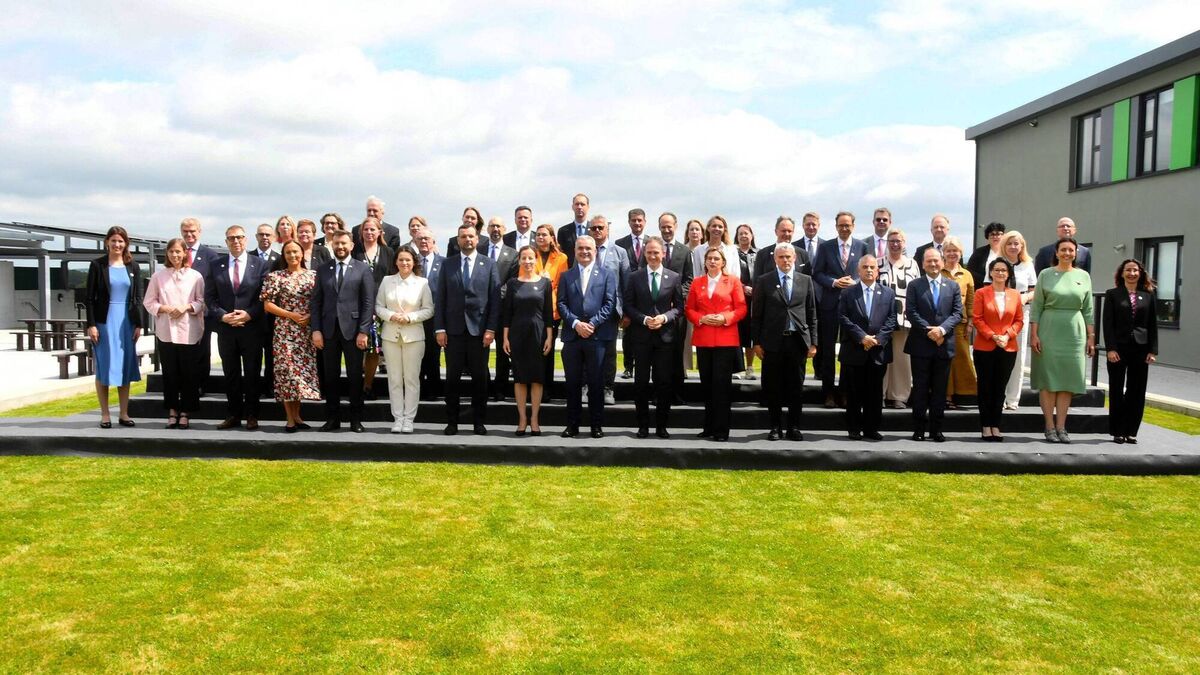
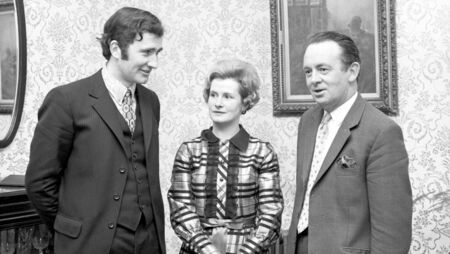
Delegates at the meeting of social protection ministers from across the European Union at St Mary's Secondary School in Ballina earlier this month. Picture: John O'Grady
Mayo’s two ministers will confront some the most profound challenges facing the European Union (EU) in the coming months of the Irish presidency.
Minister for Social Protection Dara Calleary and Minister of State with responsibility for employment Alan Dillon recently invited European colleagues to Ballina for an informal meeting of the group of ministers from across the EU that works on social affairs and employment at a time when the industries which sustain EU jobs and wealth face existential threats from Chinese manufacturing and American big tech.
A good number of EU states sent officials or their Dublin-based diplomats in place of a minister. Perhaps they were too busy or perhaps their absence hinted at the distance between some of the viewpoints on how to approach the existential problems that face the EU in matters of employment and social welfare.
A series of anodyne briefings from the two Irish ministers in Ballina merely highlighted the divisions among EU members on how to deal with the onset of artificial intelligence and competition from China [and the US], all of which are putting in danger EU jobs and the European social model about which the bloc has been rightly proud.
Speaking at the end of the Ballina meeting, Minister Calleary said: "Our shared values are the foundation upon which our Union is built. They guide our collective efforts to strengthen our citizens’ quality of life and standard of living, to promote social inclusion and equal rights, and to increase competitiveness and fair growth.”
It’s not quite obvious to what extent there are shared values among EU leaders and political groupings when it comes to employment and social affairs.
It was odd to hear a Fine Gael minister, Alan Dillon, speak of collective action on employment and social issues given the centre-right European People’s Party (EPP), the home of Fine Gael in Europe, traditionally does not want to cede social and labour issues to Brussels, preferring to keep those competencies in national capitals. To the EPP’s right in the EU Parliament, the Patriots for Europe and Europe of Sovereign Nations are even less keen for more directives from Brussels on jobs and welfare.
Ireland over the years has been keenest of all to keep competencies like tax and employment law in member states to allow Dublin cater to multinational corporations coming to invest here. Economic expediency rather than sharing of values defined Ireland’s economic success as an EU member.
The more federalist minded European left has decried what it terms regressive pension reforms in France and the increase in working hours in Greece as well as changes in Belgium that reduced unemployment benefits and, in the eyes of the left, reinforced the precariousness of work.
The European right-leaning parties who now control the EU Parliament have prioritised spending on EU competitiveness and defense over social spending and agriculture. That means less, not more, EU regulations on employment.
Right across Europe centre left-wing parties who in past decades drove much of the collective EU action on social and labour reform have lost their shape and lost power as the continent shifts rightwards in voting preferences. Today Spain is the only major country where a left-wing party holds power while the right is less concerned with the EU’s social model than it is with increasing the bloc’s competitiveness, in part by making it easier to hire and fire workers.
That EU social model prized protections for workers and quality employment as well as quality of life. But the arrival of cheap, high quality Chinese competition in key industries like automotives, chemicals and machinery has terrified Germany, the traditional paymaster of the EU.
Berlin fears losing swathes of its manufacturing industries and its highly specialised engineering companies whose quality products are now being made by Chinese workers paid a fraction of their employees’ wages and with few of the social safety nets afforded European workers.
America’s technology sector has left EU counterparts in the dust and some within the EU believe to compete Europe has to lower wages and social protections - and laxer employment regulations – to compete. Employment regulations and social protections, the argument goes, put EU companies at a disadvantage in the international marketplace.
There are also diverging values among EU politicians on the issues of demography and pensions. While social welfare rates are a national prerogative, the EU institutions have struggled to come up with a single voice on how to deal with the fact that two million workers will retire every year between now and 2040. Replacing them is difficult as working age native populations continue to shrink in all European countries.
Raising retirement ages, cutting pensions and increasing immigration are all offered as solutions but politicians oppose them on electoral grounds. The likely future president of France, Marine Le Pen, vows to undo even the modest reforms of current president Emmanuel Macron who ran into a brick wall in his efforts to restructure the perilous finances of Europe’s second largest economy.
Into this morass wade Messrs Calleary and Dillon. But as already stated most of these issues are not going to be decided at the EU level, so informal conversations will remain just that.
Fortunately, in part due to the aforementioned demographics, unemployment is at a historic low across most of the EU. The urgency of creating jobs has been replaced by the need to reduce the precariousness of much of today’s work.
The shrinking left-wing block in the EU Parliament has fought hardest for protections for gig workers and the use of bogus self-employment contracts by companies to dodge tax and labour laws. Again, there’s not much the EU can do given the prevailing preference for labour to be the prerogative of national capitals.
The left-wing block wants the EU to do something collectively about social dumping – the hiring of staff in an EU country different to that in which they are working to avoid more trying regulations and higher pay.
Irish airline Ryanair has been fined for social dumping – specifically, for hiring French staff on contracts written and signed in Dublin to avoid far more stringent French social requirements.
Yet the issue has merited little mention in Irish legislative circles, dominated by the centre right Fine Gael-Fianna Fáil government.
Ireland has long been admired by new and aspirant members of the EU as a model of what is achievable by a small member state. But the Irish miracle is also a source of enmity as southern and eastern member states see their workers and their tax euros leave for Ireland.
Consider that Ireland’s tax revenues rose from €17.8 billion in 1985 to €107.4 billion in 2025, of which a third comes in corporation taxes paid largely by multinationals for whom Dublin is a convenient place from which to pay an artificially low tax on activities in other EU member states.
By contrast, Lithuania’s total tax take in 2025 was €17.9 billion, of which corporation tax provided €1.8 billion. Many Lithuanians living in Ireland staff jobs in firms which would not be viable without a steady supply of minimum wage migrant labour.
The perennial question of whether more or less social welfare and whether less or more employment regulation is better take on a particular urgency during Ireland’s EU presidency.
If the traditional powers like Germany have their way we may see a cutting back on some of the social protections in the name of increasing the competitiveness of European industries.
Of course, reform happens very slowly in the EU institutions. Modelling employment and social laws on the American system is hardly a panacea either - not given the income inequality that characterises American society. And trying to compete with China on wages is a non-starter.
One particularly thorny part of the brief is the shift in the EU’s spending priorities recommended by the EU Commission and to be haggled on during the Irish presidency.
Cutting back on subsidies paid to agriculture in favour of more money for industrial competitiveness and defence is a given as Germany supports this, but French politicians - again for electoral reasons - won’t support cutbacks to the Common Agricultural Policy. Mayo politicians will hardly want to be seen backing any cut to agriculture subsidies to support European competitiveness.
Difficult compromises will have to be found on Ireland’s watch to save or scrap the EU social model.
Alan Dillon and Dara Calleary adopted Brussels vocabularies and inoffensiveness for their briefings at the Ballina meeting. Eurospeak is so bland because so much of what the EU does is about inelegant compromises, fudges.
But there are plenty of sharp words in meeting rooms where social affairs are discussed, because there is much the EU members can’t agree on, and yet so much at stake.