The ancient tradition of Pattern Sunday
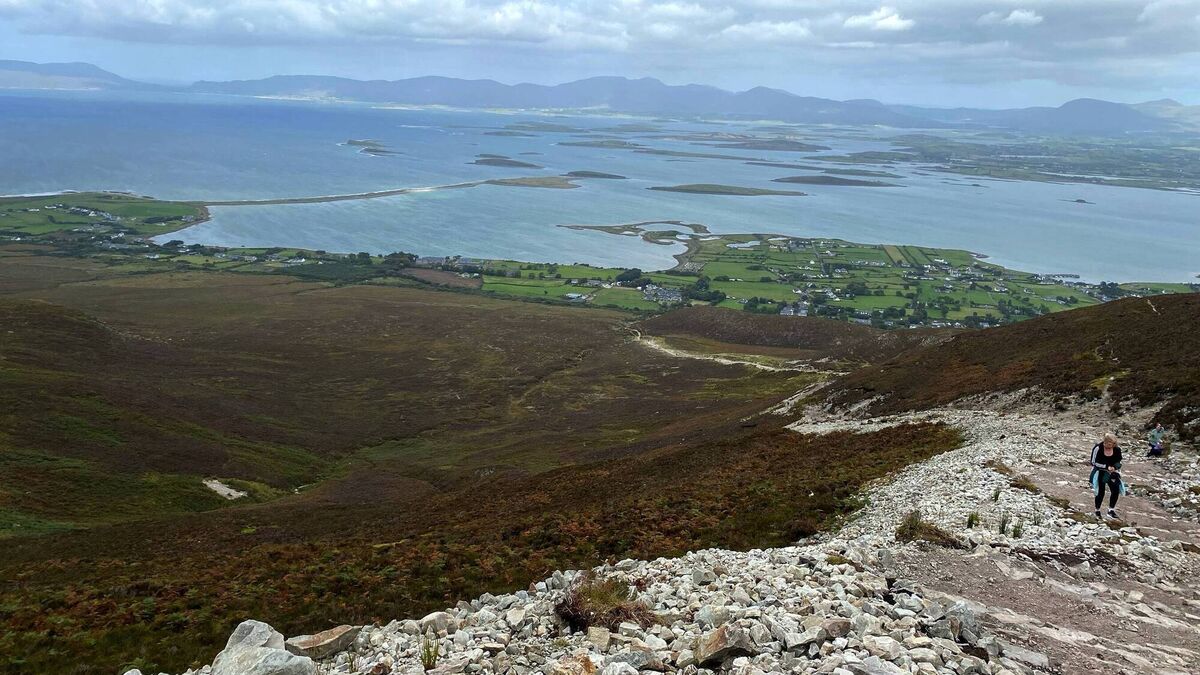
A lone pilgrim sets off to climb Croagh Patrick against the backdrop of the magnificent Clew Bay. Picture: David Farrell Photograpy
The last Sunday in July will see thousands of people make the annual pilgrimage to climb Croagh Patrick. It is a beautiful and worthwhile experience that attracts pilgrims from all over Ireland and now that the route to the summit is paved, allowing the mountain to heal, long may the tradition continue.
It is little wonder that this particular mountain is the subject of such dedication; its spectacular shape and its sea-to-summit aspect making it an inspirational experience for those seeking a stairway to heaven or just a spectacular view over Clew Bay.
Lúghnasa, meaning the ‘Assembly of Lugh’, signifies the beginning of the harvest season, and gives its name to Lúnasa, the Irish word for August. Lúghnasa is traditionally observed on August 1st, or if you want to celebrate as the ancient Celts did, on the day of the full moon next to this date.
The ancient festival is named after Lugh, a god in Irish mythology and one of the chief gods of the Tuatha Dé Danann. Lugh is associated with light, skills, craftsmanship and the arts. According to mythology, Lugh established the festival to honour his foster mother, Tailtiu, who died of exhaustion after clearing the plains of Ireland for agriculture. Thus, the first games were held where Tailtiu was buried on the banks of the River Blackwater before it joins the River Boyne. The is the same Tailtiu who gave her name to the former Tailteann Games and the current Tailteann Cup.
The original festival, known as the Aonach Tailteann, involved games, music, trading and matchmaking. In pre-Christian times, the festival was celebrated with gatherings at significant places like hilltops and sacred sites. While one of the most notable sites for such gatherings was the Hill of Tara, it is without doubt that Croagh Patrick, resulting in what we know today as Reek Sunday, was of similar importance.
In relation to Pattern Sunday, 'pattern' is a traditional Irish term that is simply a local corruption of the word 'patron'. It refers to the annual religious devotions and communal celebrations held to honour a local parish's patron saint.
The origins and traditions of Pattern Sunday, or Garland Sunday, vary depending on the specific parish or region. Festivities usually kick off with a Mass in the local church or an open-air Mass in a parish graveyard. Pilgrims may also visit a local holy well, a practice that includes walking around the site while reciting prayers, and sometimes drinking the water.
In recent times, Pattern Sunday has morphed into Cemetery Sunday but in the past, the religious ceremonies were typically followed by secular festivities. Historically, these included trading, music, dancing, and sports, bringing an entire parish together for a massive social gathering.
Faction fighting was a common occurrence on such occasions, especially in contested areas, such as parish boundaries. Other evidence points to the fact that many of the fights were related to land disputes and the origin of such fights may reside in the agricultural based secret societies such as the “white boys”. These events, and all they contained, did not escape the notice of outside observers.
It was noted that “bloody knees from devotion and bloody heads from fighting” were not uncommon (Croker, in Hall & Hall, 1841:284). Hardy tells us how “parties come to fight and quarrel” at Croagh Patrick (Hardy, 1840:57). These brawls could be incredibly bloody; the infamous 1834 confrontation at Ballyeigh Strand in County Kerry resulted in massive casualties. The last officially recorded faction fight took place in Cappawhite, County Tipperary, in 1887.
By the mid-19th century, the British authorities were happy enough to let the Irish peasantry beat the living daylights out of each other on such days, only intervening in such shenanigans to make sure the aristocracy or the judiciary were not discommoded while going for their Sunday jaunts. It was in fact, the Irish themselves who tidied up these outbreaks of unbridled violence in an effort to better direct the peasantry’s enthusiasm for victory.
When founded in 1884, the GAA formalised older, often more dangerous community games, such as primitive forms of hurling and Gaelic football. Such ‘games’ were given rules and such parochial factions were formed into teams; the whole process being capped with strict rules of engagement. By forcing men from historically hostile parishes and rival factions onto the same sporting pitch under agreed-upon regulations, the GAA helped eradicate the practice and foster community cohesion. Mind you, a visit to a junior C football or hurling match anywhere in Ireland might cause the casual observer to question how far we have come.
At this same same time, the Catholic Church introduced certain codes of practice around the rituals associated with holy wells, holy mountains and other places of pilgrimage - many extending back to pre-Christian times - in an effort to get their flock to conform.
Local clergy were strongly opposed the violence frequently witnessed on pattern days - such fights sometimes even broke out in graveyards. To stop the brawls, priests often rode directly into the fray using horse whips to separate the fighters. Folklore records a famous event where a local bishop made rival faction leaders march, side by side, down the church aisle to hand over their sticks and take a vow of peace. In addition to these efforts, the temperance movement led by Father Theobald Mathew further helped to curb the violence.
One of the main focal points of Pattern Sunday is the local holy well - traditionally visited on the last Sunday in July. There are countless holy wells dotted throughout Ireland, with quite a number along the foothills of the Ox Mountains. These wells are holy because people of faith frequent them. They have remained popular since pre-Christian times and continue to hold a special place in the hearts and minds of many people. Elizabeth Healy has travelled the length and breadth of Ireland, seeking out some of the more interesting wells, discovering their origins and learning the customs that associated with them. Healy, in her book, , explains what makes a holy well holy.
Not everyone will be able to climb Croagh Patrick next Sunday - many with be on a similar pilgrimage to the other 'C' - but it may be within the compass of others to visit a holy well. A short car journey will get people to a local well and you will be spiritually rewarded for your efforts. You will be upholding an ancient tradition, you will spend time in a sacred place and you can dedicate your visit to a special intention – Mayo for Sam, for example. While there, your safety should be assured - you are unlikely to encounter a face-fracturing faction fight, but then again… this could be the year – for Sam, that is.