Today's church was unimaginable 60 years ago
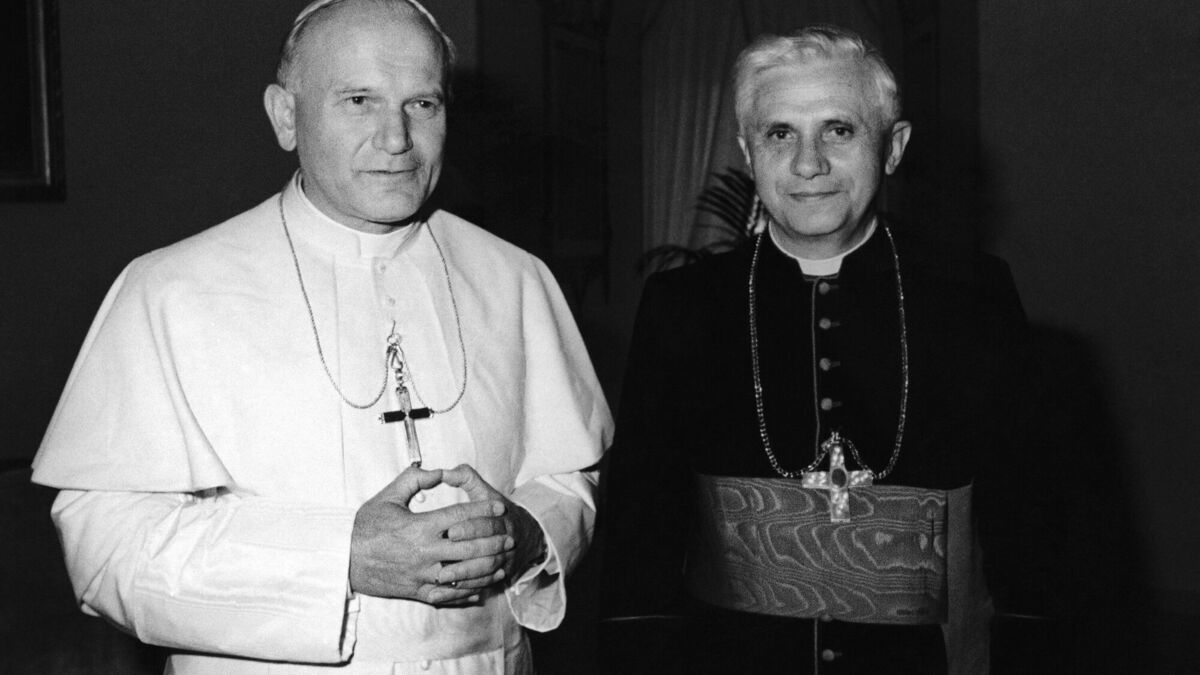
Pope John Paul II, left, stands next to German Cardinal Joseph Ratzinger at the Vatican in 1979. Ratzinger went on to become Pope Benedict XVI. Picture: AP Photo
This September 60 years ago, I was on my way to Maynooth to begin studying for the priesthood. In the Maynooth class of 1966, in a total cohort of 84 students, five were from Killala diocese and ten from Tuam. In 1973, seven years later, 52 were ordained; and 32 had decided - over the seven years - to return to the lay life. At the time, the breakdown of 84 into 52 and 32 was an unsurprising result.
In reflective mood this week, I look back over the years. In 1973, when I was ordained, the Catholic Church in Ireland was sailing full steam ahead: full churches; full seminaries – over 400 students in Maynooth; plenty of energy; oodles of talent; brimful of confidence. There were occasional blips when some of the crew were washed overboard but generally the vessel moved purposely through uncharted waters, confident in the new rules of navigation that a great Council of the Church – Vatican Two (1962-65) – had delivered.
After 1916 and its fall-out, the Catholic Church, found itself in effective charge and set about creating a State in its own image. In the words of James Joyce: ‘Christ and Caesar were hand in glove’.
Catholic bishops became a kind of autocracy and aristocracy; they inhaled at leisure the clear air of unquestioned obedience; they lived in ‘palaces’ and could do no wrong; and, even if they did, no one could mention it, least of all hold them to account for it.
So, in 1936, the paid a typically fulsome tribute to the then Bishop of Killala: ‘Most Rev. Dr Naughton is the most beloved of bishops who has ever had charge of this ancient diocese. Still full of vigour, mentally and physically, his flock pray that he will long be spared to carry on with dignity and success the duties of his high office.’
The exaggerated (and misleading) praise for Naughton was a response to his decision to put on an extra Mass in Ballina Cathedral!
However, in the unchanging world we lived in, change was coming: bishops and priests were reviled; vocations were in decline; churches were emptying; and the decline, at first gradual then drastic, has now reached once unimaginable levels.
Attitudes were changing too. Newspapers gradually withdrew their coverage of bishops’ pastoral letters, even of once important religious events. Media, once at the beck and call of the diocesan office, gradually backed away from the almost voluntary roles that Catholic journalists were expected to play. A tide was turning and the clerical abuse scandals and what they surfaced whipped into a hurricane that swept aside previous allegiances.
In 1996, the editor of the newspaper, who had tried to free that publication from what Fr Kevin Hegarty memorably described as ‘the stodgy grip of pious devotionalism and defensive conformity’, felt compelled to resign. Hegarty himself was removed from the editorial chair of , a publication of the Catholic Communications Institute, by the Irish bishops – which in time confirmed his uneasy feeling when he took on the role three years earlier that it would be like editing the in de Valera’s heyday.
Hegarty's intention had been, he later wrote, ‘to turn into a popular journal where different views are argued forcefully but courteously, where those alienated from church structures are given a voice, where there is respect for dissent and where no one is excluded because of a perceived orthodoxy’. However, he soon concluded that what he thought of as a space for openness and diversity was described by one bishop ‘as a safe haven for dissidents and cynics’. He would later compare editing under the watch of the Irish bishops as akin to ‘plotting a safe course though a minefield’.
What Hegarty and many others came to realise was that the huge promise that Vatican Two represented would not survive unscathed through the compromises inflicted on it by those who knew better. Some like Popes John Paul II and Benedict XVI recognised that much had changed and more would change if they didn’t take measures to subvert it! Others, like many of the bishops they appointed, would devise ways to resist structural change.
While in theory everything was open to change, in practice almost everything was going to remain the same.
Gradually it became clear that there was a calamitous lack of leadership on the part of John Paul II and Benedict XVI. Most bishops and more than a few priests had no serious interest in what Vatican Two promised. While many in theory would speak in favour of the many possibilities it represented, in practice they greeted any movement in the direction of reform with modified rapture. This attitude had something to do with the palpable decline in energy/morale/confidence among the clergy but truth to tell it also involved an unexpected enthusiasm for calling a halt to what was perceived as a lay threat to present power, position and influence.
While there was no obvious or outright clerical opposition to structures that would energise and sustain our Church in the future and to which bishops and priests were seen to pay due deference, a creeping sense of outrage - widely experienced though rarely articulated - percolated among some clergy and people at the failure to realise the purpose and the promise that Vatican two represented.
An outstanding exception was Fr Pádraig Staundún of Tuam speaking at the Jubilee Mass in Maynooth College Chapel in 1996, before his fellow jubilarians and the Irish bishops:
It was a chilling truth that has come home to roost.