The pig is one of society's real aristocrats
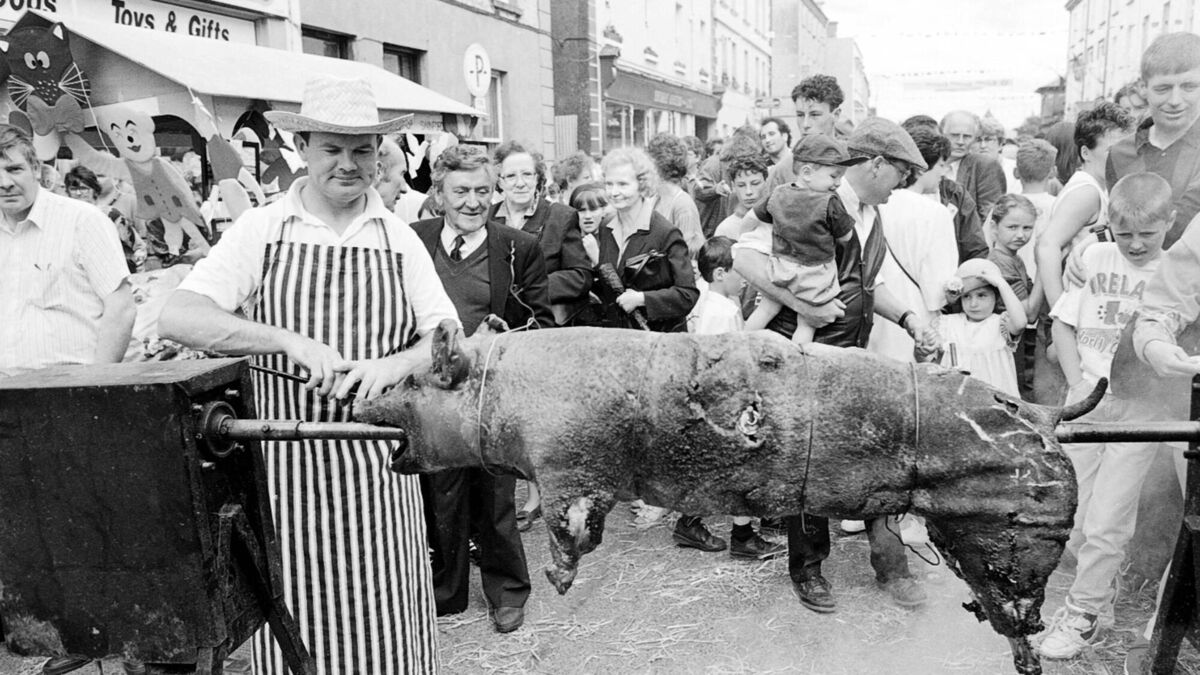
Michael Quinn roasts a pig at Ballina Heritage Day in 1994. Picture: Western People Archive
Those of you who have read , the memoir written by Billy Heffron and launched in Ballina recently by my good self will be aware of Billy’s detestation of the pig as a farm animal. He had no problems with cows or sheep but Billy developed a perverse aversion to the pig and while he had little choice but to be associated with the animals, as his father Alec invested in a piggery to provide additional income from the farm, he never warmed to the pig.
Billy’s aversion had to do with the smell associated with pig husbandry. It can be a bit overpowering but one can also get accustomed to the smell especially if you choose to think aroma, rather than smell. Billy got it into his head that the aroma of pigs was a disadvantage when it came to courtship. He convinced himself that the smell of the pigs infused itself into his clothes and indeed into his skin and that interfered with his chances with the ladies.
He even convinced himself that the pig aroma was at play when he tried his hand with a young lady in Castlebar after delivering a load to pigs to the local Bacon Factory. A romance that, in Billy’s mind, was about to blossom, withered on the vine and came to naught and all because of the pig fixation.
There could be a long litany of reasons why the courtship concluded. It could be that the young lady met another Lothario whose charms outweighed Billy’s. It might be (unlikely though!) that Billy’s many attributes did not measure up to the demands of the young lady. There’s hundreds of reasons.
And in the light of the defamation of the pig that was highlighted in , I thought it appropriate, in the interests of balance, to say a few words in defence of an animal that has many endearing qualities, not least a most inquisitive demeanour that can melt the hardest of hearts.
We do not need the long-running newspaper serial, Count Curley Wee and Gussie Goose - now unfortunately confined to the waste basket of humanity - to remind us that the pig is one of the real aristocrats of society, in the widest context of that word - both ancient and modern. The pig, perhaps because of her humble demeanour, has always enjoyed a hallowed place in our hearts and minds.
Now, having said that, it is well known that you can’t make a silk purse out of a sow’s ear. What is not so clearly understood is that, with the right knowledge and craftsmanship, the making of a silk purse out of two sow’s ears is perfectly achievable. The science - and it is a science rather than a craft - of making the much sought after accessory has not been developed for the very simple reason that sows’ ears are too valuable, as an epicurean delicacy, to be wasted on the manufacture of silk purses. After all, we have the much more inferior silk worms for that purpose.
You know that pigs’ ears have “arrived” (as they say in the most polite company!) when the Chinese authorities are launching investigations into the making of fake pigs’ ears. This investigation emerged some years back when 30 people were arrested for making pigs’ ears out of gelatine and the chemical, sodium oleate, which is used in the production of soap. It has been suggested that food safety officials were foaming at the mouth, not so much because of the breach of food safety, but, because of a well-defined sense of duty that compelled them to sample, to the point of over-indulgence, the tasty morsels.
In terms of cuisine, the pig is that quintessential lean, mean, economic machine. Apart from her hair, which is miniscule as a percentage of her weight, there is absolutely no waste in the pig. Her snout, cheeks, ears and neck rank among the most sought after delicacies. Her skin (crackling) is, for many, the most exquisite of tastes. Her hams, her bacon and her hocks are for the haughty. Her knees (knuckle bones), her delicate feet (crubeens), her curly tail are to foodies what religion is, according to Marx, to the people. Her offal - what an ignoble and offensive word to use alongside the pearl that the pig is - is the stuff of delicate delights. Her intestines are the chimera that holds the sausage together, her blood the queen of puddings.
In literature the pig has had a chequered career. She has, in turn, been vilified, ostracised, lionised and eulogised. With an equanimity that borders on the divine, she has emerged unscathed from all the vicissitudes that have been hurled at her. She remains beloved of all, including vegans and vegetarians. It goes without saying that, despite her aristocratic station, she has been the mainstay of the common people.
The 18th-century English essayist Charles Lamb, writing following England’s belated emergence from the Dark Ages, played his part in elevating the pig to her appropriate place in the affections of the people, with his 'Dissertation upon Roast Pig'. The article (which, by the way, should be essential reading in all national schools) relates how the Chinese came to appreciate how delectable roast pig is.
But, if Lamb was a porcine dote, then his fellow-countryman George Orwell was the pig’s Pierrepoint. For all his literary talents, Orwell was a dark man, certainly bewildered and perhaps even demented. When it came to pigs he was unquestionably racist. His view of the pig, as depicted in , was clearly antagonistic, outrageous and perhaps genocidal (should that be pigocidal?).
As we all well know, the pig has a platonic and peaceful approach to life. Orwell argued that his pigs were metaphors for humans and was a damning treatise on the human race in the aftermath of World War II. Pig lovers were not duped by Orwell’s fantastic claims and the pig (as a species) survived his attempts at extermination. In fact, the pig emerged from the post-Orwellian era with an enhanced reputation and an ever closer relationship with the human race.
That affection and affinity received fulfillment in the film which dispelled any lingering doubts that Orwell may have left in the minds of a minority of sad people. Babe was the Oscar winning pig who played the role of a sheepdog on an Australian farm. She too was the victim of prejudice but she rose above it, and many other challenges, to become the champion (pig) dog in the national sheepdog (pig) trials. And as Babe’s owner, Arthur Hoggett, observed at the end of the film: “That’s do, pig, that’ll do.”
Note to parents (and chefs): Burn , buy 'Dissertation upon Roast Pig', introduce your offspring to 'This little piggy went to market etc etc', check any child that uses the 'pig stubborn' epithet (they can use mule stubborn, instead) and, above all, introduce them, at an early stage, to the pig as a tasty and nourishing meal in all its many dishes. In fact, a pig’s ear (cold, obviously) makes an excellent and healthy soother.
- Frank Crumit