The Irish Wake is now a dying tradition
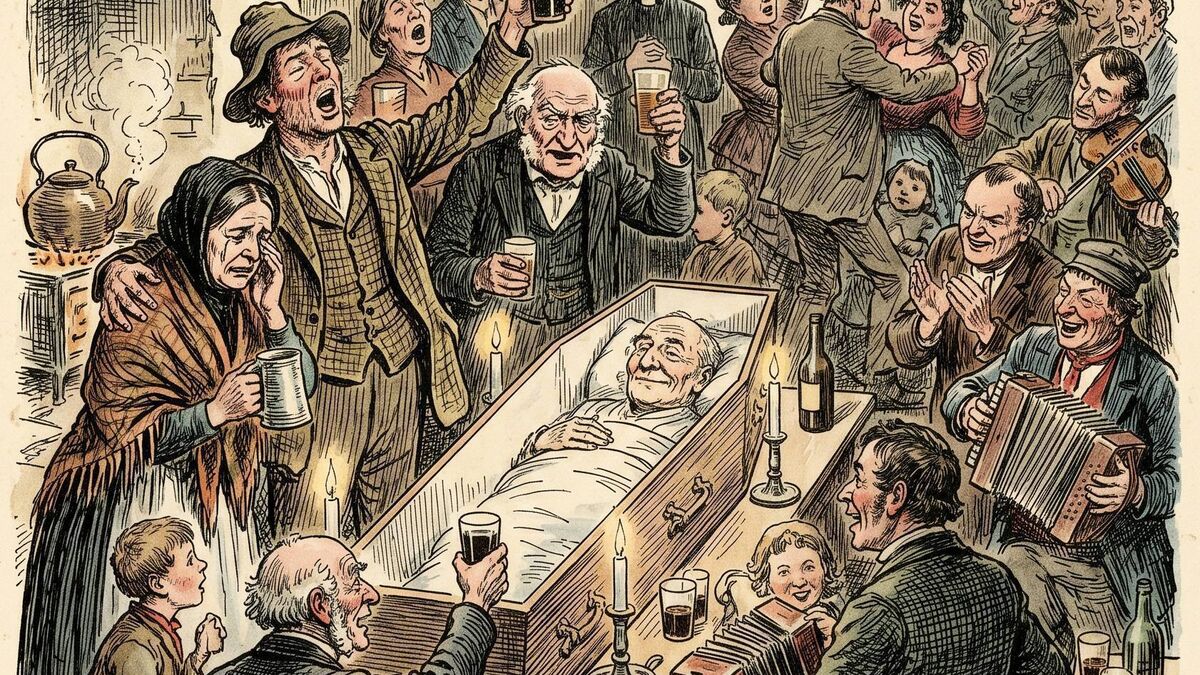
Something that took 14 centuries to evolve and did the job with quiet, reliable brilliance turns out to be harder to emulate than anyone anticipated. Illustration: Conor McGuire
There was a funeral I recall from a few years back - a handyman, a good man, the kind who'd give you a day's work for nothing and never mention it again. He was laid out in the front room of the family home outside Ballina, in the good suit he'd worn to his daughter's wedding years before and probably hadn't been near since. The neighbours came. Sandwiches were made in industrial quantities. Someone produced a bottle of Paddy at half ten at night, and nobody remarked on it. The Rosary was said, started by a local woman and then shared decade by decade among the mourners. There were people in that room who’d had disputes which were put aside to honour the deceased, standing shoulder to shoulder, murmuring the Hail Mary like they meant every syllable. Which, I think, they did.
That was an Irish Catholic funeral, the tradition of centuries. The full ceremony, the whole weighty architecture of it. And it's going. Quietly, steadily, without fanfare or announcement. The way most important things in Ireland tend to go.
We don't like to make a fuss about endings.
The numbers tell the story plainly enough, even if nobody's quite ready to read them aloud at the kitchen table. Only 13 trainee priests are entering Maynooth this year. Thirteen. For the whole country. The Diocese of Killala - 22 parishes covering the breadth of north Mayo and west Sligo - has just 40 priests in total and a single seminarian to show for the future. One. The age profile of those 40 does not, it's fair to say, inspire wild optimism about the decades ahead.
What this means in practice, as the Irish Association of Funeral Directors has been noting quietly for a while now, is that families increasingly won't get a Mass when they want one. Or, sometimes, at all.
"The expectation that you can have a funeral on the day you want," Mary Cunniffe of the Association observed recently, with the tactful understatement of someone who deals professionally with the bereaved, "that's no longer there."
Grouped funerals, postponed funerals, lay ministers at the graveside instead of a priest, a Service of the Word where a Requiem Mass once was.
And into that space - where the priest used to stand in his vestments, where the incense used to curl toward the rafters of a church where your grandfather tied the knot - have come the lay celebrants.
I don't say that disparagingly. I sell memorial cards for a living, have done so since 1995, so I've watched this shift from a front-row seat with a professional interest. And I can tell you the celebrants are warm, sincere, genuinely gifted at holding grief in a room. In our Diocese, they've trained well and are doing a commendable job. What they can't do - what no one outside Holy Orders can do - is say a Mass. And for a country that built its entire emotional infrastructure around the Mass, that is not a small thing to lose.
What's replacing it is personal. Often movingly so. The video tributes. The curated playlist running through the funeral home speakers. The eulogies that go on slightly too long because no priest is standing nearby to gently shepherd proceedings toward a conclusion.
It's intimate. And it's fine. And something in it is absolutely, undeniably missing.
What's missing isn't God, exactly - or not only God. What's disappearing is the communal grammar of it all. The Catholic funeral in Ireland was more than a religious ceremony; it was a civic event. The village assembled peacefully. Far-flung friends and acquaintances showing up. The men who drove forty miles because they played Gaelic football with the dead man in 1974, and you don't not go. The couple who'd had the row with the family over a right-of-way and came anyway, because that's what you do, because community sometimes means precisely that, laying aside all differences to show solidarity and respect. The priest who knew the family over decades, through baptisms and confirmations and weddings and previous funerals - and could say something specific and true about the person in the coffin. Not a consoling generalisation. Something true.
The hard-pressed priest, if there is one, is probably covering four parishes and his head is already at the Wednesday evening Mass in a church forty minutes away.
There's a practicality to the shift that doesn't get discussed enough either. The home wake is diminishing. Fewer people have the kind of house - the large, rambling, drafty house with the good room that was kept for best - where you can lay a body out for two days and feed two hundred people across three sittings. Urban apartments don't lend themselves to it. The funeral home is warmer, more convenient, and professionally managed. The mirrors don't need covering. Nobody stopped the clock.
So we've made dying more comfortable and less true.
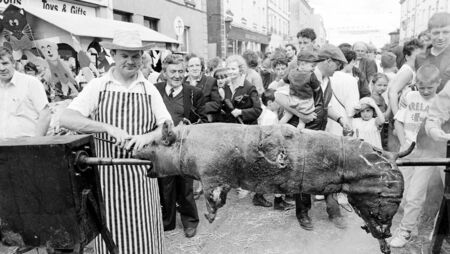
The home wake was strange and raw and exhausting and occasionally, at around two in the morning with the whiskey going around, unexpectedly hilarious. Which is exactly as it should be. Grief in all its stages is, by turns, disabling and exhausting, and we Irish, for centuries, had the good sense to acknowledge all of it over an extended support system rather than arrange it neatly into a single afternoon of catered sandwiches and then pretend it was done with.
What I find myself mourning is the inevitable diminishment of the ritual. The specific, embodied, enacted ritual of the thing - the solemnity of the Mass, the sprinkling of holy water, the smell of incense that catches in the back of your throat and pulls you suddenly back to your grandmother's funeral, your father's, every funeral you've stood through since you were old enough to understand what standing there meant. The gathered community. The spoken prayers. The crowded graveyard in the rain. The token fist of clay thrown into the gaping earth. The swift surprise of the month's mind mass. The reflective and painful first anniversary. All the small, structured ceremonies of continued remembrance that knit loss into the fabric of ordinary life, rather than folding it up and storing it somewhere in the back of the wardrobe.
We Irish, it's often said, do death well. There was a quiet genius to the old way - the two nights of the wake, the bawdy humour running alongside the grief like a twin current, the indulgent storytelling, the absolute refusal to leave the dead alone until they were in the ground.
Families are still trying, and the celebrants mean it. The eulogies mean it.
It's just that something that took fourteen centuries to evolve and did the job with quiet, reliable brilliance turns out to be harder to emulate than anyone anticipated. Which is the thing about rituals that actually work reliably. You don't fully appreciate and understand what they were doing until they're gone.
The handyman from outside Ballina, the one in the good suit, his rosary was unhurried. A warm front room, a wet January night, the clock stopped on the mantelpiece and the neighbours three-deep in the hall.
I hope someone does as well by the rest of us.