Society can benefit from family diversity
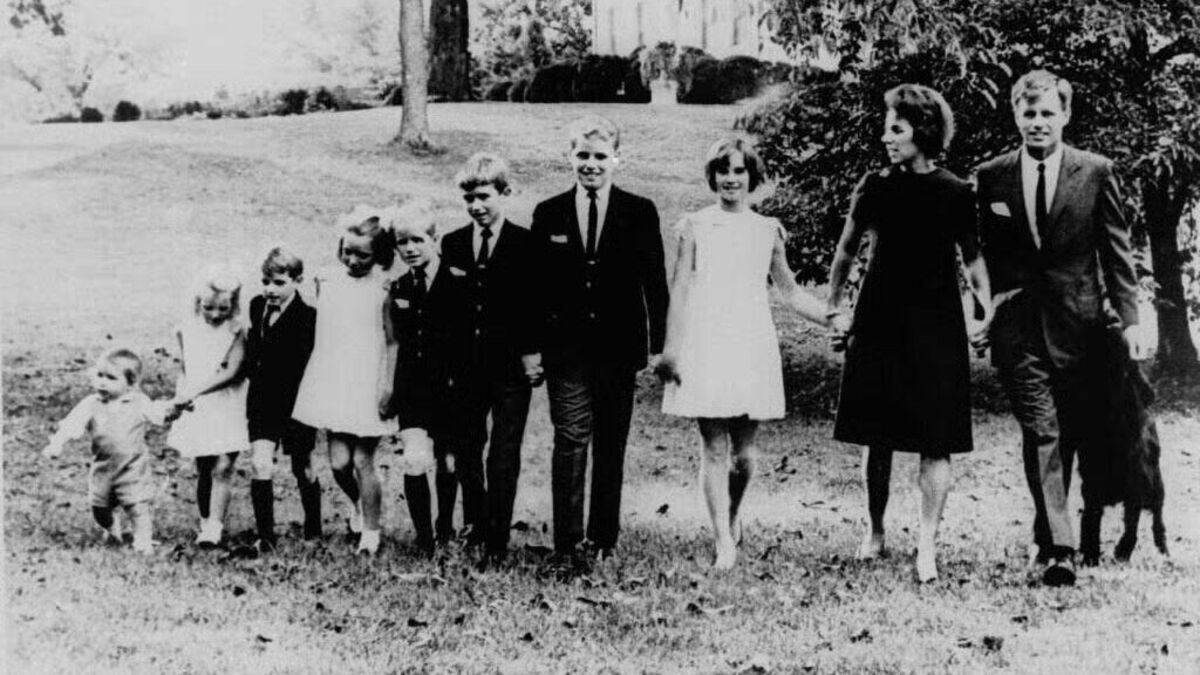
Senator Robert F. Kennedy and Ethel Kennedy pose with eight of their nine children on the lawn of their home in 1966.
Fergus Campbell is a leading Irish historian and Professor of Social and Cultural History at Newcastle University. He is best known for his influential book , which explores how land hunger, class tensions and local disputes shaped nationalist politics and revolutionary activity in counties Mayo and Galway during Ireland’s struggle for independence.
He was also a key resource for my PhD where his research informed much of my thinking on community and the social underpinnings of the Irish Revolution. Since first published in 2005, his work has become one of the most important studies on revolutionary politics in the west of Ireland.
Yet Campbell’s thinking has evolved. More recently, he has researched the history of psychoanalysis in Ireland alongside continuing work on Irish social and cultural history. This has informed deeper thinking on his original work on land purchase, radicalisation and rural politics.
In particular, he has argued for “new and creative ways” of thinking about why young men and women became involved in conflict in Ireland of the early twentieth century. Lost in the arguments over politics, nationalism and land hunger, he suggests, is the reality that “Irish children were reared in a particular way (or ways) and that this may well have influenced their behaviour when they became adults”. Campbell even raises the provocative possibility that the Irish Civil War could have been influenced by “child-rearing methods in rural Ireland [which] may have created a population that tended towards insecurity and feeling easily slighted and that therefore fell easily into conflicts with one another that were difficult to resolve”, later underwriting the long political stagnation of 'Civil War Politics' in Ireland up to modern times.
Few academics have taken up his suggestion. Instead, there remains a heavy focus on economics, demographics, political ideology or the legacy of the Great Famine. Others point towards the Gaelic Revival, or the wider revolutionary spirit sweeping Europe in the early twentieth century. The “brother against brother” narrative rooted in contested but noble principles still underlies much of the thinking on our civil war violence.
Yet Campbell’s idea, placing family upbringing at the core of modern Irish history, has been rummaging around my brain of late, seeking validation in my own musings.
After spending a happy month in my native North Mayo, I boarded a packed flight back home last Tuesday. Like everybody else, when booking the seat I tried to strategically situate myself somewhere that would minimise the chances of sitting beside young children and/or babies.
But I and/or failed. After grabbing my place, my heart sank as a large, noisy Dublin family assembled around me.
Before I even saw them properly, I heard them. Strong working-class Dublin accents. The sort endlessly caricatured online and on television. And to my shame, I immediately made assumptions. I instinctively imagined trouble, ignorance, loudness, dysfunction. Years of cultural conditioning had quietly lodged those stereotypes in my brain without me ever really challenging them.
Finally, our flight took off with ironic applause, after an eternity waiting for a nervous woman with broken English to sit with her own child in adjacent seats, which they had not pre-purchased. The Dublin Granny announced, “here, her husband should’ve gotten up to sort that out” and didn’t much mind if the scowling gentleman in question understood her drawl or not.
Her family consisted of adult sons, their wives or partners, a sister and several young children, cousins and a newborn baby. Some were seated together while others were scattered throughout the plane, constantly moving between aisles checking on each other, sharing snacks, swapping children, telling stories and arguing in the normal good-humoured way families do.
And what struck me was not chaos, but health.
The children were energetic but well behaved. They laughed loudly, occasionally annoyed people, dozed, ate crisps and sweets, played with each other and were gently (if loudly) admonished when they crossed lines. One little toddler spent much of the flight being passed from arm to arm while his father proudly introduced him to amused strangers nearby. The adults chatted with each other in authentic conversation, without forced niceties or needless politeness, everyone comfortably participating in this extended family of genuine connectiveness.
At one point a Ukrainian couple seated nearby - despite limited English - began interacting with the toddler, smiling and producing a teddy bear to entertain him. The whole section of the plane slowly became less like anonymous airline passengers and more like a temporary community.
What I was witnessing was not simply a family on holidays, I was watching a social ecosystem.
The children were learning constantly, not through lectures or therapy sessions or educational toys, but through interaction. Through cousins, uncles, aunts and grandparents; through arguments, affection, boredom, compromise, forgiveness, sharing, waiting their turn; through annoying each other and being corrected by multiple adults including strangers.
As a child raised in a large family myself, despite all the rows and tensions that come with it, I began wondering if this is where the edges are knocked off a person to create a rounded, self-aware human, fit for local society.
In large families you learn early that the world does not revolve around you. You learn alliances, betrayals, humour, negotiation and survival. You learn that somebody can hurt your feelings without being an evil person. You learn that you yourself can behave badly without becoming irredeemable. Most importantly, you learn to continue living together afterwards.
That education happens organically through daily life, but increasingly, I wonder if modern society is quietly losing that.
According to the Pew Research Center, in 1970 around 67% of Americans aged between 25 and 49 lived with a spouse and children. By 2023 that figure had fallen to 37%.
At the same time, the 'one-and-done' family structure has become one of the fastest growing family models in America. According again to Pew, the average United States family downsized from 3.7 children in 1960 to 1.9 currently and about 20% of households with children are one-child families.
This does not mean that an only child is destined to be automatically selfish or maladjusted. But there is increasing evidence that modern life has reduced face-to-face interaction with extended family and community networks as relatives increasingly live far apart from one another.
And perhaps that is the more important point. The real issue is not whether a child has siblings or not, but whether they grow up embedded within a thick web of relationships of cousins, neighbours, grandparents each with variations on obligations, humour, conflict and forgiveness.
Because increasingly, especially in places like California, I encounter children being raised almost entirely as individual projects. Often they move between separated parents, isolated households and highly controlled environments with relatively little exposure to wider family dynamics or broader community life.
And I cannot help wondering what kind of adults this produces.
Not bad people necessarily. But perhaps people less emotionally equipped for compromise, less resilient to discomfort, more fragile in conflict, more self-centred in outlook and more vulnerable to ideological tribalism.
Perhaps many of the problems consuming America today such as the endless culture wars, political rage, online narcissism, social fragmentation and loneliness, are not merely economic or political problems at all. Perhaps they are, at least partly, family problems - now spreading to Europe.
Once societies were structured around layers of human belonging: parents, siblings, extended family, neighbours and community. But increasingly, modern structure is focussed on the individual, entitlement and ideology.
Watching that Dublin family, I found myself hopeful. Not because they were perfect. They were noisy, argumentative, messy and occasionally irritating. But because they were each deeply connected in a diverse and extended family unit, rooted in tribal bonds of authenticity and love.
And perhaps that is a form of diversity we rarely speak about anymore.
Modern society often discusses diversity almost entirely through the lens of ethnicity, nationality, identity or culture. Yet there is another kind of diversity which may matter just as much in shaping stable and emotionally resilient human beings: diversity of relationships, personalities, generations and daily human interaction.
Those children on the plane were not being raised solely by one worldview or one emotional dynamic. They were learning to navigate grandparents, cousins, siblings, uncles, aunts, strangers, authority, affection, conflict and compromise all at once. They were learning that life consists of constant negotiation with other imperfect human beings.
Perhaps that is what extended families and strong communities once quietly gave us. Not perfection. Not endless happiness. But emotional depth. Resilience. Perspective. Humility. The ability to survive disagreement without turning every conflict into a permanent war.
As Fergus Campbell points out, this does not mean that family life used to be perfect - clearly not, as our Irish Civil War may part-exemplify. But in a modern age increasingly defined by loneliness, outrage and ideological tribalism, perhaps those life lessons from our past matter more than ever.