The Civil War is over, but nobody told voters
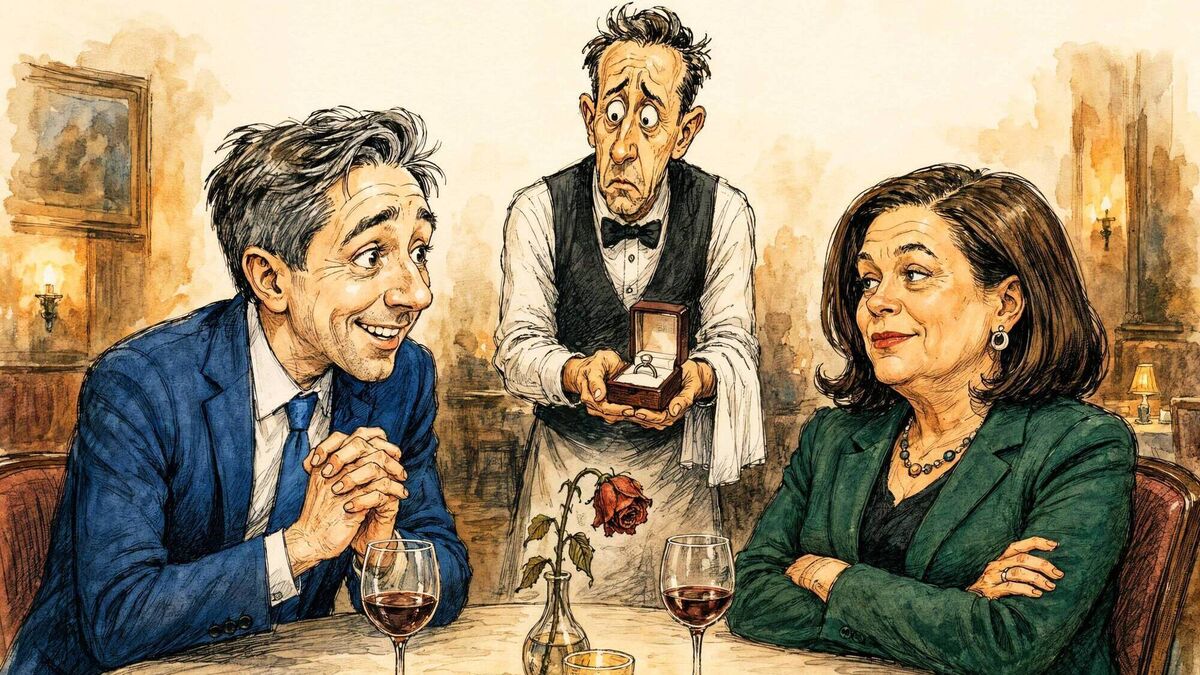
The unity flirtation may be exactly a way for Fine Gael to look bold and green and constructive without ever paying the price of actually governing alongside Sinn Féin. Illustration: Conor McGuire
Rose Conway-Walsh leaned across the floor of the Dáil a few weeks back and told Simon Harris that Michael Collins would be pleased with him. Read it again. A Sinn Féin TD telling the leader of Collins's own party that the Big Fella himself would have nodded yes. Offer that sentence to anyone in Irish politics twenty years ago and they'd have felt your forehead for a temperature.
Well, guess what, nobody in the chamber fainted. Mary Lou McDonald, sitting nearby, called Harris's little presentation on Irish unity "refreshing" and "exactly where we need to be". The Tánaiste's people put out a warm and welcoming word about working across the House. The whole thing was logged as "extremely constructive", which is the sort of phrase that usually gets said about a divorce mediation, and is roughly as ominous.
Here is the thing the headlines missed while they were busy with the opinion poll. Fine Gael, the party of the Treaty, the party of the Free State, the party of Kevin O'Higgins and the firing squads of the Civil War, is now the outfit making eyes at the republicans about a united Ireland. And Fianna Fáil, born squalling on the losing anti-Treaty side, the party that spent half a century wrapping itself in the Tricolour and the memory of the boys who wouldn't compromise, is now the one bolting the door and complaining about foreign direct investment.
The sides have swapped costumes. Collins's heirs are courting the republic. de Valera's heirs are playing the cautious Free Stater who'd rather not upset the multinationals. If you handed that plot to a first-year drama student, you'd send it back for being too on the nose.
Micheál Martin won't say the words, of course. He never does. Ask him why Fianna Fáil won't touch Sinn Féin, and you get an impromptu lecture on the enterprise question and the economic model that has served this country well. Sinn Féin, he'll tell you with a furrowed brow, opposed every policy that ever brought a data centre or a pharma plant to a bog in the midlands, and they're "very negative about the European Union". It's all very reasonable and grown-up and boardroom. It is also a hundred-year-old wound that has been quietly rebranded as a spreadsheet. Martin can't say "my grandfather's people fought yours in a ditch outside Cork", so he says "stronger alignment on the macro principles". Same grudge, better suit..
I don't entirely blame him. The Civil War was the realest thing in Irish politics for the guts of a century precisely because everyone knew which side their own crowd had been on. Where I'm from in Mayo, you could still, within living memory, name the families who'd taken the Treaty and the families who hadn't, and you knew not to seat certain of them together at a funeral. That was the divide. It wasn't left and right; it was 1922, and it held two enormous parties apart for generations on the strength of pure ancestral spite. It was mad. It also worked, which is the maddening part.
Then 2020 happened, and the two of them climbed into the same cabinet for the first time, and the Civil War just quietly died in its sleep. No wake, no rebel song, no last stand. One coalition deal and a hundred years of enmity turned out to be negotiable after all. Which rather gave the game away. If the great blood feud of the nation could be resolved by a programme for government and a rotating Taoiseach, then it was never a feud. It was a habit.
What replaced it as the unbreakable rule was the new pariah down the road: Sinn Féin. Leo Varadkar, in his pomp, called them "not a normal party", and for a while that was the whole of the law. You could talk to anyone in Leinster House except them. They were the untouchables, the ones with the past nobody would shake hands with. And now Fine Gael, Varadkar's own shop, is holding "constructive" chats with their leader about the biggest constitutional question on the island. The last taboo is peeling at the sides like a damp poster.
The poll everyone got excited about, by the way, is mostly weather. Fianna Fáil down a single point to sixteen, Sinn Féin and Fine Gael level on twenty. All of it comfortably inside the margin of error, which means it might be real and might be the statistical equivalent of a sneeze. If you want to write that as an earthquake, off you go, but you're transcribing a press release. The interesting number in the same survey is the one nobody led with. Ninety-three per cent of Fine Gael voters think a coalition with Sinn Féin would be a bad idea. Ninety-six per cent of Fianna Fáil voters agree. The base hasn't moved an inch.
So picture the peculiar if not unprecedented shape of it. In the upper echelons, the leaders are drifting affectionately toward one another, exchanging compliments about Collins, unity, and constructive pathways. Down at the more prosaic bottom, in the branches and the parish halls, the faithful voters are digging their heels into the same ground their grandparents held. The elite are busily thawing in the chambers of Leinster House while the grassroots are frozen solid in an unchanged landscape. That gap is where the real and more interesting story lives. I suspect it's a more honest column fodder than any fantasy of Harris and McDonald lunching together.
Because here's the reality stripped of all pretence. The only thing actually holding the last taboo upright is one 65-year-old man's already weakened word. Martin has said he'll lead his party into the next election. His own people are briefing that January 2027 is the real finish line, once the EU presidency is wrapped and the party posturing for photographs is taken. After that, there's a queue. O'Callaghan, Ballina’s own Calleary, O'Brien, Chambers, whichever of them gets the keys will have about ten months as Taoiseach before the rotation hands the office back to Fine Gael, and not one of them owes the old rule anything. The coverage already suggests that a new leader "may want to keep options open". May want to hold his own constructive talks. You know exactly what that means.
A principle that expires the week its author retires was never a principle. It was a grudge with a pension, and the pension is nearly due.
Now, before anyone marries these two off, a word of caution. Talking about a united Ireland is cheap, and it polls beautifully, and it commits you to precisely nothing. Sharing a budget, a health service and the blame for the next housing catastrophe is a different sport altogether. The unity flirtation may be exactly a way for Fine Gael to look bold and green and constructive without ever paying the price of actually governing alongside Sinn Féin. Flirting is not marriage. Half of Ireland has learned that the hard way.
But the costumes are off the pegs now, and everyone can see who's wearing what. The party of the Free State is singing rebel songs. The party of the Republic is doing the sums and finding reasons to stay home. And the voters, God love them, are still fighting a war that ended when their grandparents were young, kept alive by two organisations who buried it themselves the minute it suited them.
Michael Collins would be pleased, apparently. I'd say he'd want to know who's minding his party, and whether they've read the ending.