So, Liam... did the acting work out?
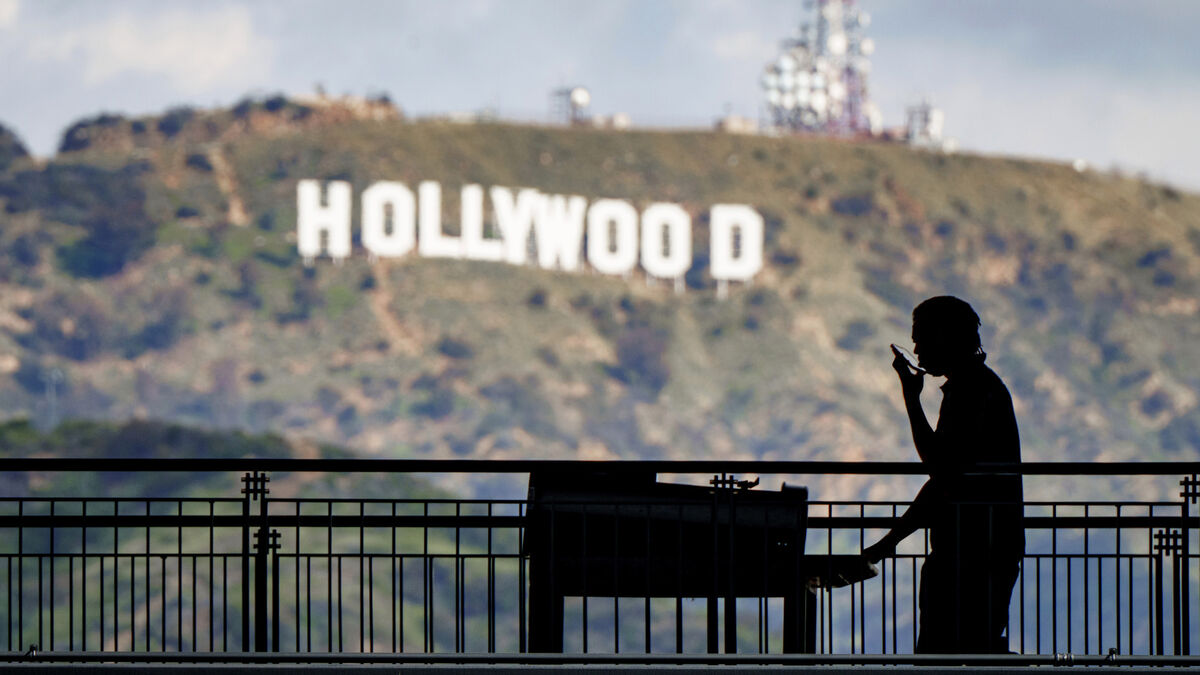
A worker wheels equipment past the famous Hollywood sign as preparations continue on March 8, 2023, for the 95th Academy Awards, which took place against the backdrop of an industrial-wide strike. Picture: AP Photo/J. David Ake
The question I’ve been asked more than any other since announcing this would be my final column from Los Angeles was a surprisingly-simple variation of: “So, Liam… did the acting work out?”
Fair question. Even if a bit loaded as only Irish questions can be.
After all, that was a motivating reason my wife and I crossed the Atlantic. Like countless others before me, we came to Tinseltown chasing Hollywood. I imagined the path to be reasonably straightforward. Work hard, train well, find a good agent, impress casting directors, book roles and gradually build a career here. For a long time, that’s how the industry worked. It’s how I remembered it during my time in L.A. over a decade ago when I first came to the mecca of film acting.
But as a social-media obsessed W.B. Yeats may have said today: “All’s changed, changed utterly. A terrible beauty is born (broken-heart emoji).”
In fairness, Hollywood was already changing pre-Covid, but the industry shutdown during the Covid pandemic with subsequent writer and actor strikes fanning the revolutionary flames of a new era in screen entertainment. And this was not just the drift from box-offices and DVDs to streaming services such as Netflix and Prime-Video.
Commercials that once paid enough to support an actor for months became scarce, often non-union and considerably less rewarding. Auditions moved from casting offices to self-tapes filmed in our apartments. Actors weren’t simply expected to act anymore. We became our own camera operators, lighting technicians, sound engineers, editors and marketing departments. We effectively swapped hours in sweaty LA traffic, scarce parking and nervous casting-room corridors for a one-person film crew in our bedroom. It meant casting could see tons more auditions but as the barriers to entry did fall, somehow the barriers to success rose higher.
Everyone now carries a film studio in their pocket. Along with the explosion in streamers, YouTube, social media and vertical videos, never has it been easier to create content but also never has it been harder to make content that people actually watch. Artificial intelligence promises another revolution and will replace at least some actors. Meanwhile other US states and countries such as Bulgaria, the UK and even Ireland entices productions away from expensive California with eye-watering tax credits.
Somewhere along the way, I realised that by the time I had finally reached Hollywood, Hollywood itself was trying to work out what it had become...
That sounds rather bleak and rather long for a casual chat on the street. But my opening question feels loaded, as it suggests the man/woman/TV licence inspector asking it, already knowing the answer seeing as I have yet to adorn the screens as James Bond with a Mayo accent.
The questions also suggests that Hollywood is just a destination rather than a place where many Irish move over and back, with work, networking or just living in a vibrant ex-pat Irish community. This is the fluidity of the modern world. Trump’s immigration policies aside.
In thinking of the original answer I realise that Hollywood taught me something far more valuable than how to book a role.
As I worked in auditions, classes and workshops I dug back into my own life of experiences, both on and off stage or screen. To stand out in L.A., you must hone your craft and dig deeper for grounded performances and authentic emotional connections.
I learned what acting is actually for. It’s not for me. It’s for you. Because acting without an audience, is just therapy and I didn’t need to be in L.A. to do either.
Preparing for one audition opposite Jude Law, I remembered closing up a theatre production one grey night in Galway city of my play about a jury deciding the guilt of a young Traveller accused of murder. Outside, I found a middle-aged Traveller woman hunched, hugging her knees with her back to the cold theatre building. She is visibly upset. Tears are running down her face. Her friend tells me it was her first play in her life: ”It felt so real."
I’m lost for words. I never thought what the experience would be like for a Traveller sitting in an audience as a non-Traveller jury debated her community’s way of life while not holding back on their prejudices.
“I’m sorry,” I simply tell her as I squat down beside her.
She shakes her head: “Don’t apologise.”
She wiped her eyes and trying to gather herself looks back at me: “I’m glad I came.”
She explains that it was simply overwhelming to hear people like her, her family and her community being talked about on stage. It hurt to hear some of the words spoken.
“But thank you. Really.”
As actors, we spend so much time worrying about ourselves. Did I remember the lines? Did I make the right choices? Was I convincing? Was my arse too big in those pants?
Sitting there, watching this woman trying to compose herself, none of those questions mattered anymore. Just as Jude Law was just another actor that I would work a scene with. Ultimately, we were just two actors “being real” for an audience.
Later, rehearsing a role opposite Russell Crowe, I remembered standing in Ballina Post Office waiting in a slow-moving queue of mostly mothers and kids. At the very front stands a gaunt-looking man I’ve seen walking around town before. He turns around, spots me and suddenly starts shouting.
“Don’t forget we’re going for that bottle of wine!”
The entire queue turns to look at me.
I have absolutely no idea what he’s talking about. I smile awkwardly. My inner small-farmer Catholic guilt is now kicking hard.
He shouts it again, a broad smile on his face.
“We’ll have that bottle of vino under the bridge!”
Now I’m embarrassed. Everyone is looking at me. I begin wondering what people must think this mysterious arrangement says about my social life. Eventually he finishes his business and leaves, calling back one final time from the exit door: “Champagne comes from France!”
When I finally reach the counter, the lady serving me laughs.
“So,” she says, “are you joining your friend later?”
I smile politely in a mixture of confused embarrassment.
Walking out the door, I’m immediately stopped by a large young fella in a hoodie.
“Can I ask you something?” he asks intently.
I instinctively brace myself. My inner small farmer is ready to run yelping for the hills.
“You were in , weren’t you?”
Confused, my small farmer nods yes. The lad’s face transforms into a happy smile.
“I knew it! You’re the fella on there always talking about the wine!”
Suddenly everything makes sense. The man in the post office wasn’t talking to Liam. He was talking to the pompous banker I had played on TV, a man so obsessed with expensive wine that he’d drink himself into financial ruin. The character had become real enough that people quoted him back to me (especially as it had just streamed on Netflix).
Throughout the rest of the week, several more people stopped me to talk about TV series. They weren’t really interested in me. They wanted to relive those moments where I had made them laugh. Some years later, people also remembered me from as the awkwardly sarcastic Garda officer. I learned to enjoy the sledging and banter in Tesco, even if the inner small farmer was never too far away.
Perhaps some viewers had difficult lives. Perhaps comedy offered a brief escape. Perhaps quoting a favourite scene to an actor they unexpectedly encountered in Ballina Post Office was simply their way of saying thank you. Again, the lesson was the same. The audience mattered.
A few months ago I was a detective interrogating a young actor playing a killer (who will be huge in TV in a decade). I thought back to signing an autograph for a young girl after a theatre performance. She looks up at me with complete sincerity, utterly convinced by the character I’ve just played.
Children don’t applaud technical acting. They believe. If you’ve done your job properly, they never see the actor at all. Only the person standing in front of them.
“You made me forget I am sick,” she simply said before she was gone, leaving me both strangely humbled, sad and proud.
Looking back now, perhaps the biggest lesson Los Angeles taught me wasn’t about Hollywood at all. It was about perspective. Actors spend years worrying about agents, auditions, credits and reviews. Those things matter. Of course they do. We all want to work. We all want to build careers. We all want our work to be praised and lauded with awards and red-carpets.
But they are not the reason to act. At least for me. It has taken Hollywood for me to see that. The reason is much simpler. Someone who watches me laughs. Someone else is angry and cries. Someone forgets the pain of life at least for a while and dreams. All finish by seeing themselves and their world a little differently. That’s the work. That’s my job as an actor.
There’s an old saying in acting that you’re only as good as your last job. I used to think that meant your career depended on your most recent performance. Now I think it means something else. The last job is over. The next one is what matters.
Each new character begins again with a blank page and a new name waiting for someone to breathe life into it. Perhaps it’s fitting that, as this L.A. chapter closes, I don’t really know what the next role will be, or where it will be found. And, looking back now, I think that’s exactly the answer to the question “did the acting work out?” with “it’s way too early to tell".
It has been a privilege to share these American reflections with you as readers of the . If you would like to continue following my writing, research and occasional adventures, please visit me at www.liamheffron.com, where the conversation continues. Who knows? Maybe one day we’ll share a bottle of wine. Preferably not under a bridge.