Everything about Donaldson was a bare-faced lie
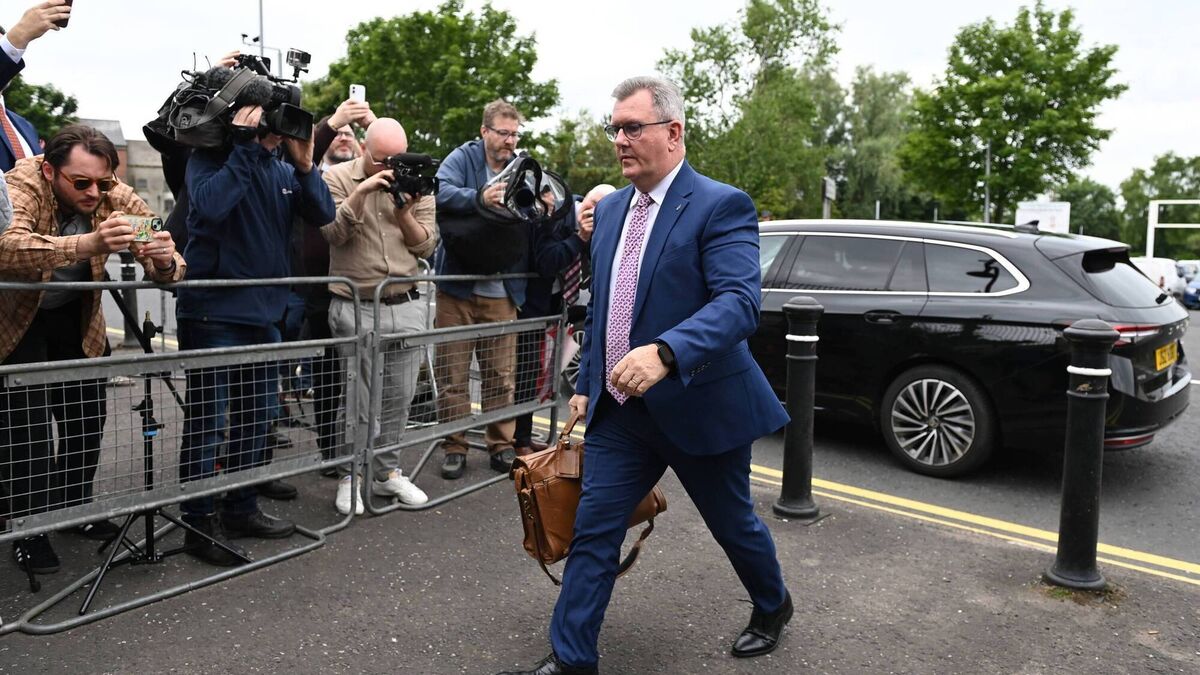
Former DUP Leader Jeffrey Donaldson arrives at Newry Courthouse as his trial reached its conclusion. Picture: Charles McQuillan/Getty Images
He gave nothing away. That was always the trick of him - the gift, the brand, the entire act. While the rest of Ulster Unionism foamed and thumped and quoted Leviticus at the weather, Jeffrey Donaldson did the quiet thing. He folded his hands. He lowered his voice. He was the one you could put on the programme without a flak jacket, the unionist who’d learned to do reasonable the way other men learn the cello - late, deliberately, and entirely for effect. And on Monday afternoon in Newry, when the foreman of the jury read out the word “guilty” eighteen times without stopping, he gave nothing away then either. The same blank Presbyterian calm. The same nothing. It turns out the nothing was the whole man.
There is a particular kind of Ulsterman the mainland press has always adored: churched, sober, a touch dull, blessedly free of the murder-gospel theatrics of the Paisley years. Donaldson was their man. Sir Jeffrey, if you please - knighted in 2016 for services to a politics he had spent decades quietly defiling. He had broken ranks on the Good Friday Agreement, boldly crossed the floor from the more moderate Ulster Unionist Party (UUP) to the Democratic Unionist Party (DUP) and there established himself as the grown-up in the room, the statesman, the one you sent in when the unruly children had wrecked the place and someone steady was needed to sweep up. It was Donaldson who marched the DUP back into Stormont in 2024 after they’d shut down the institutions for two years over a customs form. The safe pair of hands. Hold that phrase up to the light. We’re going to need it.
Because here is the arithmetic the court has now made official, and it is the cruellest sum in Irish public life, north and south, this year. The offences ran from 1985 to 2008. Twenty-three years. Lay that against the CV - the climb from Lagan Valley councillor to MP to party leader, the handshakes, the carefully managed gravitas, the knighthood - and the two timelines are not parallel. They are the same line. The man was not leading a double life. He was leading one life, and we were only ever shown the half of it he wanted photographed. Every reasonable interview, every furrowed appeal to decency and the rule of law, every grave little homily about respect - all of it issued from the same mouth, in the same years, by the same man who was doing what a jury of his neighbours has now decided, beyond reasonable doubt, he did to two children.
You want to know what’s obscene about it? Not only the acts, monstrous as they are. It’s the register. This is the party that gave us Save Ulster from Sodomy. The party that wielded the petition of concern like a claymore to keep two men from marrying in Belfast long after the rest of these islands had grown up and got over it. The party of the Free Presbyterian frown, forever appointing itself the moral environmental-health inspector of other people’s bedrooms, sniffing the province for sin and finding it, reliably, everywhere except home. And the steadiest hand that party ever produced, its respectable face, its ambassador to civilisation, was abusing children the entire time he was lecturing a nation on virtue. There’s a word for the gap between what a man preaches and what he does, and no, it isn’t hypocrisy. Hypocrisy is in all of us when compromised; it's too small, too familiar and too social, the sin of saying grace and skipping church. This is something more sinister and colder. This is a man who built a cathedral of decency specifically so that no one would think to look in the crypt.
And we bought the architecture, every last one of us, because we are trained to respect a certain kind of man, possessed of a dark suit, a low voice and a firm, dry handshake, and he will be read precisely the way he intends - as ballast, as gravity, as a soul that has done its sums and found itself in credit: the stillness we mistake for depth, the reticence we flatter into wisdom. We’re especially prone to it here, in a culture that distrusts the man who emotes and all but canonises the one who holds it in. Donaldson held it in for sixty-three years. Turns out there was a reason. Turns out the reservoir wasn’t full of still water.
He denied all of it, of course, to the bitter end. “Crystal clear,” he told the court - the rape claim was “simply not true". The rest was “just unbelievable”. There was a letter, written in 2020, in which he expressed “regret” for “all the hurt, pain and distress I have caused”, which he insisted, with a straight face, referred to something else entirely. Some other unspecified hurt. Some other freelance distress. The jury, mercifully, declined to imagine what.
And then there’s Eleanor Donaldson. In a separate trial of the facts, she was found medically unfit to stand the ordinary kind - the court determined that his wife had aided and abetted him. There is a particular darkness in a house where the abuse is not a secret kept from the home, but a thing the home was arranged around, and the kindest thing I can say is that the court will weigh it, and I’ll spare you my weighing.
What I won’t spare you is this. Two women walked into a police station in 2024 and said the thing out loud, knowing - one of them said as much from the witness box - that it would become “a huge, huge decision”, a public affair, a media circus, their childhoods turned into evidence and read back to them by a man in a wig being paid to call them liars. They did it anyway. The leader of the Ulster Unionists, no friend to the DUP, got it exactly right when he called them heroes and called Donaldson an absolute disgrace. Note which of them needed a barrister.
The DUP, naturally, has discovered that it barely knew the man. Party insiders, we’re told, “never knew the real Jeffrey”. Gavin Robinson has informed the world that Donaldson “betrayed the trust” placed in him and - my favourite municipal flourish of the week - that “he is not a member of our party". No. He is not. He is, as of Monday, a number on a remand sheet, awaiting a sentence the judge has already promised will be long. But he was your leader, lads. You knighted him with your votes long before the Crown got round to the sword. He didn’t betray a party that was pure and clean and unsuspecting. He was the party, its best self, its respectable shop-front, the proof you kept holding up that the dour old certainties could be trusted with the keys.
Judge Paul Ramsey put it more economically than I can. When it was done, when the eighteen guilty verdicts had been read, and the no-emotion man had stood there feeling, apparently, none, the judge said three words to the officers in the dock:
And they dutifully did, while somewhere a knighthood hangs in a wardrobe, and a province that spent fifty years being told who the decent people were is left to work out, yet again, that the loudest guardians of the gate were the ones who should never have been handed the key.