Mallard - the original of the species
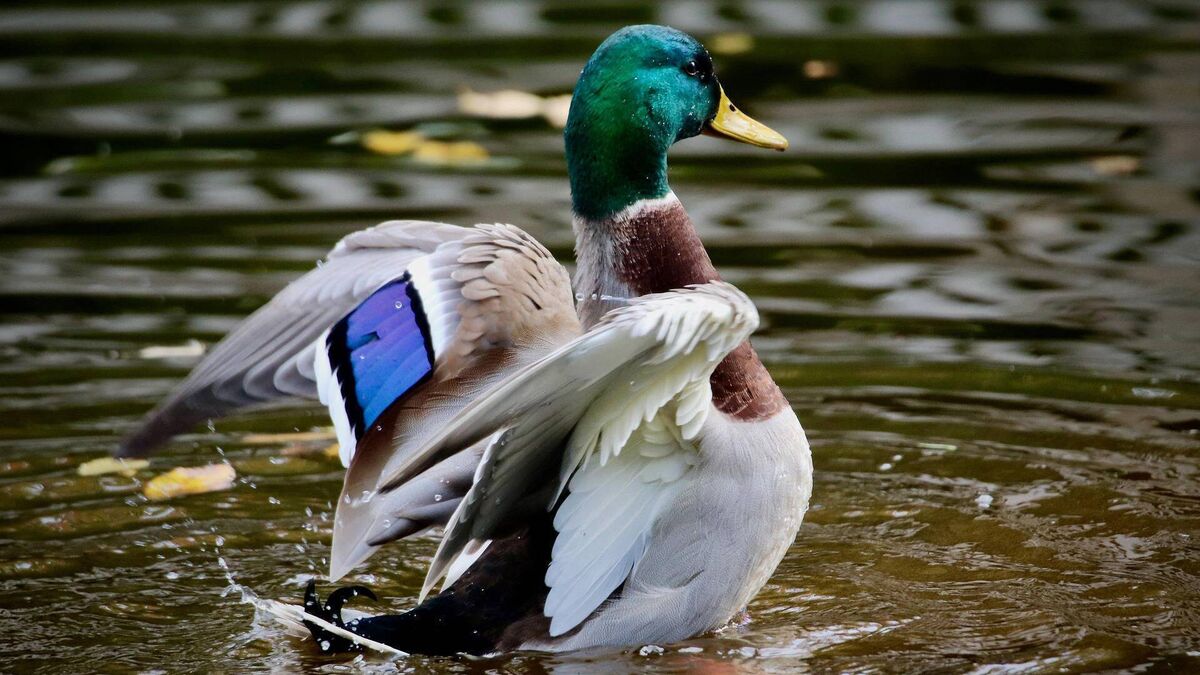
The mature male birds have beautifully coloured plumage; their heads and necks a brilliant green, and at the base of their neck, a white ring.
Walking along a secluded bank of the River Moy, there is something almost breath-taking about the sudden burst into flight of a wild duck. And then there is their arcing flight path, along the base of a pale autumnal sky, as they seek peace once again on a distant section of the river. With these experiences, we are reminded of the secret life of the mallard, our most colourful wild duck.
While it can be difficult to get close to the wild mallard, they are nonetheless one of the most recognisable ducks in the world. The mature male birds have beautifully coloured plumage; their heads and necks a brilliant green, and at the base of their neck, a white ring. Male mallards also have a dark brown chest, and the sides and most of the wings are a steel grey. Their tail is black and white, and their bill, a powerful yellow. In contrast, females do not have these Sunday coloured feathers, preferring instead their everyday, understated coat of mottled tan and brown. All mallards have a special wing patch, a flash of purplish-blue outlined in white called a speculum, that is only visible when the bird’s wing is outstretched.
Mallard ducks are common throughout the world. Despite the secrecy of some, others are often seen swimming around park ponds, popular river locations, and even on man-made water features, having given up some of their wildness in favour of easy pickings and a less adventurous life.
Mallard are foragers and will eat a wide variety of foods. They prefer to forage in shallow water, where they can dip their heads down to reach aquatic plants. They will also eat animal matter, including insect larvae, earthworms, and snails. While migrating, mallard will opt to feed on seeds and grains.
Mallard form nesting pairs in the autumn and winter. In late spring, females lay between 5 and 15 eggs, which they incubate for almost four weeks. The ducklings leave the nest within a day of hatching, led to the water by their proud mother. This is a sight to behold but you might need to get up early in the morning to see this particular spectacle of nature. A lucky mallard can live for up to 10 years in the wild (they are hunted as a game bird). The oldest known mallard was a recorded male that lived to be 27 years old – a very lucky mallard indeed.
Ducks are very suited to farming because of their reliable flocking behaviour, and their ability to forage effectively for themselves. Breeds such as White Pekin are raised for meat, while the prolific Indian Runner can produce over 300 eggs per year. In East and Southeast Asia, polycultures such as rice/duck farming are widely practiced: the ducks help the rice growing with manure and by eating small pests, allowing a patch of ground to produce rice and ducks at the same time.
The domestication of ducks seems to have originated during the Neolithic period, followed by a rapid selective breeding process favouring meat or egg production. All this seems to have occurred in Southern China around 2000 BC and later spread outwards from that region. There are little or no archaeological records available in this regard, so the date of domestication is unclear but there is no doubt that duck farming, for both meat and eggs, was a widespread industry in ancient Southeast Asia.
Despite domestication, wild mallard ducks remained hunted extensively in other parts of the world in ancient times. Ducks are documented in Ancient Rome from the second century BC, but descriptions suggest that ducks in Roman agriculture were captured in the wild and not domesticated as such. It seems ancient Romans preferred to harvest their eggs from wild ducks, albeit in a managed and structured way.
While domestication has greatly altered the colour and characteristics, most varieties of domestic duck derive from the mallard. Domestic ducks are mostly promiscuous, while wild mallards are monogamous. Domestic ducks have lost the mallard's territorial behaviour, and are less aggressive. Only the female produces the classic 'quack'; males make a quieter, raspy sound, giving rise to the expression, ‘as hoarse as a drake’.
A wild mallard weighs some 1.1kg (2.4lb), but large breeds like the Aylesbury may weigh 4.6kg (10lb), while small breeds like the Appleyard may be only 0.7kg (1.5lb). Those breeds are raised for meat and eggs, while other breeds are purely ornamental, having been selected for their crests, tufts, or striking plumage, for exhibition purposes.
Among the domestic ducks raised by French farmers several hundred years ago was a duck resembling large mallards. Around 1800, these ducks were introduced to England, where they were given the name Rhone, after the region in southwest France. Once the Rouen arrived, English breeders began to redesign the bird through selective breeding, doubling its size and improving its colours.
In 1850, the Rouen breed was brought to the United States where they soon became popular as a general-purpose farm duck. Livestock Conservancy gives further detail on the breed and says, while they are not very productive, they remain well worth their place on any small farm.
Keeping ducks is fun but keeping ducks safe is another day’s work. A good egg-laying breed such as the Kaki Campbell or the Indian Runner will lay up to 300 eggs each year – the best hybrid hen will only lay 270 eggs – and a duck egg is a powerful egg. Ducks love the rain, seek out water and love to rove about seeking snails and slugs as part of their diet – sounds like a good fit for the Ox Mountain smallholder. Apart from that, they are great for hoovering up household scraps and they really need very little feeding besides.
However, ducks are a little smelly and between that and their playful quacking, the neighbouring fox soon gets to hear about them. But hey, keep numbers small, fence in a suitable area and provide a vermin proof house and the job should be a goodun! You will soon have a group of very entertaining companions, eggs for omelettes and, if you keep a hoarse drake, maybe next spring you might be lucky enough to hatch out a clutch of adorable ducklings. If your mother duck won’t sit on her own eggs, a broody hen makes a good surrogate… but watch out for the moment her adoptive babies finds the water - she will go mad!