Giving voice to a dark era in Ballina's history
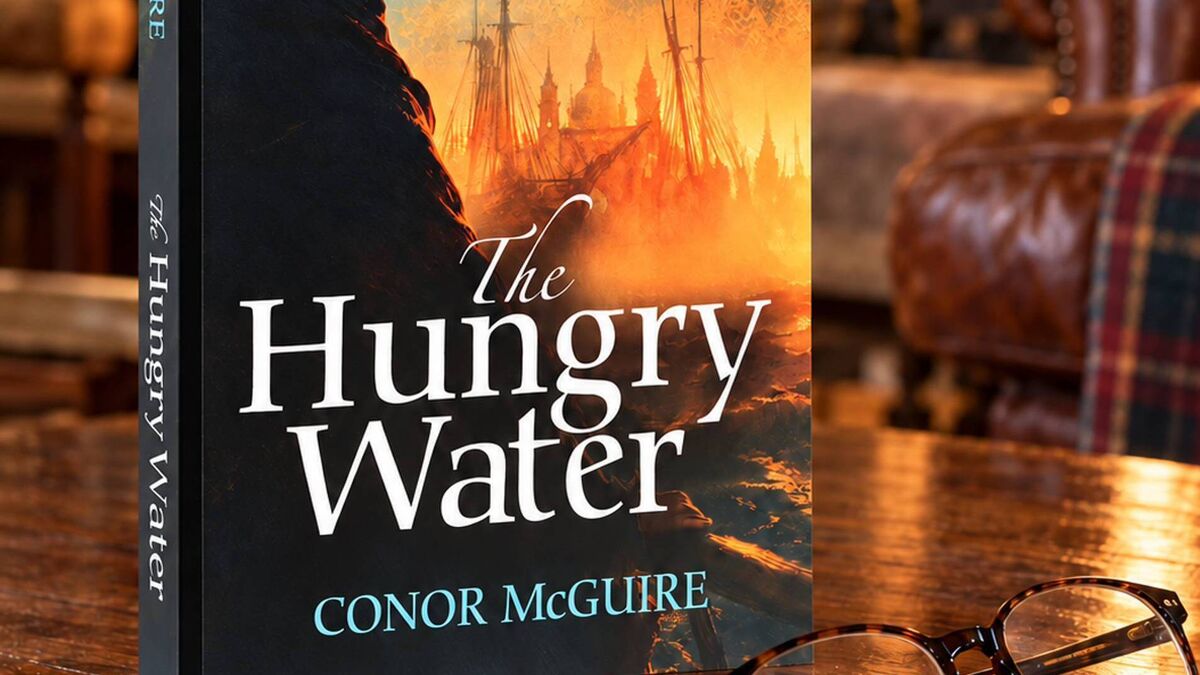
Conor McGuire's new book 'The Hungry Water' will be launched in Ballina next Friday.
My great-great-grandmother was the matron of the Ballina Workhouse. I know that the way you know the date of a battle is as a fact, with nothing inside it. No photograph, naturally. No diary or letter that survived the house clearances of a century and a half. Bridget McLoughlin, workhouse matron, a title and a name, and a building that no one missed when it was demolished in the 1930s. I've built two novels on that association, which tells you something about either writers' imagination or their desperation. I'd rather not say which.
My grandmother remembered a little more than the records would have, had they survived. Her maternal grandmother Bridget was a kind woman, but sad with the memory of the Famine and its aftermath. She remained stoic but deeply pensive in her old age. Doubtless whatever she saw in that building cost her dearly, professionally and emotionally. Ten years ago I went inside her head and drew out her character, in the absence of any ledger. History gave her the keys, the burden, and the right to choose silence. I gave her a voice, reimagining the private moments, the long nights, a memory of tragedy she kept out of sight like a bottle in a drawer. I put her reimagined character in a book called ‘The Hunger House’, and strangers have been reading about her since.
Is that a liberty? Of course it is. Every historical novelist is a grave robber with good manners. We dig up a name, dress it in clothes it never wore and send it out to say things it never said. The civil word is research. The honest one is theft, and I've done it twice now.
The second theft is a girl from the Mullet. She was real too, a servant girl who came in from Erris to Ballina to housekeep for my newly-married grandmother. Sixty-odd miles of bog road to scrub other people's floors. I've walked bits of that road in good boots on a dry summer’s day, and it was invigorating, and I did it on a full stomach. She did it hungry, in whatever sufficed for shoes, towards a job, and that was the lucky version.
One of her sentences came down to me through my grandmother. Standing in Ballina for the first time, Mary said in wonder: "There were an awful lot of towns in it." She thought every street in Ballina was a town in its own right. For the sake of prose, I called her Mary Mahon and invented almost everything else. Her sufferings, her fearlessness, the way she spoke. All mine. If her people are out there, in Erris or in Queens, I owe them an apology or a drink, and possibly both.
Here's the thing about writing about the Famine from a Ballina perspective. You can't get away from it, and nobody realises it. It's under the car parks. It's in the shape of the fields and the gaps in the townlands where the ruined cottages once stood, in the clay pipes and shards of speckled delph that come up with a spade of soil in any back garden. Whole families went on the boat. A whole townland reduced to a verb and a vessel, and no one remembers the boats or the passengers or whether they got over to America alive. My own grandmother got even less. Bridget McLoughlin, who saw more of those years than anyone in the town, refused to speak of that period of rupture at all. So I didn't grow up near that silence. I grew up inside it. The novels are mostly an argument with it.
'The Hunger House' was about the ones who stayed. Bridget stayed, and so did most of them, because staying is what the dying do and what the stubborn do, and the line between the two was thin enough in 1848 to read a newspaper through. Everybody in this town with ancestors three generations deep is descended from the stubborn. It's worth remembering the next time you're held up behind a tractor on the Sligo Road.
The second book was meant to follow swiftly but instead took me ten years. I'd love to say I spent my time drafting manuscripts and carefully crafting paragraphs, but I spent it trying to earn a few bob, painting the Nephin range in oils and filing copy for this paper. In other words, I spent them making a living. And in those ten years the town did the thing the book is about while I watched.
I’d be foolish to pretend that a young man flying from Shannon to Boston with a degree and a phone full of contacts is a predicament comparable to that of a girl from Erris crossing the Atlantic in a filthy coffin ship. It isn't, and anyone who says otherwise has never read a ship's manifest. But the leaving has a shape, and the shape hasn't changed much. The vacant bedroom and empty chair at Christmas and a mother who learns how to work a video call before she's ready to. I knew the second book would be about the emigrant and the foreign shore, and I’m thankful the crossing is no longer a terror.
'The Hungry Water' starts with Mary Mahon on the Liverpool quays, then follows her to New York, where the real girl went. The title comes from something the sea does that the land of 18th-century Mayo never managed. The over-farmed land eventually gave up, as it had nothing left to give, and people starved on it. The water took everything put on it and remained hungry for more. I won't tell you more than that, partly because I'm superstitious about launch weeks and partly because the girl who thought every street was a town deserves to tell it herself, even if I'm the one putting words in her mouth.
It's being launched at the Ballina Library on Pearse Street this coming Friday, October 23rd, at 8pm, Minister Dara Calleary graciously doing the honours. If you're passing, come in. There'll be tea and coffee, and I'll be the one at the back trying to look like he didn't write it.
I keep wondering what Bridget would make of it. She was an educated woman in a county where many country people signed their name with a cross. She tended the dying and nursed children back from starvation for a living, and then she went home and said nothing about it for the rest of her life. She'd have read the book, I think. Then she'd have stuffed it in the range, like my grandmother used to do with the rubbish, stoked it well with a poker, and said nothing before moving the kettle to boil over the warming hob.
She kept her silence for the rest of her days. I've spent ten years breaking it for her. I'd like to think that squares it. It doesn't. But I’ll write the next one anyway.
- 'The Hungry Water' launch takes place at the Ballina Library on Pearse Street this coming Friday, October 23rd, at 8pm.