Ireland's energy debate is collective delusion
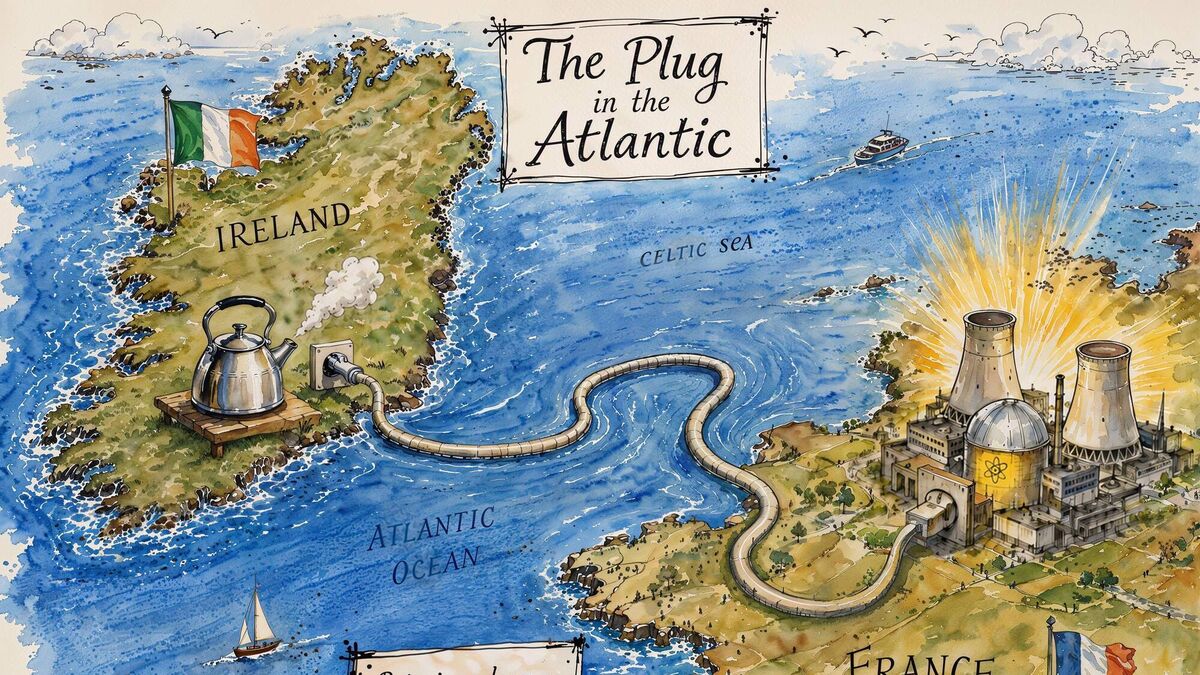
Once the Celtic Interconnector with France is operational, Ireland will be, “to all intents and purposes, importing energy generated through France’s nuclear capacity”, according to Taoiseach Micheál Martin. Illustration: Conor McGuire
There’s a particular Irish talent for moral outrage that conveniently stops at the point where it might cost us something. We can protest anything - a motorway through a bog, a pylon across a view, a wind turbine within eye shot of a heritage cottage - as long as the lights stay on. And they do stay on, don’t they? Every night, without fail. We just prefer not to ask too many questions about who’s keeping them burning.
This made the spectacle in Leinster House earlier this month mildly entertaining. A Fianna Fáil TD, James O’Connor, had the impertinence to introduce a bill proposing we lift Ireland’s ban on nuclear power. The reaction was magnificently excessive in its theatrical fury. Labour leader Ivana Bacik called it a “hare-brained notion" while People Before Profit’s Paul Murphy declared it “absolutely crazy” and the Greens muttered darkly from their political wastelands about Chernobyl shadows. The whole thing had the feel of a parish meeting that’s just been told the priest wants to sell the church car park.
And in the middle of this national hand-wringing, Taoiseach Micheál Martin quietly let slip the detail that will haunt this debate for years. Once the Celtic Interconnector with France is operational, Ireland will be, “to all intents and purposes, importing energy generated through France’s nuclear capacity”. To which Independent TD Ken O’Flynn responded with the kind of line that doesn’t need a speechwriter: “Ireland bans nuclear energy at home while it imports nuclear-generated energy directly from France. That is not climate leadership. That is policy contradiction.”
It’s hard to argue with that. It’s like a man who refuses to touch alcohol on principle, but is perfectly happy to eat the rum cake.
Here’s where we actually stand. Ireland has the highest household electricity prices in the entire European Union - 40.42 cents per kilowatt-hour, nearly 40% above the EU average of 28.96 cents. That adds up to €480 more per year on the average household bill compared to our European neighbours. And it’s getting worse. Irish prices jumped 32.7% between July and December 2025 compared with the same period in 2024. PrepayPower, the first of the suppliers to move, has announced an 8.8% rise in electricity and 10.6% in gas from June 2026, hitting 240,000 households.
So we’re paying the most in Europe. For a country that talks endlessly about fairness and the cost of living, that’s not a footnote, that’s the headline.
Meanwhile, down in Cork, they’re laying cable. The Celtic Interconnector - that €1.6 billion undersea umbilical cord running 575 kilometres from Knockraha to Brittany - is inching its way toward completion, currently expected in 2028 after the usual Irish infrastructure delays. When it does arrive, it will have a transmission capacity of 700 megawatts, enough to cover the demand of 450,000 households. And since over 70% of French electricity is generated from nuclear power, the interconnector is expected to significantly increase Ireland’s access to imported nuclear-generated electricity.
We will essentially be plugged into a French reactor. Quietly. Officially. With EU funding.
But don’t call it nuclear, for God’s sake.
The energy debate in this country has always been conducted in a kind of collective delusion. We’re already partially powered through nuclear stations via the UK interconnector. Ireland has been importing some nuclear-generated electricity through the UK interconnector since 2012 - and nobody picketed that. Nobody demanded we unplug. We just didn’t talk about it, in the same way we don’t talk about where the chicken in the supermarket actually comes from.
And then there are the data centres. Oh, the data centres. They currently account for 21% of Ireland’s total electricity consumption and are expected to consume one-third of the island’s electricity by 2026, with concerns there could be rolling blackouts. The servers of Google, Amazon, Microsoft and the rest hum away in their vast chilled sheds outside Dublin, eating our grid alive, because we decided decades ago that low corporate tax and cheap land were a viable long-term national strategy. In January 2026, Ireland’s electricity demand hit 4,087 gigawatt-hours - a 4.5% increase from January 2025 and the highest January demand ever recorded. People Before Profit’s Paul Murphy even accused the Government of raising the nuclear debate specifically “to avoid having a conversation about data centres”. He might have a point, though it doesn’t make the nuclear question any less real.
Out here in the west, this debate has a particular texture. You look at the ridgeline on any clear morning - and there aren’t many in Mayo - and you see the turbines. The wind is certainly here. God knows it is. And yet the offshore wind farms that were supposed to power us into a green future are now unlikely to deliver before 2031 or 2032 at the earliest, according to senior lecturers in wind energy, and even that is subject to “considerable risk". The Celtic Interconnector was already supposed to have gone live in 2026. It’s been described as “the most important Irish infrastructure project for this decade”. It’s now delayed to Q4 2028 at the earliest.
We’re a country that can’t build anything on time and can’t afford to pay for the electricity we already use.
Aontú leader Peadar Tóibín provided a moment of notable parliamentary honesty by affirming he was open to nuclear energy in principle, but predicted that not a single TD in Leinster House would welcome a reactor in their constituency and wryly including himself in the observation. That’s perhaps is the whole Irish energy policy in one sentence. We want the outcome but not the tainted thing that produces it. We want the lights on without having to acknowledge the lights dark source. We want to feel virtuous while importing the very atoms we’ve banned from our own nuclear free horizons.
Germany, which decided to phase out its use of nuclear energy, now has the second-highest electricity prices in the EU, and there isn’t a German politician alive who’ll admit that was a mistake - at least not publicly. We have the chance right now to avoid repeating their error. Not necessarily by building a reactor next week. The timeline and cost arguments are real. Small modular nuclear reactors offer the prospect of building at a scale more appropriate to Ireland’s size, though this technology is not yet widely available. But we could at least stop pretending the conversation is crazy.
Because the truly crazy thing - the genuinely hare-brained notion - is this: we are paying the highest electricity prices in Europe, we’ve licensed a third of our grid to ever growing data centres, our offshore wind is at least a decade away, our French cable is delayed, and our political and practical answer is to stand in the Dáil and shout “absolutely not” at the only technology that’s already keeping the lights on for half of France.
We’re not anti-nuclear. We’re just anti-honesty.