Ancestry is about more than just a name
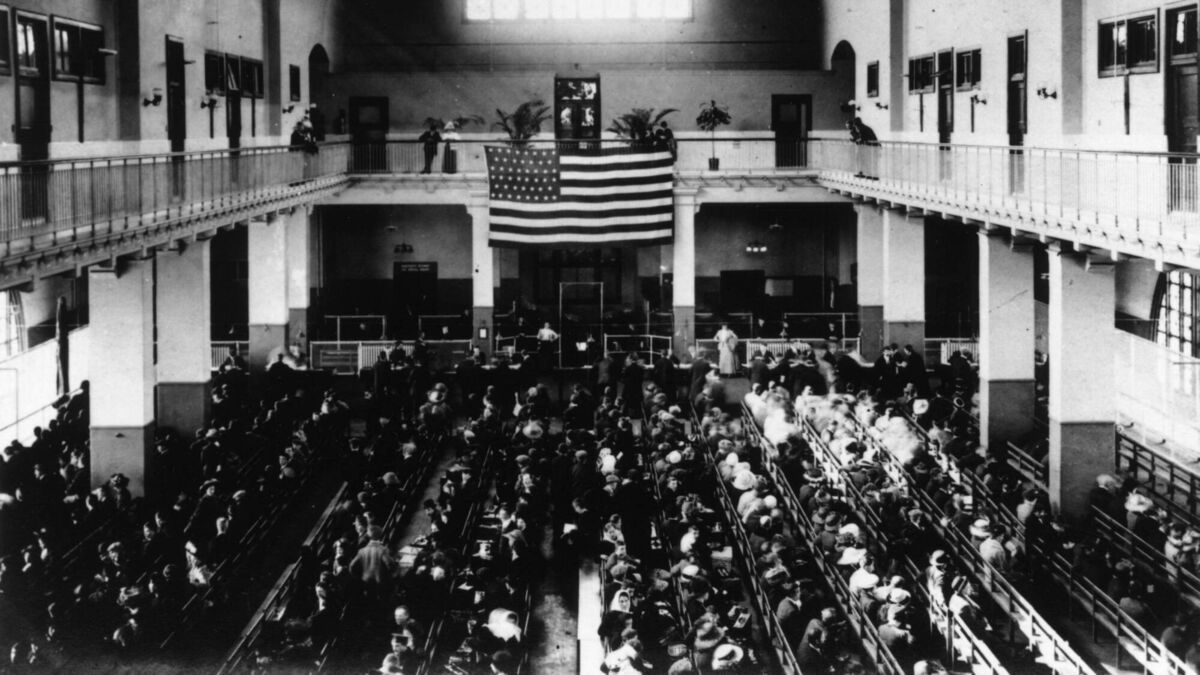
The Registry Hall on Ellis Island, New York, where hundreds of thousands of Irish emigrants were processed on arrival in the United States. Picture: Hulton Archive/Getty Images
I am one-quarter American.
At least, that’s what I occasionally tell people, usually when a pub conversation subsides and I really do not want to discuss the current state of Mayo football again.
The reaction is usually confusion followed by “would ya ever get outa that!” or worse… more Mayo football.
After all, I am from North Mayo. I sound Irish. I look Irish. I can trace my Ballycastle genealogy back generations. Yet my grandfather was born in San Francisco. His parents were naturalised American citizens. Had my great-grandfather made one different decision a century ago, I might today be sitting in Brooklyn explaining to strangers that my ancestors came from the lush potato fields running down to the Céide coast.
During a “team bonding” exercise with my American colleagues, I recently found myself explaining where my ancestors came from (while doing the obligatory slagging-off of Americans) when a friend pulled me up short with “Bro, I am more Irish than you!” and explaining that all their parents and grandparents were born in Ireland. “Sick burn, dude” is the reply I would have said if I were indeed American. Instead, I went with the passive-aggressive muttering of “Fair play to ya”.
Yet, for the first time I realised some of my family were Yanks. Indeed I was part-Yank! That possibility has made me think differently about names, identity and why I am so unable to do a convincing American accent.
My own name tells a story.
I am Liam Alex Heffron, although my birth certificate records me as William Alexander Heffron. I have never gone by William. Like many children born in Ireland during the last half century, My parents called me by my Irish name instead.
That small distinction says something about modern Ireland.
The name Liam would have been relatively unusual in nineteenth-century Mayo as an official name. The old school registers and census returns I spend my days examining are full of Williams, Patricks, Michaels, Jameses, and Johns. Yet by the time I was born, Ireland had experienced a cultural awakening. The Gaelic Revival, independence, the growth of Irish cultural confidence and a renewed interest in Irish identity had all left their mark. Even our names changed and birth certs now reflect the actual names our families and community know us by, not by their anglicised versions.
So William is from my father and Alexander came from my grandfather. In countless Mayo families, names travelled down through the generations like treasured heirlooms.
Heffron tells a different story.
Growing up, many people pronounced it “Heverin”. My Dad’s cousins in Ardagh still spell it that way. As I later discovered through genealogical research, the shift from Heverin to Heffron likely reflects my ancestors’ emigration to the United States where the spelling gradually changed to something more familiar to American ears and then was brought back to Ireland.
In one surname sits a story of migration and adaptation. Names, it turns out, are historical documents. They preserve traces of the journeys that brought us here.
My own family story stretches far beyond Mayo.
In the early years of the twentieth century, my great-grandfather James Heffron left Ballycastle for Pennsylvania. He later returned home, married Margaret McDonnell from a few townlands over, and together they emigrated again a few months after the sinking of the Titanic.
Their original destination was Oregon but instead, once aboard they were persuaded by fellow Ballycastle parishioners to head to San Francisco. They settled in California and my grandfather Alexander was born and christened in the Noe Valley Catholic Church.
The family later moved to New York where three daughters were born and my great-grandfather established a successful chauffeur business. According to family lore, he drove wealthy clients between hotels and railway stations, building a prosperous life for himself and his family.
All things being equal, that might have been the end of the story. My grandfather could have grown up entirely in America. The family might have remained there. I might today be writing this column from New York rather than Mayo. But history often turns on small decisions. Following Irish independence, my great-grandfather decided to come home.
He had made his money. He wanted to raise his family in what my grand-aunt fondly described as “holy Catholic Ireland”. He hoped to buy a shop and a farm in Ballycastle. The shop was secured. The farm was not. Eventually the family settled in Moygownagh instead.
The children, including my American-born grandfather, attended the local primary school and were reportedly teased for their American accents. They were the Moygownagh Yanks.
The rest, as they say, is history. Or perhaps more accurately, it became part of my history and I found myself retracing my great-grandfather’s journey in 2013.
I crossed the Atlantic with the same shipping company (The Cunard Line) as my great-grandparents, following their path through New York and eventually reached California. I found the site of their home (now replaced by a modern development) and the Noe Valley church now catering for a more Hispanic than Irish community.
Along the way, I would tell my fellow travellers of my journey, sharing connections. What struck me most was how often names entered the conversation.
When Americans heard my accent, many would immediately tell me they were Irish. “I’m Murphy.” “I’m McCarthy.” “My grandmother Mary came from Cork.” “My great-grandfather Kelly came from Lacken.” At first, I dismissed their claims of being Irish with a laugh. These people were clearly American.
But gradually I came to understand what they meant. They were not claiming to be Irish like me. They were explaining where their story began. Not explaining what they were but who they were.
In a nation built by immigrants, ancestry forms part of identity.
Americans understand instinctively that people can belong fully to a country while still remembering where their families came from. That insight also made me think differently about Ireland.
From time to time, debates emerge over who is or is not truly Irish. Some people point to passports. Others point to ancestry. Neither answer seems entirely satisfactory.
After all, possessing an Irish passport does not automatically make somebody Irish in any meaningful cultural sense. The Irish government only ended the practice of selling Irish passports to the ultra-wealthy in 1998. Meanwhile American entrepreneur Andrew Henderson encourages the accumulation of passports in his Nomad Capitalist boutique consulting business. I have difficulty accepting any such passport holder as Irish.
Equally, in the era of increasing tensions over immigration, ancestry alone cannot be the whole story. My grandfather was born in America to American citizens. Yet most people would instinctively regard him as Irish (apart from their primary school colleagues). They regard me as Irish. Meanwhile, I have met people born in Ireland to parents from Africa, Eastern Europe or Asia who have spent their entire lives here, attended Irish schools, played Gaelic games, worked in Irish communities and built their futures in this country.
How could they not be Irish when measured by the same yardstick as I am? Why should my name be more Irish than theirs?
The older I get, the more I believe identity is less about paperwork and more about participation. About community. It is about contributing to a place. It is about becoming part of its story.
My wife was born in Ukraine. She later became an Irish citizen. She worked in Ireland, paid taxes in Ireland, built friendships in Ireland and became part of an Irish family. Her heritage remains proudly Ukrainian. That will never change. But that does not make her any less part of modern Ireland.
The same is true for countless others.
People who come to a country, raise families, join communities, contribute to society and invest themselves in the future of that place become part of its story. That is how nations have always evolved.
Perhaps that is the lesson hidden inside a name.
Names tell us where we came from. They reveal migrations, marriages, languages and forgotten journeys. They connect us to places and people long gone. But they do not fully define who we are and nor should they be used to exclude us.
Being Irish (or American) is being accepted as part of the Irish or American community, irrespective of what we look like, sound like or where our family came from.
My name contains echoes of ancestors who left, returned, stayed and travelled again. It tells me where the journey began. It tells me I am one-quarter American.
Still can’t do a passable American accent though.
Before I finish, I must mention that this column is entering its final weeks. It has been a privilege to share these American reflections with readers. If you would like to continue following my writing, research and occasional adventures, please visit me at www.liamheffron.com.