Beermaking has a long and intriguing history
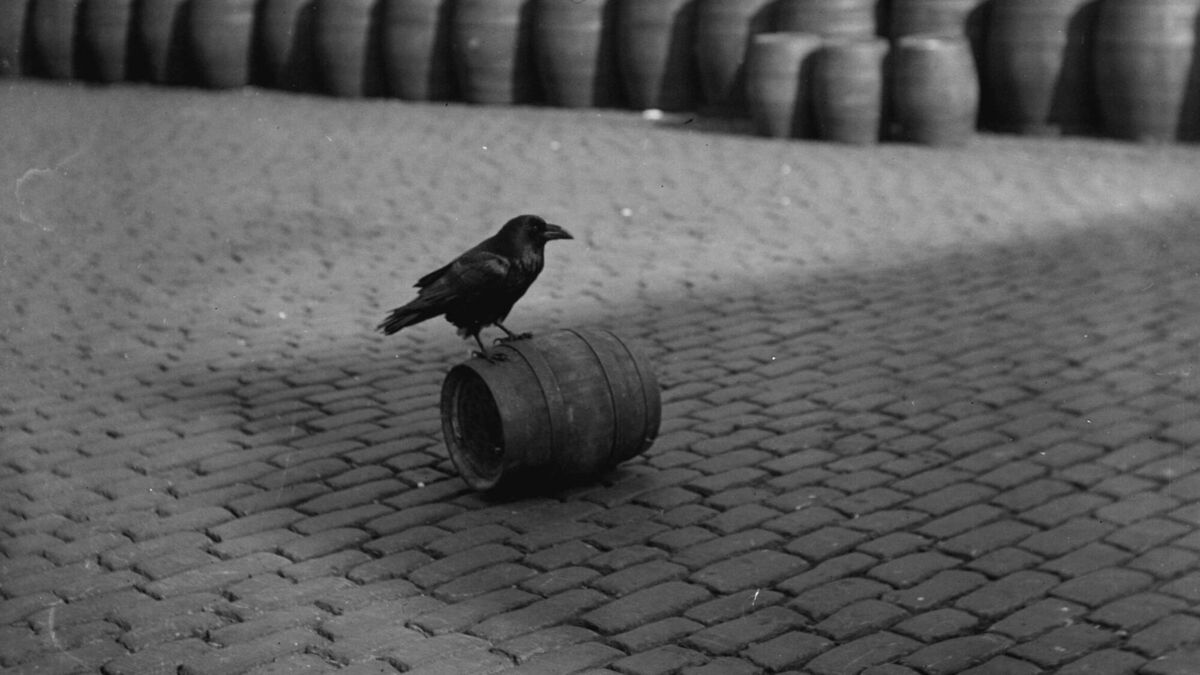
Joey the raven, the mascot of a London brewery, perches on a barrel in the yard in 1934. An ancient superstition holds that the beer would go bad in a brewery without a raven to provide good luck. Picture: Fox Photos/Getty Images
As I get older, I have discovered I like a beer; not too many, just one or two, now and then. A hoppy red is my favourite, but a solid brown ale, unusual enough in Ireland, is best of all. There is something to suit all tastes among the beers currently being produced by the ever-growing craft brewing industry here in Ireland.
This is not a piece about the virtues of beer; it is more a piece about the tradition of beer. Beer is a bit like cheese or bread; there are lots of different types but enjoying it depends on an individual’s taste and the particular company you happen to be in at the time.
Many people who enjoy an occasional beer may never ask the questions, when, where or how brewing beer first began. It’s an interesting story and is one that goes back a very long way.
Brews Cruise, an American tour company, founded in 2006, have spent the past 20 years facilitating visits to the finest craft breweries throughout the world. Their information platform, includes a chronology of beer, from its origins to the present day.
The next civilisation to embrace beer consumption was also from Mesopotamia; the people of the ancient city of Babylon. Babylonians produced over 20 different types of beer around 3,000 BC – that’s over 5,000 years ago. Beer was considered divine in Babylon, a true gift from the gods. The drink was so respected that people were sometimes paid for their work in beer, instead of money. Brews Cruise continues the journey, taking us to ancient Egypt.
Brewing soon made its way from Egypt to Greece but in that ancient place, beer was considered a substandard drink, deemed only fit for the lower classes. The Romans, on the other hand, brewed quite happily and beer became one of the most common drinks throughout their empire – indeed, it is widely believed that it was the Romans that brought beer to Northern Europe.
During the Middle Ages, all over Europe, beer was produced primarily in monasteries. With high nutritional value, beer was the perfect beverage for monks during times of fasting. The beer production also helped the monasteries survive the Dark Ages, allowing them to earn considerable incomes from sales.
Legends of Beer expand on this relationship and the contribution made by monasteries to beermaking over the centuries.
Beer production took a massive leap in standard commercial production when Bavaria instituted the famous Reinheitsgebot (Beer Purity Law) in 1516. Later, the Industrial Revolution shifted beer production from small-scale artisanal crafting to large, steam-powered industrial plants. The first brewery to achieve major global commercial success was the Guinness Brewery at St James's Gate in Dublin. Founded in 1759 by Arthur Guinness, the brewery capitalised on the Industrial Revolution and expanding British Empire to become the largest brewery in the world by the 1880s.
The role of monks in the history of brewing beer over one thousand years is quite significant. Uniquely, they combined brewing techniques with the monastic life of prayer, farm work, and hospitality. Monasteries became repositories of brewing knowledge, where generations of monks could build on the work of their predecessors.
Today, European monasteries continue to brew some of the best beers in the world. A UK Trappist brewery that follows this tradition, and only established in 2018, say they are unable to satisfy demand. The brewery at Mount Saint Bernard Abbey, in Leicestershire, was set up in 2018 after the monastery dairy farm failed to make enough money.
Here in Ireland, St Brigid was said to have the power to miraculously magic up beer as the need arose, while St Patrick reputedly had his own personal priest brew master named Mescan. Later, in the early Irish monasteries, as on the continent, beer was the dominant beverage. Mead, more akin to wine, was also brewed using the honey produced by monastery bees – but that was for Sundays.
Being neither a saint nor a monk myself, I have nonetheless, made my own home brew a few times. The results, while not award-winning, were quite acceptable. In many ways, home-brewing is a throwback to the time of those early Babylonian efforts and later developments in monastic setting. Today it has become more formalised and has grown into a global hobby. Outlawed for generations, homebrewing was legalised in the United Kingdom in 1963. The decades that followed saw the rise of simple malt extract kits which brought the hobby to the masses.
As a task, brewing is a bit like baking bread; making sure to use quality ingredients and adhering to a few basic principles. Homebrewing can be a fun experience and seldom leads to the sticky, sugary, gaseous explosions of myth. Basic raw material, simple equipment and the right atmospheric conditions are all that is needed to create your very own little brewery.
I have often thought, more like fantasised, about starting my own Ox Mountain brewery. Alas, youthful enthusiasm, finance and the essential business acumen are no longer my preserve. Maybe someone else will latch on to the idea - I still believe it is there to be done. I would happily name the various beers and design the labels and help with the tasting. Maybe, if I am to be honest, these were the elements of the venture that most interested me anyway…