The way things were in Kiltimagh in 1975
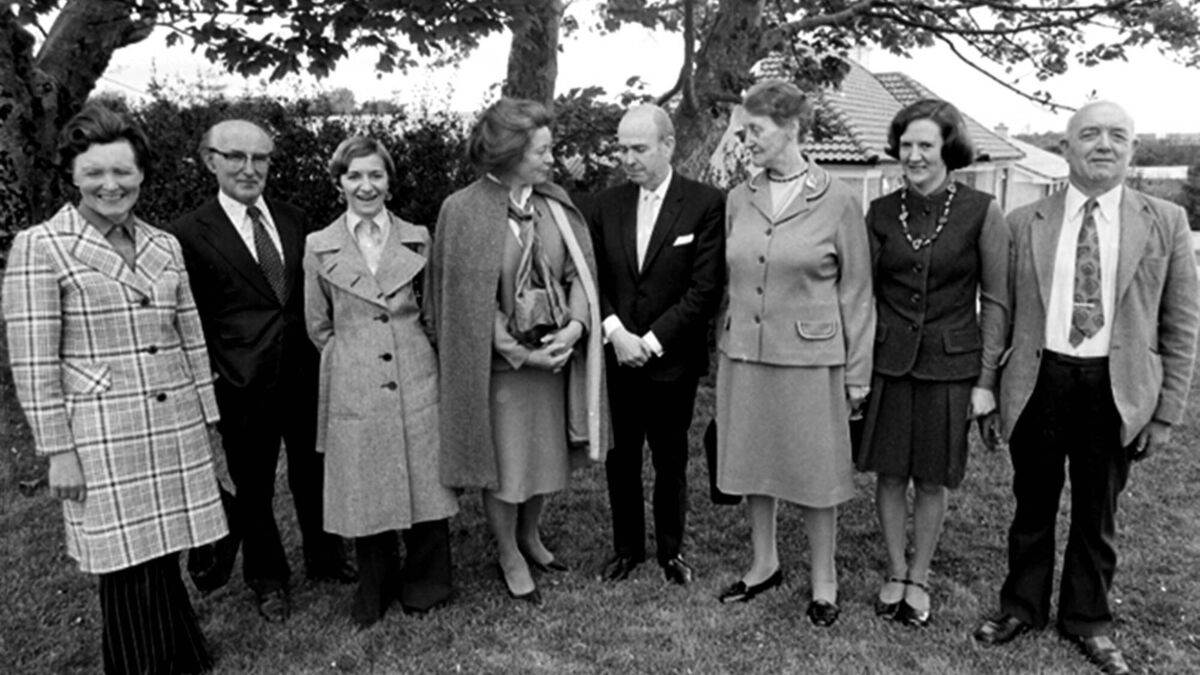
President of Ireland Cearbhall Ó Dálaigh on his visit to Kiltimagh in 1975 for the closing ceremony of Éigse Raifteirí. It was his first official visit to Mayo. He is pictured with members of the Eigse Raifteirí committee, from left: Seosaimhin Ní Donncha, Áine Ní Ceanann, Máire Nic Raibhaigh, Eoghan O'Breithunaigh, Brid Seoighe, Máire Ní Cheallain, Padraic Ó Filain, Martha Ní Ghurran, an t-Athair M. Fionan, CC. Picture: Western People Archives
The famous opening line of L.P. Hartley's 1953 novel, , came to mind when I had a look back to the Kiltimagh News in the Christmas edition of the of 1975. The line suggests that past eras are fundamentally alien, requiring empathy and understanding to grasp their unique perspectives and customs, much like visiting another land.
In particular, 1975 didn’t seem a particularly good one for women’s identity. A glance through a report of an Irish Country Women’s Association meeting held in the town shows that members were known by their married name and the title ‘Mrs'. Mrs X, Mrs Y and Mrs Z all seemed to have lost their own personal identity, including their given name. Only the single ladies retained any of their own identity, being referred to by both their given names and birth surname. I wondered what these women thought of that at the time.
There were job opportunities for women around Kiltimagh in 1975. Irish Spinners Ltd was recruiting ‘young ladies’ to train as twisters and reelers. Applicants had to be 18 years of age, the advertisement said, and obviously female. Presumably 18 was the minimum, rather than the only acceptable age. The wages were £24.78, and the advert said that generous piece-rates were on offer, promising to enable workers to increase this figure after training.
The posts were for a five-day week ‘in excellent working conditions’, commencing at 8.15am and finishing at 5.15pm, with a lunch break from 1 to 2pm. There would be no shift work but there were three weeks’ holidays with pay. Overalls would be provided and the ad also mentioned 'after hours’ recreational facilities', without specifying what these facilities were.
Other ads from the area offered day-old Cobb broilers from Walsh’s Hatcheries. They didn’t say how much they were, but they did provide a phone number so you could ring up.
In the classified ads, under Motors, a 1968 Morris Oxford was for sale, with a Kiltimagh phone number. There were no details provided other than it was ‘in good condition', and the price was £200. The car would make a lot of money if it were in existence today, but any surviving broilers probably wouldn’t.
There were some familiar names from the town elected to various officerships of the East Mayo GAA Board. Jimmy Byrne was elected President, Michael Higgins, Chairman and Tom McNicholas, Honorary Treasurer. John Creighton was elected to the County Activities Committee and Michael Higgins to the County Disciplinary Committee. Thomas McNicholas was elected to the County Appeals Committee.
DJ Curtin from Tralee, and his band, The Kerry Blues, played the Crystal Ballroom in the pre-Christmas dance. DJ had a fabulous voice. He left the Kerry Blues in 1979 to join Brendan Bowyer's Big Eight in Las Vegas, where he now lives.
The Crystal advert also mentioned a ‘£500 Session’ every Sunday night at 9pm. The term ‘session’ had a different meaning in 1975 to what it has today. The description was a coded message to bingo followers to circumvent the strict laws on advertising at the time.
The Raftery Room had no such problems with its advertising. A full programme of entertainment was advertised including performances by The Foxhunters, the Killala Céilí Band and the Moysiders, amongst others.
The lead story was that the Cheshire Home should be completed in March.
At a meeting of the steering committee of the Cheshire Home, held in the Westway Hotel, it was announced that the construction of the Cheshire Home in Bohola, should be completed by the following March and that the home would be fully occupied by early summer.
The meeting decided that an 'Admissions Committee' would be set up to determine the suitability of those applying for admission, and that the County Physician, Dr Con Lucey, an active member of the Steering Committee, would be invited to serve on this committee. It was announced at the meeting that the committee had received a cheque for £17,000 raised in New York by Paul O’Dwyer and the Mayo Foundation. This brought the contribution from New York to £77,000 up to that point.
The committee also said that more money would be urgently needed for the facility, which is located on the site of the original O’Dwyer homestead at Lismirrane, Bohola. It was also stated that the Cheshire Home needed furniture and that an appeal would be made for new or second-hand furniture. Domestic appliances and linen would also be gratefully accepted. It was stated that Cheshire Homes throughout the world were furnished in this manner.
A vote of thanks was passed at the meeting to the Dublin Committee which, under the chairmanship of Dr Margaret Durkan, organised an exceptionally successful fund-raising banquet in the Burlington Hotel in November. The function raised £4,000.
The 'Coillte at Home' dance held in the Crystal Ballroom was also in the news. The dance proved so enjoyable that it was described as “the best ever". The music was supplied by Brose Walsh, while the catering, under the expert supervision of Paddy Walsh, Raftery Room, exceeded all expectations.