Old Moore’s Almanac – predictions, piles and poems
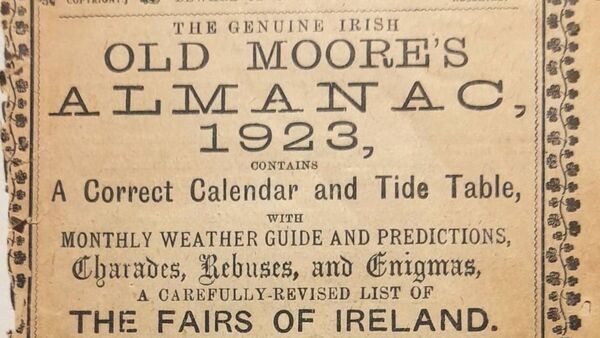
The 1923 edition is a treasure-trove of nostalgic information and an interesting insight into former times - a kind of social history of an Ireland that was very different.
Growing up, there seemed to be a copy of in almost every home. On most kitchen dressers in the Ox Mountains, this essential item was stashed neatly between the mugs and plates for regular consultation.
At this time of year, the was an item on shopping lists that also included Brussels sprouts and fruit for the Christmas cake. My father loved it; he enjoyed leafing through its pages, musing over dates of local fairs and enjoying its poetry section.
The 2026 edition of the says that its origin goes back to over 300 years. It may have taken a few forms over the centuries but, for one reason or another, it has captured people’s imagination ever since.
is an astrological almanac that has been published in Britain since 1697. Originally, it was written and published by Francis Moore (1657-1715), a self-taught physician and astrologer who served at the court of Charles II. This almanac is still published annually by W. Foulsham & Company Limited (UK), giving predictions of weather, politics and sporting events, as well as more conventional data such as tide tables and moon phases. It claims to have predicted the September 11 attacks - I’m not quite sure whether that is a positive or a negative?
It should be pointed out that there are two distinct - one British and one Irish. While both publications are of long-standing, the Irish version only started in 1764, a generation after the birth of its British cousin, and was the brainchild of Theophilus Moore (1730-1809).
John McCall, in his book, (1878), notes that most information on Theophilus Moore is of doubtful authenticity. Some sources suggesting he was an Englishman but, in doing so, were probably confusing him with Francis Moore, mentioned above. Theophilus Moore was, however, Irish, and very likely a descendant of the O'Moore clan of Co Offaly.
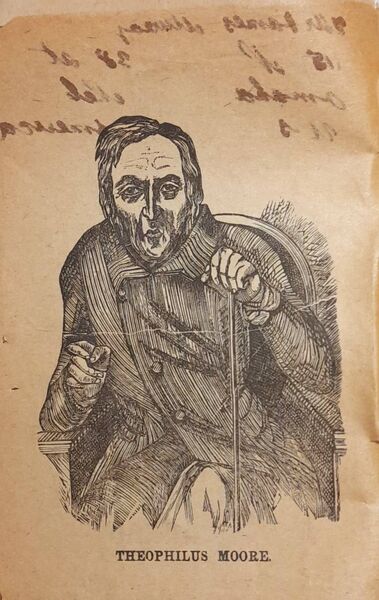
It seems, from its foundation, the Irish version became the almanac of choice for Irish readers and it is this version that I will refer to from now on. An old faded copy of this almanac gives the following version of its origin and its subsequent progress over many years. At the time, they were very proud of their annual circulation of 300,000 copies.
A simple definition of an almanac says that it is an annual calendar containing important dates and statistical information such as astronomical data and tide tables. But that’s not the whole story… and in the case of , more far-reaching content was needed if they were to sell enough copies to make their efforts worthwhile.
So, what might entice the ordinary people of Ireland to buy up a copy of in their local general mercantile and keep it on their dressers for the next 12 months? Back in its heyday, was being presented to a fairly down-trodden readership, most of whom were not that well educated, poorly nourished and in bad health. To hook such people, some wise editor made the decision to offer them all kinds of cures and good fortune. The good fortune was offered freely but advertising the cures and remedies created worthwhile revenue for the publishers and a little hope for the readership. It was all a good example of paper not refusing ink.
Annual editions gave lengthy predictions for each month of the following year, sometimes in great detail, but seldom with any dependable degree of accuracy. Horoscopes were similarly handed out for each star sign and each birthday... and sure everyone has one of those. What down-at-heel cottier would not want to thumb through the pages of a book that promised love, money, and sporting success in equal measure.
A friend recently sent me a copy of the 1923 edition of . It is a treasure-trove of nostalgic information and an interesting insight into former times - a kind of social history of an Ireland that was very different.
At that time, the cures and remedies advertised in the were of considerable interest to people living in poor housing and suffering all manner of ache and pains. Many of these people had just survived the War of Independence and the Civil War that followed. The remedies promised renewed health and increased vigour, and while some of them may have been of value, in hindsight, they are quite comical.
The following is a selection of banner headlines, coaxing readers to respond to various promotional prompts. But don’t get your hopes up; readers should note that all of these ‘cure companies’ no longer exist... and I can’t, for the life of me, imagine why?
The Almanac also provided a platform for poets. Every locality had a poet of renown but very few of them had an outlet for their work. If you could afford the price of a stamp however, there was a good chance that you could have your work published in . Countless respectable rhymers had their verses brought to readers in this way. My research project on Henry L Gavaghan, The Bard of Kilmactigue, undertaken a few years ago, was populated by the many poems that he had published in the pages of the . The criteria for such verses were that they be on a romantic or nationalistic theme - another good selling point in former times.
As I write, I have copies of both the British and the Irish almanacs for 2026 in front of me. I notice there is not a poem to be found in either edition. As for a cure for piles, they are similarly lacking.