The fascinating life of Achonry's patron saint
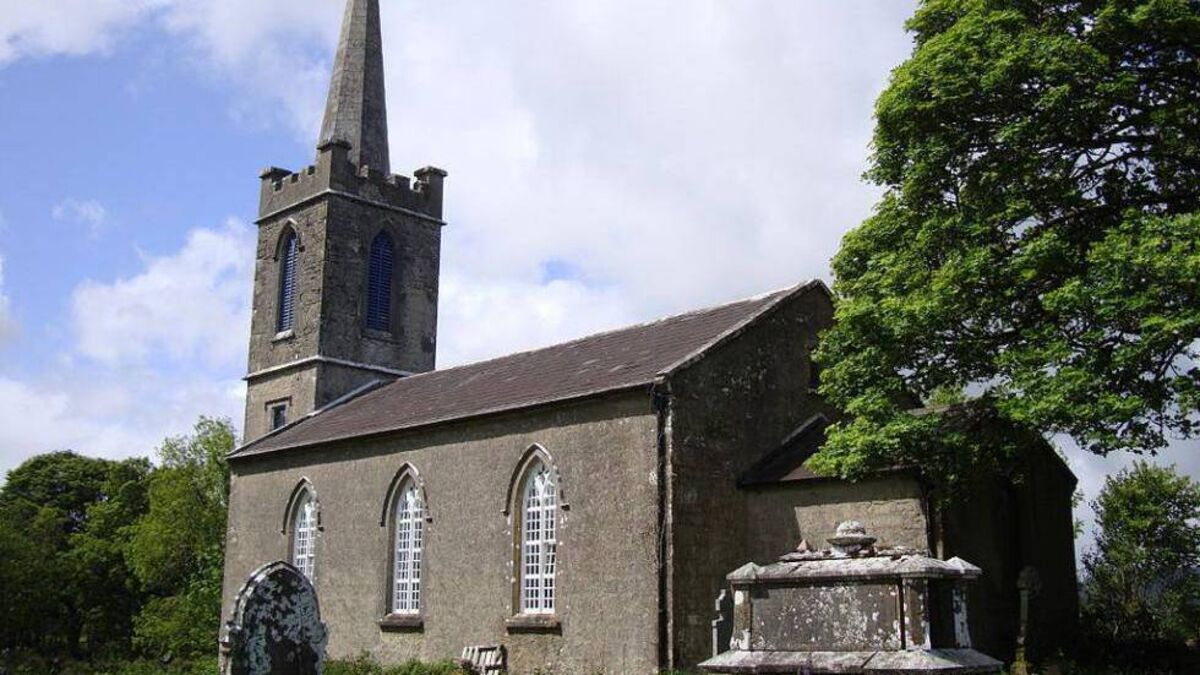
To visit the site of Saint Nathy’s Cathedral at Achonry is to take a step back in time. Picture: Pat McCarrick
Many people around the Ox Mountain region will be familiar with Saints Nathy and Attracta, the patron saints of Achonry Diocese. Saint Attracta was featured in this column a few weeks ago and this week we take a look at Saint Nathy, finding out who he was and why he holds such an important position locally.
While widely associated with a Catholic diocese here in the north west, it might seem unusual to find our first snapshots of Nathy coming from an Anglican parish in the east of the country. The parish of Taney, near Dundrum in Dublin, also has long-standing associations with Nathy or Nahi.
Nathy, Nahi or Crumnathy, was a sixth-century Irish saint of royal blood. He was born at Luíghne (Leyney) in Sligo around 529 AD and became a disciple of Saint Finnian of Clonard, who made him a bishop – or did he?
Leyney is a barony in Co Sligo that corresponds to the ancient túath of Luíghne. Leyney consists of the modern parishes of Achonry, Ballisodare, Kilvarnet, Killoran and Kilmactigue that we are familiar with today.
There is a debate as to whether Nathy was ever a bishop. If he was a bishop, it was more likely an honorary title bestowed upon him because of his renowned learning or holiness. This question arises because it seems he most associated with his duties as abbot, hermit and school head. In addition to this, his geographical area was probably not diocesan, despite his monastery being included in the territory of Achonry diocese, which was the site for his early cathedral.
Omnium Sanctorum Hiberniae (All the Saints of Ireland) is a dedicated website that has been researching and providing information about the Irish saints since 2009. It has a lengthy passage on Nathy, despite little enough being known of his life, and hardly anything of his earlier years.
Saint Finian of Clonard, near the close of life, paid a visit to Connacht for the purpose of spreading the faith locally. When he reached Sligo, he met up with Nathy, “a priest of great perfection, and admirably qualified by learning, prudence, and sanctity, to rule an ecclesiastical community”.
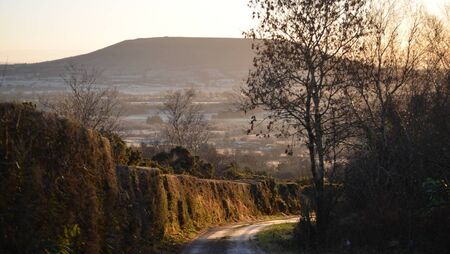
Finian recognised Nathy’s talents and virtues and saw him as an ideal apostle. Together, the holy men went in search of a suitable location for a religious base. In keeping with the religious tastes of that time, they decided that their base should be “pleasantly and picturesquely situated”. Such a spot was found at Achonry, “a stretch of fertile land, lying tranquilly at the foot of Mucklety, not far from the beautiful lake of Templehouse, on a plain of immense extent, bounded and sheltered by the curved and stately mountains of Leitrim, The Ox range, Keash, and the Curlews”.
It was one thing to find a suitable base but it was another matter altogether to get permission from the landowner. The chieftain of the district, who was called Caenfahola (Wolfhead - probably from his “obnoxious manners and belligerent disposition”), hearing that the holy men were on his patch, sought them out and told them to be on their way, as fast as their holy legs could carry them. Not to be undone, the two boys held their ground and made their case “so wonderfully and so effectually” that Wolfhead changed his mind and gifted them the site at Achonry. The following, from the life of Finian, is an account of the transaction that suggests procuring the site at Achonry was a kind of miracle in itself.
A monastery was eventually established and quickly became a school of piety and learning for the surrounding neighbourhood, and “considering the passion that then existed throughout Ireland for science and sanctity, it must soon have been crowded with scholars”. Indeed, legend has it that Nathy taught several eminent persons in this establishment.
It is generally agreed that Nathy lived to a very old age. He must have been about thirty years old in 552, the supposed year of Saint Finian’s death. Nathy seemed to live a long life as he was reputed to have been “about ninety years when he passed to the reward of the just”. He was buried within the precincts of his monastery at Achonry. Through the passage of time, a new cathedral was built over his remains. This new church was dedicated to the saint, and named in his honour, the Church of Crumther Nathy, shortened sometimes into Crumnathy.
That church, or cathedral, still stands to this day. According to local historian, Elaine Conroy: “It is the smallest of the Church of Ireland's cathedrals, with seating for just two hundred and fifty. This simple and unassuming building is hidden away not far from the busy Sligo to Galway road, the N4, close to Tubbercurry.”
This cathedral was built 1822/3 at that time at a cost of £1,066, with a grant from the Board of First Fruits, on the site of the earlier monastic settlement. This cathedral was closed, 1997 and deconsecrated in 1998 and is now disused. According to local information, the traditional pattern day, which is still observed, is held on August 15th. Mercifully, the cathedral is currently set to be preserved, thanks to the efforts of an energetic community group and local fundraising.
To visit the site of Saint Nathy’s Cathedral at Achonry is to take a step back in time. It truly is an old world setting and the legends associated with it are easy to believe.
Among the local places named in his honour - apart from the dioceses itself - are Saint Nathy’s College and Saint Nathy’s Cathedral at Ballaghaderreen and, in a quirky twist with male monasticism, the combined parishes surrounding Achonry is home to a highly successful ladies Gaelic football team that bears the saint’s name. I wonder what Nathy would think of them; to hear of these girls contesting a County Final on a Sunday morning and him trying to say second mass!
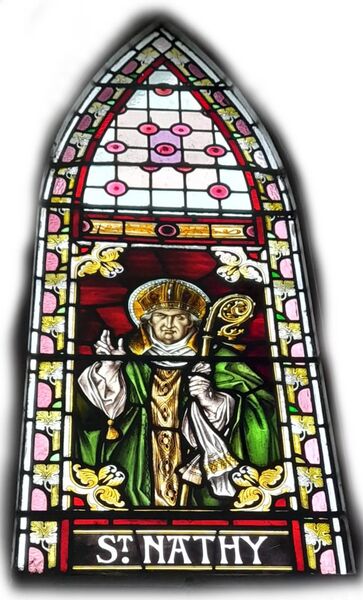
Saint Nathy died in or around 610AD and his feast day is on August 9th. The accompanying image is from a stained-glass window in Saint Michael’s Church in Cloonacool, Co Sligo. The window was put in place by the family of James Sweeney of Cloonacool, who requested those who view the window, and the representation of Saint Nathy, to pray for their father’s soul. I imagine we can do the same on seeing it here.