Local Notes: Ballyhaunis community groups give updates to AGM
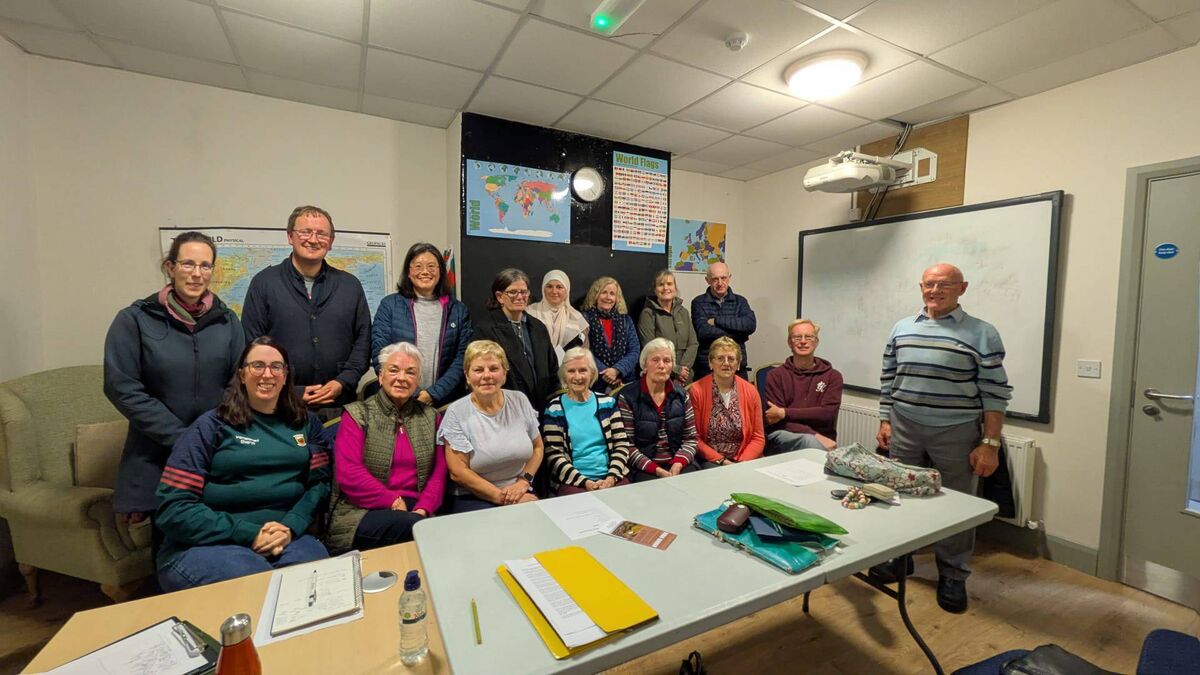
Members of Ballyhaunis Community Council pictured with representatives from the Abbey Trust, Abbey Partnership, Tidy Towns and the Defibrillator Group at the Community Council's recent annual general meeting.
The annual general meeting of Ballyhaunis Community Council heard that the group has borrowings of €90,000 outstanding from the refurbishment of the Community Hall, which was completed three years ago.
A partnership with a philanthropic organisation meanwhile has allowed the Community Council to channel funds to the preservation of St Mary’s Abbey (the Friary) and to community programmes run at the Community Hall, explained secretary Mary Donnelly, who outlined various cultural, heritage and integration programmes run at the hall.
The tenancy of the Brazilian community’s Agape Church in part of the building has helped the financial situation of the Community Council, she added.
Several groups updated the meeting on activities in their specific organisations. A new defibrillator at JG Fitness gym was one of the highlights of the past year for Ballyhaunis Defibrillator Group. Paula Grogan, a representative of the group, described various fundraising activities to update and maintain the defibrillators around the town while also training new members on how to use them.
Meanwhile, work on the Biodiversity Plan launched by Ballyhaunis Tidy Towns has been halted due to the requirement to conduct archaeological surveys on the grounds of the Friary in Ballyhaunis after it was placed on the list managed by the National Monuments Service. Trees planted as part of the plan were removed by Mayo County Council, which has plans to plant them in other locations in the town, according to Ballyhaunis Tidy Towns chairperson Kay Curley in a report to the meeting. She thanked Dawn Meats for sponsoring flower baskets and said the group is currently awaiting the national Tidy Towns results with hopes that the high score for Ballyhaunis in 2025 will be repeated this year.
Speaking as a member of the Abbey Trust, Paul Waldron outlined the various archaeological surveys underway in the Friary grounds which will determine if there are more items of archaeological value in the grounds that must be preserved. He also spoke of how the symposium on the history of the Friary during Heritage Week in August is expected to become an annual event.
The cutting back of an imposing ash tree in the Friary grounds which succumbed to ash dieback disease received much attention on social media but the trimming was necessary and professionally done, according to a spokesperson for the Abbey Trust, the body which holds the Friary property in trust for the community.
“The older or native trees in the Friary grounds have now been tagged and monitored for bats, wildlife and ash die back etcetera,” explained the spokesperson.
The tree tagging forms part of recent monitoring and consultations in the ground as part of the drafting of a master plan for the grounds which are a popular local leisure amenity.
“On consultation because of the tagged tree status the tree was cut back in lieu of removal,” said the spokesperson. “Sadly, it does not look like the tree will make it in the long run as it is too diseased but its value as a habitat for bats, birds and burrowing animals will remain so it should not be removed even if it fully dies in the future.
“This tree has been carefully trimmed by Mayo County Council foresters and not cut down... An identification number, 114, has been attached to it to help the foresters with monitoring it's state. In the trimming they saved some smaller green growth on trunk, but they judged that one large limb had the potential to destroy the already badly damaged trunk as well as an issue of pedestrian safety.”
A €68 increase in the capitation grant paid to primary schools announced in the recent Budget 2027 is insufficient, according to the principals of two primary schools in the East Mayo area who also want action on the pupil-teacher ratio.
Paid per number of pupils in the school, the capitation grant is meant to cover day-to-day operations and maintenance.
“We are eating into other grants to pay basics like oil, electricity bills, bins etc,” said one head teacher, who spoke on condition of anonymity. “As the principal of a rural primary school in the West of Ireland, what I would have liked to see from this Budget is a much greater recognition of the real cost of running a school.
“Heating costs in particular have gone through the roof. In a rural school, especially in an older building, heating is a major expense and there is very little flexibility around it. We cannot simply decide not to heat classrooms during the winter. Children and staff need a warm, safe environment, but energy costs are taking an increasingly large share of already stretched school budgets.
“Capitation needs to reflect those real running costs. Schools should not be constantly trying to make savings on basic essentials or relying on fundraising to bridge gaps in day-to-day expenditure.”
The principal teacher was very disappointed that the Budget made no provision for improving the pupil-teacher ratio, with a recent report published by the OECD emphasising that Ireland has one of the highest ratios of pupils to teachers in Europe.
“Smaller classes give teachers more time with individual pupils and make a real difference, particularly where there are mixed classes or pupils with additional needs. In rural schools, even a small improvement in staffing can have a very positive impact on teaching and learning.”
A principal from another primary school in East Mayo said rising expenses, particularly for fuel, erased any benefit from the Budget.
“The increase from the previous budget has had little impact for schools due to rising costs of fuel, etc. A better funded free book scheme and IT grant would be helpful but a higher rate of capitation is certainly required to keep schools running efficiently on a day to day basis.”
The principal added: “We need enough capitation to heat and maintain our buildings properly. We need a school book grant that genuinely covers the materials children require. We need sustained IT investment so that rural pupils are not left behind digitally. And we need fair pay and conditions for the secretaries and caretakers who are vital to the daily life of our schools. None of these are luxuries. They are the basic requirements of running a modern primary school and giving children the standard of education they deserve.”
The Government’s plan to introduce charges for accommodation in its International Protection Accommodation Service (IPAS) centres are reasonable, according to a resident of the Ballyhaunis IPAS centre.
From South Asia, the IPAS resident agrees with a government plan to introduce charges for IPAS accommodation later this year.
“My wife and I both work full-time, and we now have two children, including a newborn who was born right here in Ireland. Ballyhaunis has genuinely become our home, a place we love and cherish.
“As for the proposed accommodation fees, I fully support this initiative and have no objections whatsoever. In fact, I believe it is completely fair and practical. Since we are both employed and paying taxes, it makes total sense that those who work should contribute to their housing costs, just like anyone else renting a home in Ireland.
“Neither my wife nor I receive financial assistance or benefits from the Government - we are proud to work hard and contribute to the society that welcomed us.”
The IPAS resident was full of praise for Bridgestock, the private firm which owns and runs the centre.
“From the day we arrived, they have treated us with immense warmth, kindness, and hospitality. We have never faced a single issue here…”
Several years in Ballyhaunis waiting on a decision from the Department of Justice on his asylum application, the IPAS resident is hopeful of a positive answer.
“Coming from a country where we faced severe hardship and neglect, being here has been a blessing. My asylum appeal process is currently ongoing, and our greatest hope is that the Government will grant us the opportunity to stay in Ireland permanently. We would be forever grateful to build our future here and continue contributing to this country through our work and taxes.”
Ireland spent over €1.2 billion on IPAS accommodation in 2025 with the average nightly cost of housing each asylum seeker rising from €38 in 2018 to €99 in 2025, according to data published by the Irish Government Economic and Evaluation Service.
Salmon poaching was a feature of rural life in the 1970s and 1980s, leaner economic times when poachers sought to trap the fish as they spawned in the shallower parts of the Dalgan River that flows through Ballyhaunis and southwards towards Galway.
A dramatic drop in the populations of wild salmon in Irish rivers - caused by a combination of river pollution but also warmer water and predation at sea reducing the number of salmon journeying to Irish rivers to spawn - has prompted a public consultation by government on how the stocks can be protected in the future.
Titled ‘Consultation on proposals for the management of Ireland's Wild Atlantic Salmon Fisheries from 2027’, the online survey is available on the website of the Department of Climate, Energy and Environment and is open for four weeks until 5.30pm on Friday, October 30th.
The disappearance of wild salmon from Irish rivers has been dramatic in recent years with numbers of fish migrating back from the marine to spawn dropping from two million in the late 1970s to less than 200,000 currently, according to figures from the Inland Fisheries Ireland whose job is to protect the wild Atlantic salmon, a species so bound up in Irish heritage and lore that it used to appear on our pre-Euro coinage.
Anatoly Nymchuk, who recently departed Ballyhaunis for his home near Kyiv sends the following update on life in a warzone.
"On the day we arrived in Kyiv, the Chancellor of Germany, Friedrich Merz, was visiting the city, and because of his visit, Kyiv was not being bombed.
“Then, the day after his visit, [the Russians] started bombing Kyiv again. They are targeting not only energy infrastructure but also residential buildings. On October 7, a missile hit a residential building in the city of Pryluky, Chernihiv region. Twenty-two people were killed (including five children). They are also targeting schools.
“Furthermore, the air raid siren sounds constantly, and missiles and drones fly over our house. They are being shot down by the air defense systems located near our house, so it is very loud. Many Kyiv residents are leaving the city due to the lack of heat and electricity. And great danger, because people die every day. But despite everything, we are at home.”
A talented violinist, Anatoly had spent four years in Ballyhaunis prior to his return to Ukraine recently.