Reminder of sport’s uneasy dance with politics
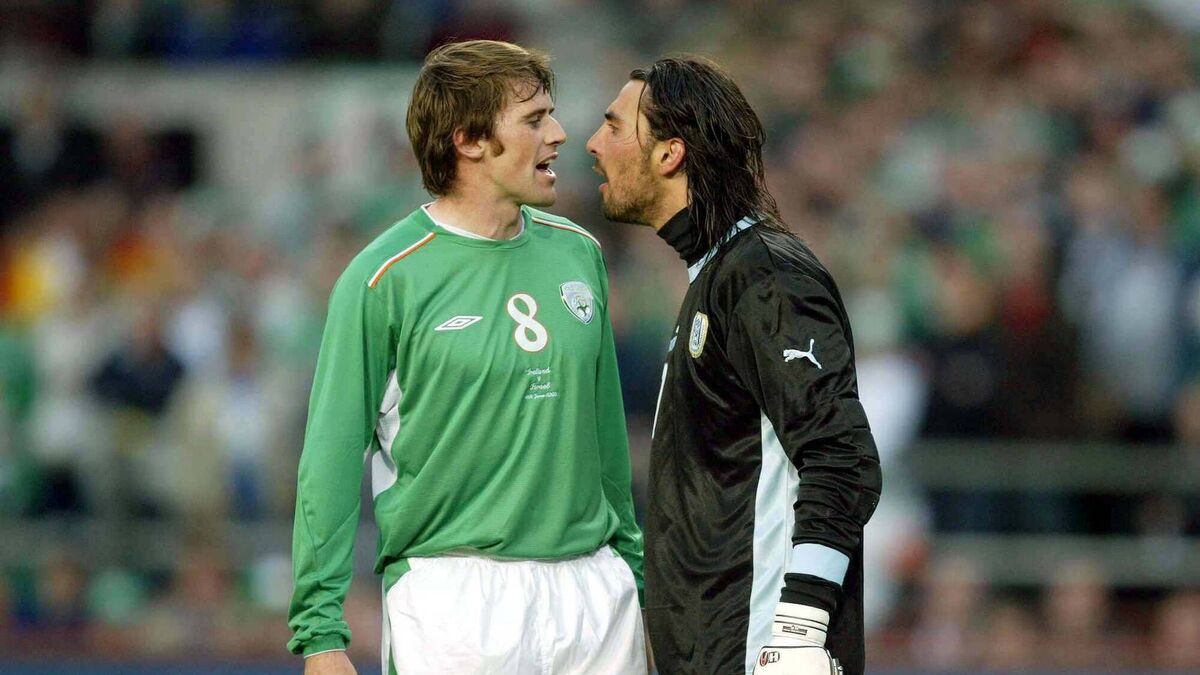
Kevin Kilbane has words with Israeli goalkeeper Dudu Aquate during the Republic of Ireland's World Cup Group Four Qualifier in June 2005. Picture: INPHO/ Donall Farmer
It begins, as these things often do, with a room full of polite applause.
International football draws usually unfold with a reassuring monotony and predictability – polished floors, soft lighting, the gentle choreography of officials who have performed this ceremony too many times to convey even the faintest flicker of surprise. Glass bowls sit waiting on the stage like centrepieces at a corporate wedding. Names of countries rest inside them, folded neatly.
Patrick Vieira, all poise and practised ease, steps forward to play his part. His hand dips into the bowl and a slip is drawn. Cameras lean in like puppies staring in over their food bowls. Most names land softly, greeted by courteous applause and the silent arithmetic of managers already calculating travel schedules and tactical diagrams.
And then a name emerges that feels heavier than paper should.
Israel.
It is only a word, only an opponent, only another fixture in a competition. The room does not erupt – though these rooms never do – but something shifts all the same. Attention tightens. Posture stiffens. And there is a faint recognition that this draw has wandered beyond the comfortable boundaries of the game. Within the hour, the FAI issued a statement. It arrived with careful phrasing, the native language of modern sporting administration. The team, it confirmed, would “fulfil” the fixtures.
The unease surrounding Ireland’s meetings with Israel did not materialise out of thin air. In November of last year, members of the FAI’s General Assembly voted overwhelmingly in favour of submitting a motion to UEFA calling for the suspension of the Israel Football Association from European competition. The motion cited alleged breaches of UEFA statutes, including the organisation of clubs in occupied Palestinian territories without the consent of the Palestinian Football Association, along with concerns regarding the enforcement of anti-racism measures.
This ensured that when the draw unfolded in Brussels, there lingered a quiet, unwelcome suspense – the faint awareness that football, so often a refuge from the world’s troubles, might instead provide a reminder of them.
Sport has always liked to present itself as an escape from politics, a world supposedly governed by rules, results and the comforting arithmetic of league tables.
But politics, drawn by sport’s visibility and its unrivalled capacity for symbolism, has a long and persistent habit of intruding upon this imagined sanctuary. Administrators may speak earnestly of neutrality, yet neutrality in sport has often proved less a condition than an aspiration.
The difficulty for sporting bodies is seldom politics itself. Politics, when predictable and carefully managed, can be accommodated. The greater unease emerges when politics resists choreography. Campaigns can be approved. Messaging can be agreed. Symbolism can be curated. But politics, once it escapes the confines of prepared statements and controlled initiatives, develops a habit of behaving unpredictably and chaotically, surfacing through gestures, protests and interpretations that no governing body can fully script.
Sporting bodies are rarely dragged unwillingly toward politics. Visibility is seductive, after all. Relevance has its attractions. Yet proximity carries its own risks. Like Icarus drifting too confidently towards the sun, institutions often discover that politics, once embraced, can be a perilous relationship.
The NFL, long comfortable with carefully curated symbolism and civic messaging, found itself unsettled when quarterback Colin Kaepernick’s protest introduced a form of politics resistant to institutional choreography. The gesture was simple. The consequences were anything but.
The NBA encountered a similar discomfort when a single tweet transformed years of commercial diplomacy into geopolitical tension. For years, the league had cultivated an image of social awareness and player empowerment, positioning itself comfortably within the language of values, conscience and progressive identity. At the same time, it had woven itself deeply into the Chinese market, a relationship built on enormous audiences, broadcast agreements and commercial partnerships.
The arrangement functioned smoothly. Until it didn’t. A single tweet from Houston Rockets executive Daryl Morey expressing support for protests in Hong Kong triggered an immediate and ferocious backlash. Broadcast partners recoiled. Sponsors wavered. The league, suddenly navigating a geopolitical storm, found itself balancing principles it had publicly embraced against markets it could scarcely afford to alienate.
It was not the presence of politics that proved destabilising. The NBA had long been politically fluent. It was the unpredictability of politics, the speed with which a gesture could reshape an entire institutional landscape. Principles, markets, audiences and governments collided in ways no league office could comfortably manage.
Sporting institutions, it seems, rarely fear politics itself. They fear losing control of politics.
The Republic of Ireland’s forthcoming meetings with Israel sit comfortably within this long and uneasy tradition. Fixtures must be fulfilled. Tables must be completed. Campaigns must proceed.
Yet football is no longer played in isolation from the wider currents that shape public life. Modern sporting occasions carry meanings that extend well beyond formations and tactics. The 90 minutes may still obey the rules of the game. Everything surrounding them rarely does.
There was a time when sport could more convincingly claim to exist at a comfortable remove from the anxieties of politics. Matches were arguments about selection, systems, fitness and form. The boundaries felt clearer then. In an age of relentless visibility however, sporting events rarely unfold in isolation. They are watched, interpreted and repurposed within a landscape shaped as much by politics, identity and symbolism as by results. The pitch remains marked by white lines. The territory surrounding it grows steadily less defined.
Sport will continue to insist upon its separateness from politics, as it has always done. Politics, for its part, will remain irresistibly drawn to sport, as it has always been. Administrators will continue to speak earnestly of neutrality and the orderly conduct of competition.
And the rest of us, no doubt, will continue to act surprised when none of it behaves quite as neatly as imagined.