Profile of club game continues to grow
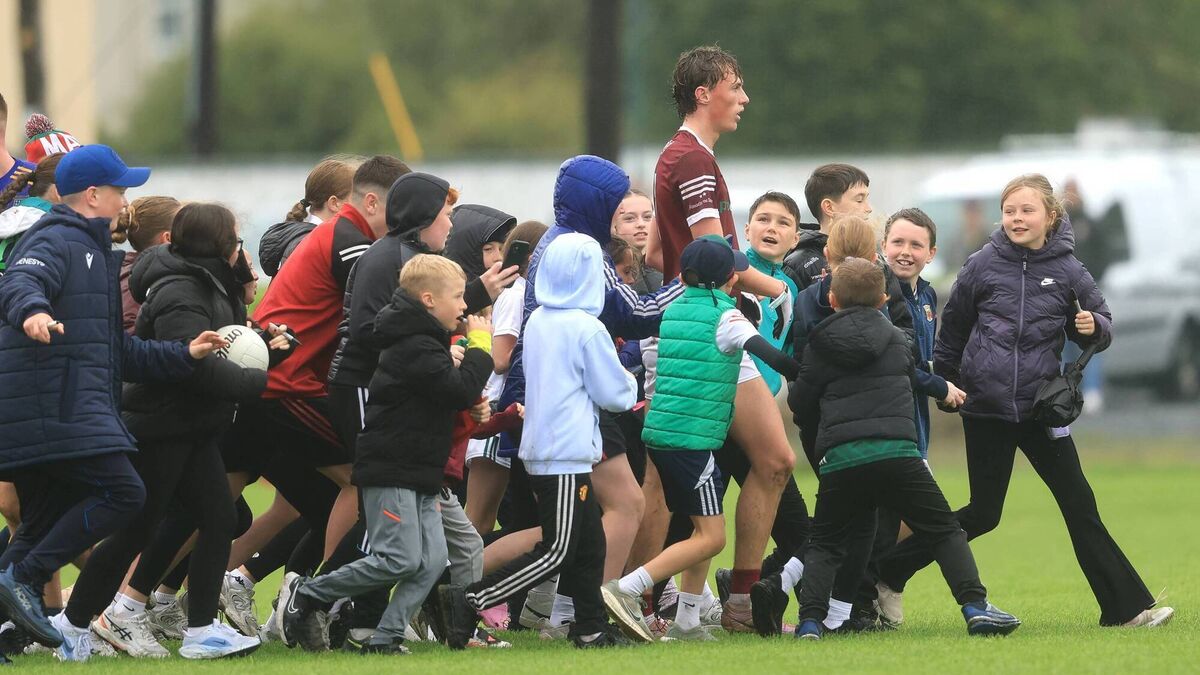
Kobe McDonald with fans after the Connacht Gold Mayo SFC tie between Mayo Gaels and Crossmolina Deel Rovers. Picture: INPHO/Bryan Keane
Of all the fixtures that have taken place over the course of the last few months, few have underlined the brilliance of the club game more than Garrymore’s superb win over Crossmolina on the weekend before last.
It was everything that is good about the GAA; county players giving their all for their local teams in front of a huge crowd, in a ground perfectly suited to create a marvellous atmosphere under lights. The rural location of Garrymore’s pitch added to the novelty for several national journalists who made the long trek to south Mayo to take in what, in some quarters, was billed as Kobe McDonald’s last game for Cross’.
Understandably, there’s a real buzz about the Mayo championship in 2026 and the size of the crowds, the interest in online streaming service and media coverage is reflective of the momentum within Mayo right now.
Andy Moran coming off the bench to help Ballaghderreen to safety last Sunday only added to the magic of it all.
Beyond the home of the All-Ireland champions, the club game is starting to really find its feet in the split-season model, which is now well established after the Covid years.
County championships have been given a greater period in which to breathe and the lack of inter-county action overlapping with that means supporters can fully engage with their club team over a period of a couple of months, instead of being tempted, perhaps, by a big inter-county match on television at the same time.
One of the charges around the split season was that, when it comes to the All Ireland finals, schools and children would miss out on the hype and excitement of their county being in the decider and, of course, the happiness and feel-good factor if you happen to win.
Mayo’s approach to things since winning Sam has been nothing short of remarkable and has certainly put any fears of a July All-Ireland final being a negative; it appears all schools and clubs will get their time with Sam and, by extension, all the young folk across the county and indeed beyond will get to savour the experience.
Another of the criticisms of the split season was that, from a media point of view, the absence of inter-county games on our televisions, radios and in newspapers would have a detrimental effect on participation and interest.
However, the strength of streaming and the use of social media has helped the club game garner a far greater profile in recent seasons from one county to the next.
Indeed, just last weekend,TG4 screened what developed into a cracking Carlow hurling final on Saturday night. In a game that burst into life in the second half, Mount Leinster Rangers produced the stronger finish to get the better of St Mullins. Then, on Sunday, I was fortunate to take in two Kilkenny hurling quarter finals at Nowlan Park, featuring no less than three former All-Ireland senior winning clubs.
Granted, as someone with a sometimes unhealthy interest in Gaelic Games (just ask my other half), I may be an exception to the rule but, in my estimation, given more time and space to prosper, interest in the club game will only grow.
Of course, the standard is improving all the time across clubs in hurling and football as they look to gain that extra edge in achieving ultimate glory.
But, much like the inter-county game, one has to wonder whether it is sustainable.
Jarlath Burns' presidency has been one of the most active of the modern era, with the implementation of the new football rules set to be his greatest legacy having ushered in those changes following Jim Gavin’s work with the FRC.
Burns, too, has been keen to re-emphasise the amateur ethos, especially at inter-county level where costs are becoming eye-watering year-on-year. Naturally, as has been the case over the years, what happens at county level eventually filters down to the club game. And that has become the case with preparation, resources and everything that goes with it.
The demand on club executives to finance their marquee club teams in chasing the dream of a county, provincial or All-Ireland title is surely coming towards a situation where the burden becomes too much.
A shorter season for the inter-county scene has been referenced as a way to cut costs, with defined timeframes on when teams can return to collective training prior to Christmas. Less training means less money when it comes to preparing teams and it’s an understandable logic.
So why not try and apply the same thing for club teams?
One of the notable things about the split season is that, while clubs are now starting their competitive seasons slightly later, club championships are still held mostly in the window they always were from July onwards. August, September and October remain the busiest months.
Yet, the anecdotal evidence would suggest that many clubs are returning to training after a winter break at the same time, usually in January or February. Naturally, the higher up the food chain you go the more that is likely to be demanded of you as a club player.
Shane McGrath, who regularly appears as an analyst on RTÉ Radio, penned a piece earlier this year emphasising the fact that the club season for many players has actually become much longer as a result of the split season.
McGrath’s suggestion of a later start date for a return to collective training for club teams may help alleviate the costs involved at club level, saving players, coaches and administrators a hell of a lot of stress on that front.
Policing it may be difficult - as it is at inter-county level - but implementing a proper off-season for club players could be a starting point in making sure the club game we’re currently all enjoying remains sustainable into the future.