Our hurling promise is a numbers game
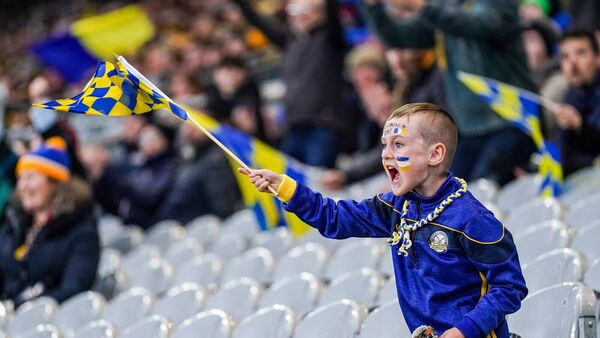
A young Easkey fan celebrates a score during the second-half of his side's AIB GAA All-Ireland Club Junior Hurling Championship Final against Kilbrittain of Cork in Croke Park last Saturday. Picture: INPHO/James Lawlor
There’s little that anyone can say to ease the pain felt by Tooreen and Easkey following their respective All-Ireland club hurling final defeats at Croke Park last weekend.
Both teams can point to how close they came to claiming the ultimate prize and, indeed, point to decisions that might or might not have gone their way that altered the outcome.
Pats on the back for coming close but not quite getting over the line won’t cut the mustard in either club this week – but when viewed through the wider lens of the state of hurling in Connacht, those committed to the small ball game can take great pride in how the two clubs handled themselves against opposition from ‘traditional’ hurling counties on the hallowed turf on Jones’ Road.
Silverware, of course, would help validate the work carried out by both clubs in developing their two teams and Easkey, in particular, can look to a very good age profile when it comes to harbouring realistic aspirations of eventually climbing the Hogan Stand steps in the coming seasons.
But watching the two games unfold last weekend, and with another west of Ireland club, Loughrea, in the senior decider this weekend, underlined the potential of hurling in our region.
In the spring of last year, Connacht GAA launched its hurling development plan. It is focused on the four counties outside of Galway, given the fact that the game is in rude health in the hurling heartlands of south and east Galway, where it stands head and shoulders above virtually all other sports.
The overall vision of the initiative is a desire to ‘maximise each player’s potential by providing the opportunity to play hurling within 20 minutes of their local GAA club’. A number of different actions are spelled out to help achieve this in the coming years.
It’s a very modest but realistic goal which, if realised, will help develop hurling entities across the province and eventually lead to the germination of new clubs to help secure a stronger foothold for the game of hurling in the west of Ireland.
There’s no questioning the fact that above the line from Dublin to Galway remains an area where hurling needs work.
That’s not to be dismissive of the efforts of those involved in the game in the west and north of the island, but the bare facts show that no county side from either Ulster or Connacht, bar Galway, will play for the Liam McCarthy Cup in 2026.
To further emphasise the point, just look at Upperchurch-Drombane, who beat Tooreen in the Intermediate final after extra-time. There was nothing between the sides on the field, yet the environment in which they operate is planets apart.
A quick glance at Upperchurch-Drombane reveals that within 20 minutes of their home ground, up to a dozen other hurling clubs are located in that area which also takes in the spiritual home of hurling of Thurles. Cork’s Kilbrittain, Easkey’s conquerors, play in a club system that has more than 250 clubs dotted across the Rebel county.
In Cork and Tipperary, there are several tiers within the club championships. In Sligo and Mayo, there are only several clubs competing at adult level altogether, though commendable strides are being made to improve that situation.
Of course, comparing the club hurling scene in Sligo and Mayo with that of Cork and Tipperary is unfair in the extreme, but it does show that clubs in this part of the country are capable of competing, despite the obvious limitations. And while the disappointment of the weekend will linger for some time, there are reasons to be hopeful.
The challenge is to ensure that the success enjoyed by the likes of Tooreen and Easkey translates to two things: more vibrant club scenes in both Mayo and Sligo and more competitive inter-county teams, too. Take a look elsewhere at what is possible.
Population has played its part, but Kildare have gotten their act together over the last number of years to the point that their senior hurlers are back in the Leinster Championship this year for the first time in over 20 years. Naas have also become one of the top club sides in Leinster, regularly challenging the best teams in the senior grade having claimed the All-Ireland intermediate hurling title in 2021.
Down are another county with plenty to show for their efforts over recent times. They will play in Division 1B of the National Hurling League this season, having beaten Kildare in last year’s Division Two final.
It may take a little more time, but there’s nothing to suggest that the likes of Mayo and Sligo can’t achieve success on a similar scale in the coming years, especially with two extremely strong club teams plying their trade at a level witnessed in Croke Park last weekend. Should one, or both, finally get over that All-Ireland threshold in the years to come, it’ll only add further belief around what is possible.
Climbing the tiers is achievable as both Mayo and Sligo have managed at other stages over the last decade or so. Solidifying that progress, however, is a challenge because players come and go and the depth isn’t quite there in the club scene, yet, to help sustain a really competitive inter-county panel.
Developing the club game to a greater extent, through the initiative of Connacht GAA, will help stimulate a greater growth of the game at grassroots level if applied correctly across the four counties concerned.
While last weekend proved a disappointing one in many ways, it also shone a light on what’s possible.