O’Connor's greatest gift shouldn’t wither on the vine
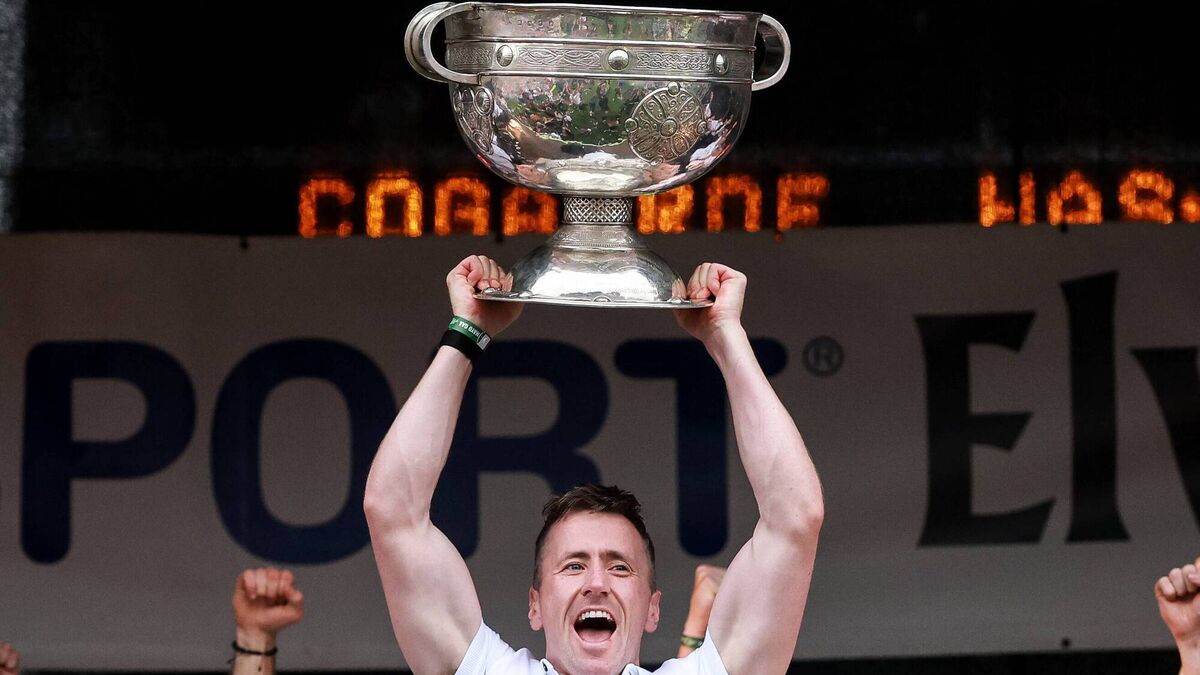
Cillian O'Connor lifts the Sam Maguire Cup at the homecoming of the Mayo team in Hastings Insurance MacHale Park on Monday, July 27. The Ballintubber attacker has announced his decision to retire from inter-county football. Picture: INPHO/James Crombie
Yogi Berra had a complicated relationship with arithmetic: “Baseball is ninety percent mental,” he once declared. “The other half is physical.” But when it came to winning, he was out on his own. The New York Yankees legend collected 13 World Series titles, ten as a player and three as a coach, so whatever difficulties he encountered with numbers, he had a fairly sound grasp of the things that mattered. And his philosophy travels rather well. Swap the baseball bat for a football, the diamond for a pitch, and the principle remains much the same. Speed and strength will only take you so far. The best players possess something less conspicuous, an ability to see what others cannot, to anticipate rather than react, to be two thoughts ahead while everyone else is still figuring out their first.
Few understand that particular art better than Cillian O'Connor. Throughout his Mayo career, he made a habit of knowing where to be, when to move and, perhaps most importantly, when to do neither. There were bigger and quicker forwards, but O'Connor had the rather irritating knack of arriving in the right place before faster men had worked out where they were supposed to be. He didn't always need to outrun an opponent. More often than not, he only had to out-think him.
That intelligence was evident almost from the moment the Ballintubber man arrived on the senior intercounty scene in 2011. Still a teenager, he possessed the instincts of a seasoned veteran, an ability to read situations and recognise possibilities that escaped more experienced heads. In the All-Ireland semi-final against Kerry, he produced a goal that offered one of the earliest glimpses of the remarkable footballing brain Mayo would come to rely upon for the next decade and a half.
Kerry were beginning to stretch out their lead when Andy Moran's shot was brilliantly saved by Brendan Kealy. The ball skittered towards the end line, apparently destined for beyond the whitewash. O'Connor had other ideas. He chased down the lost cause, gathered possession and found Paul Galvin covering a narrow angle between himself and the uprights. A little feint sent Galvin in the wrong direction. Then, almost casually, he made his way along the end line, invited Killian Young to commit, shimmied past him and buried the ball in the net.
The remarkable thing was the absence of any great urgency in his movements. No blistering acceleration. No dramatic change of pace. Just a teenager outsmarting two seasoned Kerry players without ever appearing to break out of second gear. While everyone else was operating at championship speed, O'Connor seemed to have found a way of bending time to his will.
The statistics will naturally dominate the tributes to O'Connor's career, and rightly so. He remains the highest scorer in championship history, after all. But numbers can be remarkably poor at explaining the man behind them. They tell you what happened, not necessarily how it kept happening.
For the remarkable thing about O'Connor wasn't that he could produce an exceptional performance. Plenty of forwards manage one of those. It was the regularity with which he delivered, year after year, against defenders who knew precisely what he was capable of and still found themselves powerless to prevent it.
Managers came and went, systems changed and Mayo continued their long-standing experiment on the psychological limits of the human nervous system. Through it all, O'Connor remained reassuringly constant.
There was an almost unreasonable dependability about him. While others enjoyed their occasional afternoon of brilliance, he turned excellence into a weekly obligation. And perhaps that's the surest indication of a rare sporting mind. The truly gifted don't merely produce moments of genius. They find a way of making them routine.
Modern Gaelic football has developed a formidable appetite for figures. Players are timed, tested, weighed and wired up. None of this is to sneer at sports science. Footballers are fitter, stronger and better prepared than ever, and much of that progress has been earned through painstaking work away from the pitch.
But there is a danger in assuming that what can be measured must also be what matters most. A defender can be beaten by a feint just as much as by a sprint. A scoring chance can be created by a moment's patience, a glance over the shoulder or the recognition that the obvious option is precisely the one the opposition is expecting.
These are the subtleties that separate the truly gifted footballers from the merely athletic. They don't register on a GPS vest, seldom feature in a post-match statistical breakdown and are unlikely to excite the strength and conditioning department. Yet they can be the difference between a player who covers an enormous amount of ground and one who actually gets somewhere.
Football intelligence needn't be some mysterious gift bestowed upon a fortunate few. Much of it can be learned, provided someone knows how to teach it. Young forwards can be shown how to read a defender's body language, recognise a developing opportunity or understand why the run they didn't make might be every bit as important as the one they did. These are skills acquired through observation, experience and the occasional painful lesson. And they deserve as much attention on the training ground as another dozen repetitions of a shooting drill.
Which brings us back to O'Connor. Fifteen years of intercounty football amounts to a formidable education, particularly when much of it was spent being pursued by some of the most accomplished defenders in the country. He learned what worked, what didn't and the small adjustments that could turn an apparently hopeless position into a scoring opportunity.
There are plenty of coaches capable of teaching a youngster how to kick a ball over the bar. Finding someone who can explain how to manufacture the opportunity in the first place is a rather different proposition. And Mayo have just watched one of the finest exponents of that particular craft walk away from the intercounty game.
O'Connor has earned the right to decide what comes next without anyone waving a bainisteoir or maor uisce bib in his direction. But it would be a shame if that accumulated knowledge were allowed to disappear from Mayo football. Whether through coaching, mentoring or simply spending time with the next generation of forwards, there is surely a role for a man who spent the best part of his adult life making the complicated look remarkably simple.
It needn't involve a seat on the senior management team or a grand title to accompany it. Sometimes the most valuable lessons are passed on during a quiet conversation on the training ground, a few words about positioning, a demonstration of how to deceive a defender or an explanation of why the obvious option isn't always the right one.
O'Connor has given Mayo enough goals and points to fill several careers, but the most valuable contribution he could make to the county might yet be something that never appears on a scoreboard.
The physical half has concluded. Mayo would be foolish to let the other ninety percent go with it.