Four stories converge on one prize
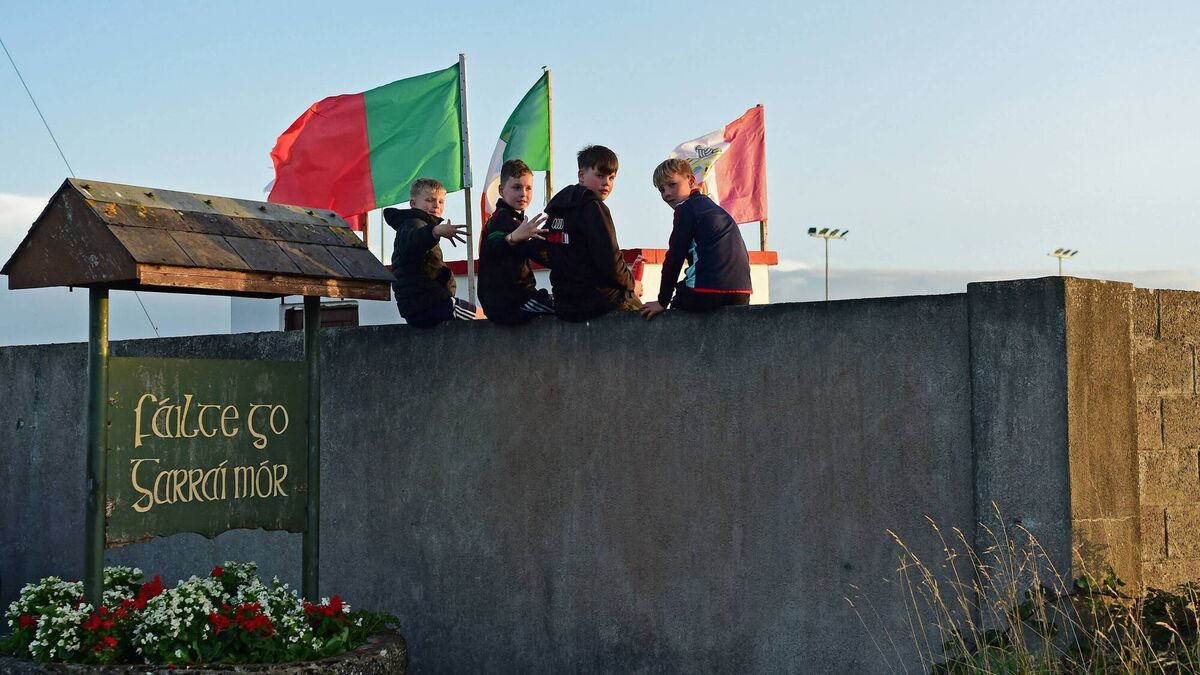
A group of four young Garrymore fans enjoy their vantage point for their club's victory over Crossmolina Deel Rovers in the Connacht Gold Mayo SFC quarter-finals last Saturday evening. Picture: Conor McKeown
There comes a point in every county championship when clubs become exposed.
The soft draws and the comforting talk about building through the group stages evaporates. What remains is colder and cleaner: four clubs, two semi-finals and the knowledge that one good afternoon can change the way a season – or a generation – is remembered.
Castlebar Mitchels are there, which surprises nobody. Garrymore are there, which awakens older memories. Breaffy are there again, carrying the weight of all the times they have reached this point and gone further without ever finishing the job. And Belmullet are there too, looking towards a prize that has never yet made the long journey home with them.
It is a curious final four because each club arrives with a different sense of what the next fortnight might mean.
Castlebar have history stacked around them in such quantities that expectation becomes part of the furniture. Garrymore have history of a different kind, belonging to an age that survives now in old photographs, familiar surnames and stories improved slightly with every telling. Breaffy have accumulated near-misses until they have become their own sort of tradition. Belmullet carry none of that particular baggage but are still chasing the dangerous thrill of the first title That is the beauty of this year’s Moclair Cup. It may be one trophy, but it never represents the same thing twice.
Castlebar Mitchels are the easy choice for anybody searching for a villain.
People may disagree on whether they would rather see Garrymore roll back the years, Breaffy finally break the habit of heartbreak or Belmullet carry the cup west for the first time. But another Castlebar win doesn't carry a whole pile of romance.
And yet, it has been nine years since Mitchels last lifted the Moclair Cup and beat Ballintubber in the 2017 final. Nine years is not an eternity in most clubs. In Castlebar, it can start to feel like one. They have been away from the throne long enough for the upholstery to gather dust, but not long enough for anybody else to feel comfortable sitting in it.
What has not changed much is the strength of the squad. As in 2017, there is intercounty quality scattered everywhere from different points on the career curve. Some have been around long enough to understand exactly what county championship football asks of you. Others are still arriving, carrying the legs and fearlessness of youth. Put them together and Castlebar has the sort of blend every club wants and very few can actually assemble.
That is why, for all the instinctive opposition to them, there is also an inconvenient truth.
If Mayo club football is to end its famine beyond the county boundary, Castlebar will believe they are the side best equipped to do it. They have the squad. They have the history. They have the experience. They have the youth.
And perhaps most importantly, they have the institutional memory of what it looks like when a Mayo club expects to be playing deep into winter rather than merely hoping to.
That is what makes Mitchels dangerous again. They are not trying to discover how to become a serious club. They are trying to remember how to become a winning one.
Meanwhile, for years, Garrymore have been described in the language reserved for clubs people admire without ever quite fearing.
Plucky. Resilient. Punching above their weight.
All true, perhaps. But you suspect those compliments didn’t always land well within the South Mayo club.
Because there is something faintly patronising in forever being told how well you are doing merely to survive. Garrymore are a small rural club operating in an age when demographics are supposed to be destiny, when young people leave, parish numbers shrink and the old footballing certainties are slowly eroded by economics, geography and the pull of bigger towns.
And yet here they are.
Not clinging on. Not making up the numbers. Not receiving polite applause for staying senior.
For much of the last decade, Garrymore was viewed as the sort of side capable of making life deeply unpleasant for somebody else – awkward and organised and proud. This was the team nobody fancied playing, but few genuinely fancied to win the title.
That has changed.
By the usual arithmetic, they should be running out of footballers. They are now at the front of the championship picture on merit, driven not by some final stand from an ageing generation but by young players coming through and putting paid to the idea that rural depopulation must inevitably mean sporting decline. Quite what their secret is remains difficult to pin down.
Every small club likes to talk about culture, tradition, volunteerism, identity and all the usual ingredients thrown into the pot. Garrymore appears to have added something else entirely.
Whatever the secret is, it’s guarded more closely than a Swiss bank vault.
Back in West Mayo, Breaffy have been trying to get over the line for well over a decade. For years, the question was when rather than if. They had the players, the pedigree, the big days behind them and the sort of generation that seemed destined eventually to force the door open. But seasons passed, chances went and gradually the conversation changed. The golden generation had peaked. The window had narrowed. Maybe the moment had gone.
Somebody then started lowering the curtain, but Breaffy has spent the year tugging it back Still moving. Still winning. Still finding a way to make people reconsider conclusions they had already filed away – perhaps not too dissimilar to the way in which a certain county team defied the odds earlier this year.
Breaffy’s season has carried a little of that wider Mayo stubbornness: the refusal to disappear merely because everybody else has decided the story should be over. They have been motoring along quietly all year, without the noise that usually gathers around them. Perhaps that has suited them.
If they were finally to lift the Moclair Cup, there would be something fitting about the timing. Not at the height of the hype, not when everyone expected it, but after the supposed golden age had begun to fade and the wider county had spent a year making a habit of ripping up its own obituaries.
And then there is Belmullet.
There is still a charge around the town from what happened in the summer, from those electric scenes when the Sam Maguire was carried out onto the peninsula and the whole thing seemed, for a few hours at least, to belong to them. You get the sense that some of that energy has never quite left.
Maybe that is why Belmullet feels capable of almost anything.
They are one of those clubs that seem to exist slightly beyond the usual rules, a wild outpost at the edge of Europe where the road gets narrower, the Atlantic gets louder and football takes on a different sort of meaning. They thrive on unpredictability.
You are never entirely sure what Belmullet will produce, only that they are rarely dull. There is something romantic about that, though it is difficult to define without ruining it. They carry the sense that a game might suddenly turn strange, that a moment might appear from nowhere, that the thing everyone thought was supposed to happen might not happen at all.
In that way, they are probably a small reflection of Mayo football itself.
That gives their run a different sort of electricity. There are no old Moclair teams to imitate, no established routes to follow. If Belmullet were to go all the way, they would have to invent the story themselves.
Three games remain, and nobody really knows what shape they will take.
The final chapter of Mayo football in 2026 looks set to live up to everything that has gone before.