Camogie's big day after year of drama
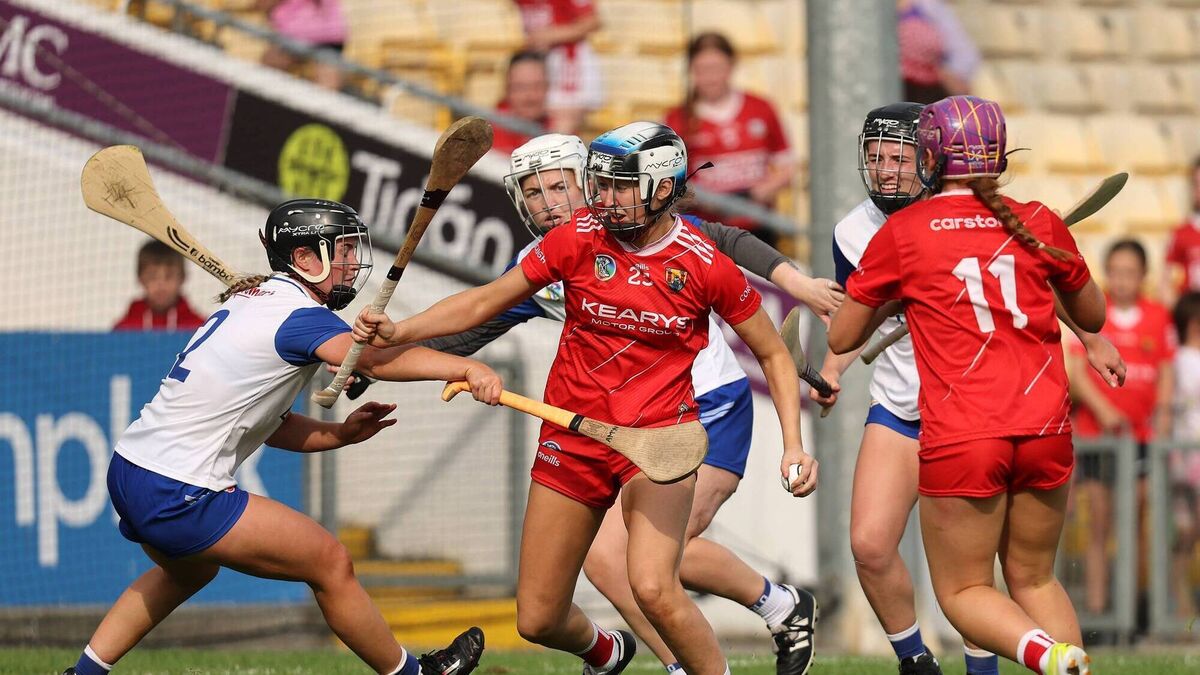
Cork's Orlaith Mullins on her way too scoring a goal during the All-Ireland semi-final against Waterford. Picture: INPHO/Bryan Keane
Some seven years ago, a groundbreaking initiative aimed at increasing for a twenty percent increase in participation, attendance and coverage of women’s sport by the year 2020.
Backed by some major brands, such as KPMG and AIG, the campaign 20x20, spearheaded by Sarah Colgan, Heather Thornton and agency ‘Along Came a Spider’ was a success.
Since that effort, women’s sport has become much more prominent in the national psyche. The Republic of Ireland reaching the 2023 World Cup was a major milestone for many reasons, not least raising the profile of the game here, and the rugby team at the World Cup this autumn is another positive.
Visibility is important, and all media organisations have upped their coverage of women’s sport. The recent European Championships, broadcast in full on RTÉ, helped bring a major tournament to a wider audience even if the Girls in Green weren’t part of the action in Switzerland.
Ladies football has also enjoyed a productive spell, with the arrival of the Meath team on the senior stage at national level helping generate a huge amount of publicity. Their back-to-back All-Ireland successes in 2021 and 2022 captured the imagination of the wider public and we were afforded the opportunity to see the likes of Vikki Wall and Emma Duggan deliver the goods at Croke Park and other venues through the superb coverage of TG4.
Attendances at the ladies football finals have always been a major talking point and, somewhat erroneously in many cases, the crowd at the All-Ireland final is often taken as a barometer of the health of the general game across the country.
The high watermark of recent times was the 2019 decider between Dublin and Galway, which reached the 56-thousand mark. Last year, though, the finals only attracted some 30-thousand spectators as Kerry got the better of Galway at Croke Park. On Sunday last, 48-thousand watched on as the Dubs got the better of Meath in impressive fashion.
The level of attendance is a particularly pertinent point this week as we prepare for the final GAA inter-county action of the season with the Camogie finals at GAA HQ this Sunday.
From a long way out, the Camogie Association has targeted improved attendances at its marquee fixtures, with a stated aim of reaching the 50-thousand mark next year.
Having marked 120 years since its foundation last year, the Camogie Association produced a report early in 2024 examining the areas in which it can improve and taking the general temperature of where the sport stands in the overall scheme of things in a modern Ireland.
Among the other aims, as well as the size of the crowd on All-Ireland final day, were growing membership by ten percent over a three-year period and improving development and educational programmes for coaches, referees and volunteers.
The Camogie fraternity arrive at their marquee day in the calendar after a year in which the sport shot to prominence when the skorts controversy reached fever pitch earlier on this year.
The issue was eventually dealt with when a Special Congress voted in a landslide to allow players the option to wear shorts or skorts, but the entire saga brought about a real sense of unease amongst many. The cancellation of the Munster final between Cork and Waterford in the middle of it all was one of the low points.
It was a difficult time for the association’s administrators, but they can also now try and use that as a positive as they look to generate more interest in the game.
Indeed, after the vote in late May, Camogie Association President Brian Molloy said at the end of his statement that, as the the All-Ireland Championships began around that time, he asked ‘everyone to support their teams, drive higher attendances at all upcoming games, and help us fill Croke Park for the finals on 10 August.” The aim of having a large crowd at the finals day is a fair goal to have, but ultimately growing the game beyond that at grassroots level, especially in the regions where camogie is close to non-existent, has to be the main target. Working as part of the Hurling Development Committee to work in conjunction with the other stakeholders will be helpful in helping achieve on that front.
On the subject of the actual games this weekend, there’s a real interest to matters at Croke Park as Cork, aiming for their first three in a row of senior titles at senior level for 50 years, are seeking to get past Galway in a repeat of last year’s decider.
Cork’s squad is littered with quality. The Mackey sisters, Ashling Thompson, Laura Hayes and Amy O’Connor are just some of the stars within Ger Manley’s ranks and, when they’re on song, there’s no team in the country able to live with them.
They huffed and puffed for a while against Waterford in their semi-final as they struggled to open up the Deise's defensive system in the opening half, but there was always a sense that Cork had a couple of extra gears to click through. And they duly did.
Galway will arrive in Croke Park this weekend desperate to claim some silverware. They've endured a torrid time at the final hurdle of late, losing last year's league and All-Ireland finals and also losing this year's league final, too.
That was to Cork in Thurles earlier this year, where the gulf between the sides was just about reflected in the 21 points to ten final scoreline.
However, their semi-final display against Tipperary gives reason for optimism. Niamh Mallon may have crashed home their goal in a seven-point win, but the victory found built on the efficiency of their outstanding full-back line composed of Dervla Higgins, Shauna Healy and Roisin Black.
That gives rise to the potential for a fascinating battle against the inside line of Cork on Sunday, where the game may well be won or lost.