All-Ireland Final countdown: Every rebellion needs a roll of the dice
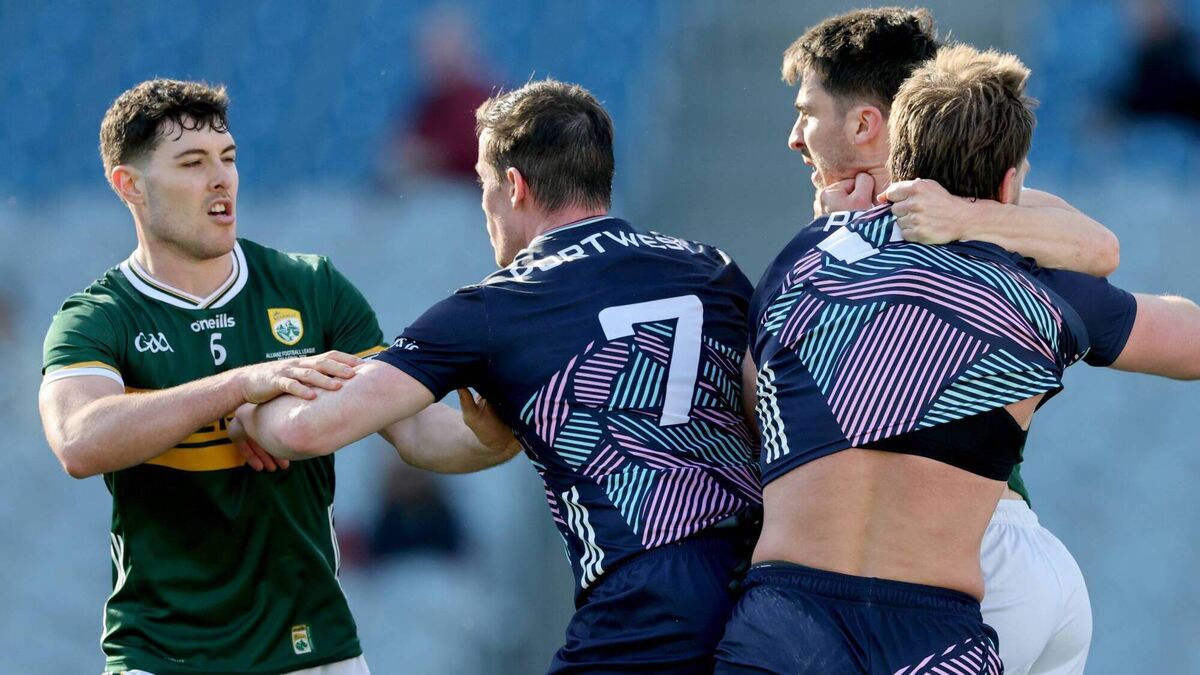
Kerry’s Mike Breen and Brian Ó Beaglaoich in a confrontation with Stephen Coen and Aidan O'Shea of Mayo during the 2025 Allianz Football League Division 1 Final in Croke Park. Picture: INPHO/James Crombie
Thrum.
Thrum.
Thrum.
Every kingdom hears the drums.
At first they are little more than an echo beyond the hills, carried on a wind that has witnessed a hundred failed rebellions before. Then come the banners, bright with youthful certainty, followed by armies convinced that history has finally chosen their side. They march believing they will be the ones to prise the crown from ageing hands, to tear down walls that have stood for generations. Most never make it beyond the gates. Some rattle them for a while before disappearing into the margins of history. Only the rarest leave scars.
That is the peculiar thing about kingdoms. They are not held together by stone alone. They are stitched together by memory, fortified by tradition and guarded by something far more elusive than battlements. Call it aura. Call it certainty. Call it the quiet confidence that comes from generations raised not on dreams of one day wearing the crown, but on the expectation that it was never truly theirs to lose.
And Gaelic football has always had a kingdom of its own.
Kerry did not become the Kingdom because geography christened them so. They became the Kingdom because, for over a century, they have made the extraordinary seem ordinary. Another All-Ireland in Kerry would probably cause less fuss than a delayed ferry in Tarbert. Great teams have risen around them, burned brightly for a handful of summers and disappeared into sepia-tinted photographs. Kerry has simply endured, each generation inheriting not the burden of making history, but the responsibility of continuing it.
That continuity always comes at someone else's expense. And no county has left deeper scars on Mayo than Kerry.
They have been waiting at the end of too many roads. Maurice Fitzgerald's virtuoso performance in 1997. The procession of 2004. A final in 2006 that had all the suspense of a coronation after a frantic opening quarter. League finals that reopened old wounds. Even an infamous semi-final in Limerick that is only spoken of in hushed tones within the county.
Kerry have never been Mayo's greatest rivals. Galway, Roscommon and Dublin would all lay stronger claim to that title. Rivalries suggest an exchange of blows. This has more often resembled an encounter with the established order. Whenever Mayo have reached for football's highest ground, Kerry have frequently been the county waiting there first. And yet the remarkable thing about Mayo has never been the defeats. It has been their refusal to let them become an ending. If hope was a renewable energy, Mayo would be powering half of Europe and the Strait of Hormuz would be as placid as Lough Conn on a Tuesday afternoon.
The danger for every dynasty, however, lies in believing the next challenger will resemble the last. This Mayo team doesn't.
Thrum.
Thrum.
Thrum.
The first quarter may tell us almost everything we need to know on Sunday.
Kerry have vivid memories of their finals against Mayo at the beginning of the century. Those afternoons have lingered because they reinforced an old belief: if Kerry establish their rhythm early enough, they become almost impossible to disrupt.
Mayo's first task, therefore, is not to build a lead. It is to destroy that rhythm. They must convince Kerry that this is not another final unfolding to a familiar script. Every breaking ball won around the middle, every hard-earned turnover, every purposeful attack must carry the same message: this will be uncomfortable. And that is where the game may ultimately be won or lost.
Kerry's greatest advantage lies not inside the full-forward line but sixty yards further back. Should they command midfield, David and Paudie Clifford will receive the quality of possession they require to dictate another final. Mayo's own dangerous attack, meanwhile, risks becoming an audience to the contest rather than participants in it. Andy Moran will know this better than anyone.
But if there has been one defining characteristic of his first season, it has been an unwillingness to mistake problems for permanent truths. Roscommon exposed Mayo's midfield mercilessly in the Connacht Championship. Rather than stubbornly sticking to their methods, Moran and Paddy Tally went looking for new approaches. Week by week, the middle third has become less a weakness than a work in progress.
It would be no surprise if Sunday brings another calculated gamble. Kobe McDonald has shown enough, both with his club and in flashes for Mayo, to suggest he could have a greater influence around the middle third. To date, he has been deployed primarily as an attacking weapon, his pace and eye for goal offering Mayo a different dimension close to the posts. Yet in fleeting moments, he has shown another quality altogether. He attacks high ball with an instinctive confidence and has the athleticism to turn claimed possession into attacking momentum. Perhaps the time has come to ask more of him around the middle third.
Mayo can afford to entertain that thought in a way they perhaps couldn't have a few years ago. With Darragh Beirne, Ryan O'Donoghue and others capable of carrying the scoring burden, moving McDonald further from goal no longer feels like weakening one line so much as strengthening another. And unlike his father, whose influence was often felt closer to goal, there are shades of Michael Donnellan in the way McDonald can gather possession in the middle of the field before driving relentlessly at retreating defences.
It would be a bold call, perhaps even an unexpected one. But then Mayo's championship has been built on recognising that yesterday's solutions are not always tomorrow's. Finals rarely reward caution alone. They tend to favour the manager prepared to ask a question the opposition had not spent the week preparing to answer.
Finals have never been especially fond of the timid anyway. The difficulty, of course, is recognising where courage ends and recklessness begins. For finals can also have a habit of making fools of the brave.
The Kingdom has heard these drums before. It has watched ambitious challengers emerge over the decades, convinced that this would be their moment, only to disappear as another Kerry team climbed the steps of the Hogan Stand. That is the privilege of dynasties. They measure time in titles rather than seasons.
Mayo have always measured it differently.
In memories. In near misses. In generations that refused to allow heartbreak to become surrender. Every rebellion reaches a moment when history no longer matters.
On Sunday, Kerry will attempt to prove that the walls are as formidable as they have always appeared. Mayo will arrive believing, as every rebellion must, that this time they have found the weakness.
The drums are now sounding again.
Now we discover whether they were simply another echo in the distance – or the sound of history finally arriving at the gates.
Thrum.
Thrum.
Thrum.