Young Irish no longer look overseas for validation
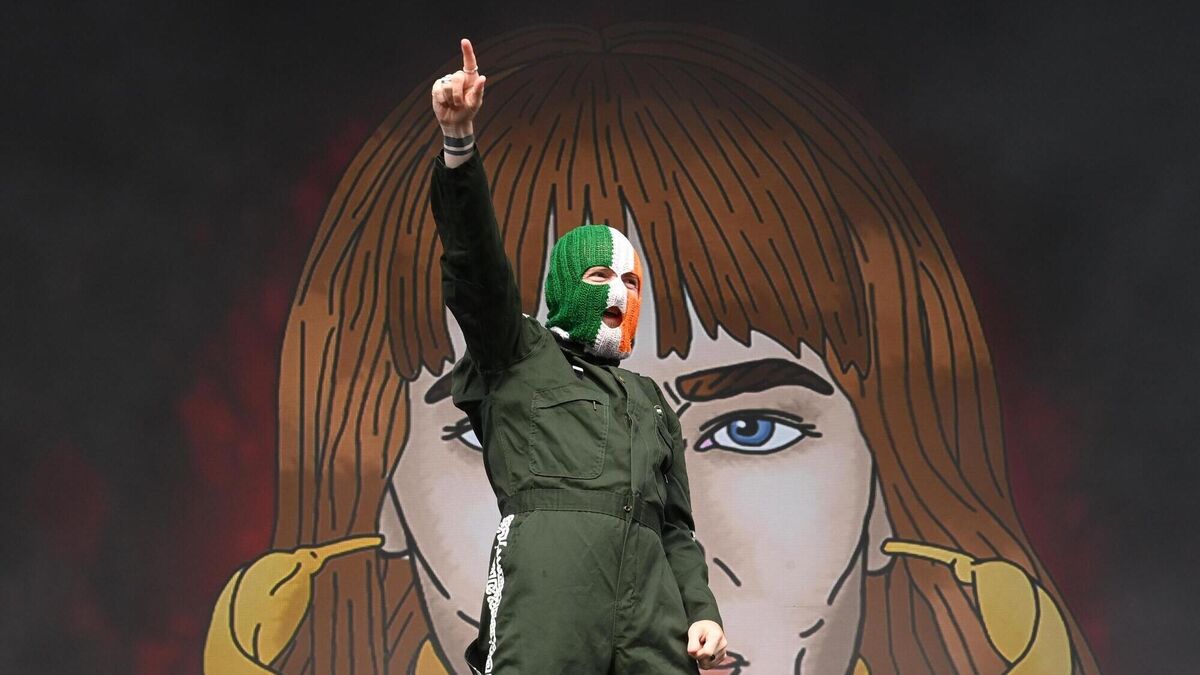
DJ Próvaí of Kneecap performing on the main stage at Electric Picnic last year. Picture: Larry Cummins
Historians have an unfortunate habit of reading too much into things, and in this regard I am particularly unfortunate as I find myself perched at the cliff-edge of conspiracy theories far too often for comfort. Or indeed my wife’s comfort.
I see significance where others see coincidence in patterns, where sensible people simply shrug and get on with their day. Sometimes this is useful. Other times it merely confirms that I spend far too much time on YouTube.
So, it is no surprise that a photo shared in the Los Angeles Irish Community WhatsApp group earlier this week sent me down a rabbit hole of reflection.
The photo, perceptively taken by Nikki Malloch, showed the wall beneath the iconic Glendale-Hyperion Bridge in Atwater Village, a neighbourhood close to our apartment. Across the wall, painted in bright red letters, were three unmistakable Irish words:
Now, finding evidence of the Irish language in L.A. is unexpected but hardly surreal. There are enough of us scattered across California to ensure that traces of home occasionally appear in unusual places. Yet there was something about seeing this distinctly Irish republican phrase of 'Our Day Will Come' beneath a cloudless Californian sky that paused my scrolling.
Perhaps it is because we are leaving after several years here. We are not necessarily leaving the United States, but our time in this city is over and there is something about leaving a place that changes the way you see it.
Suddenly Glendale acquires significance. The Ralph’s store around the corner acquires an affection it never previously possessed. The Reelarc film studio lingers in my thoughts. The Glendale primary school intercom still echoes its exhortations of kids to do unfun things. I miss the cute library a block over. Even the L.A. traffic becomes strangely sentimental.
Well, perhaps not the traffic. Still, you begin to notice things. And lately I have found myself thinking a great deal about the future. Not simply our own future, but the future in general. Because the older I get, the more I think there is a real difference between hope and faith. I realise that I, finally, thankfully, have no hope. I agree with the deeply philosophical actor Jim Carrey, to believe in “Not religion, but faith. Not hope, but faith”.
Hope is wishing things might improve but faith is behaving as though they will. Hope is regret projected forward and is aspirational, uncertain. Faith is a foundational way of living. Perhaps foundational way of living.
This distinction occupied thinkers such as St Augustine and Søren Kierkegaard long before I arrived at it from a piece of graffiti on a Los Angeles wall. But it seems to me that faith has always been one of the defining characteristics of emigrants even as few leave home with certainty.
Irish emigrants who boarded a ship or a plane did so without guarantees. Yet, they left family, friends and familiar landscapes behind because they believed something better lay ahead. Faith brought them across oceans. It sustained them when things went wrong. It convinced them that the sacrifices would eventually mean something. It is why the world’s restless, ambitious or oppressed have long sought out the 'American Dream'.
The United States is built upon that same faith in “American Exceptionalism”, epitomised by the exhortations of John F Kennedy and Ronald Reagan to be that “City upon the Hill”, acting as a beacon for the rest of the world. That stubborn determination has always been one of the things I have admired about its history.
Nowadays, this same country appears lost, conflicted and in turmoil. The political movements that dominate headlines seem increasingly unsatisfying. Anti-intellectual MAGA and populist Trumpism inspire fierce loyalty among some and fierce opposition among others. Progressive activism transformed many institutions but now Woke culture faces growing resistance from those fatigued of divisive, identity politics. The political centre of conservative Democrats and 'soft Republicans' appears exhausted and uninspiring - unable or unwilling to provide strong leaders.
The political writer Martin Gurri argues in that the internet shattered trust in many traditional institutions without creating convincing replacements. The result is a society that often knows what it dislikes but struggles to articulate what it wants. Speak to enough Americans and you quickly discover that most accept that “the system” isn’t working, but nobody seems entirely certain what social, political or economic structures should replace it.
“The old world is dying, and the new world struggles to be born: now is the time of monsters” is a line attributed to the former Italian Communist party leader Antonio Gramsci. Whether or not he actually said it exactly, I suspect many Americans would recognise that feeling attributed to the political philosopher. Perhaps many Irish people would too.
Housing shortages, rising costs, political frustration, technological revolutions and social division are hardly unique to the United States. Around the world, needless wars rage, migrations induce panic and protest, while wealth inequality escalates and the world burns with environmental destruction and climate change. AI fear-mongering is rapidly reaching Skynet levels of doom-laden prophecy even as it takes over our digital lives.
Writers such as Neil Howe and William Strauss in argue that societies periodically pass through moments of upheaval before new arrangements emerge. We see some American intellectuals such as Ezra Klein and Derek Thompson, in their own book , suggest that the challenge facing modern societies is less about ideology and more about rediscovering the ability to actually build things again such as homes, infrastructure, institutions and opportunities. Maybe it is about practical ideas over policy and ideals, but the underlying question remains the same. What comes next?
That, I suspect, is why those words beneath the Hyperion Bridge stayed with me. I have no idea who painted those words. I do not know whether they intended a political statement, a cultural statement or simply an act of bored mischief. Yet the phrase stays with me. Perhaps because, for all the uncertainty I encounter in America, I find myself feeling surprisingly optimistic about Ireland.
It sounds strange even to my own ears. I grew up understanding that we lagged both Britain and America on every front. Yet today, as increasing numbers move to Ireland from America and fewer Irish feel compelled to leave, it seems that our island is beginning to light a beacon of its own.
Over the past decade I have noticed a growing cultural confidence, particularly among younger generations. They seem less burdened by the Catholic inferiority complex and post-colonial mentalities that haunted earlier eras. Caring less of what others think of them, they embrace Irish language, music, storytelling and history with a confidence that feels fresh and authentic rather than nostalgic.
They are not turning their backs on the wider world. Quite the opposite. They appear comfortable being both Irish and global, rooted and outward-looking at the same time.
You can see it in music. In film. In literature. In comedy. In sport. In the growing interest in local history, genealogy and place. You can hear it in conversations that would have been far less common when I was younger. You even hear it in Los Angeles itself. Conversations in Irish that would once have seemed improbable now take place in cafés, parks and community gatherings thousands of miles from home. When I attended a cinema screening of Kneecap at the Glendale Americana, I was struck by how many of the voices around me were American. Here they were, awe-struck, watching a rebellious, counter-cultural film in the Irish language, about modern Ireland. Twenty years ago, that would have been unimaginable.
For generations, Irish people often looked elsewhere for validation. London. New York. Boston. Somewhere beyond our shores. Increasingly, I sense a generation that is content to start from Ireland itself.
Perhaps that is what I saw beneath the Hyperion Bridge. Not a hopeful slogan from the past, but a glimpse of a future still struggling to emerge; a future built not on certainty, but on confidence. Not on grievance, but on culture, community and belonging. On faith that 'Our day will come'.
Before I finish, I must mention that this column is entering its final weeks. It has been a privilege to share these American reflections with readers of the . If you would like to continue following my writing, research and occasional adventures, please visit me at www.liamheffron.com, where the conversation will continue after this column reaches its final full stop at the end of June.
For now, thank you for reading.
Tiocfaidh Ár Lá.