Who would envy Pope Leo his life's work?
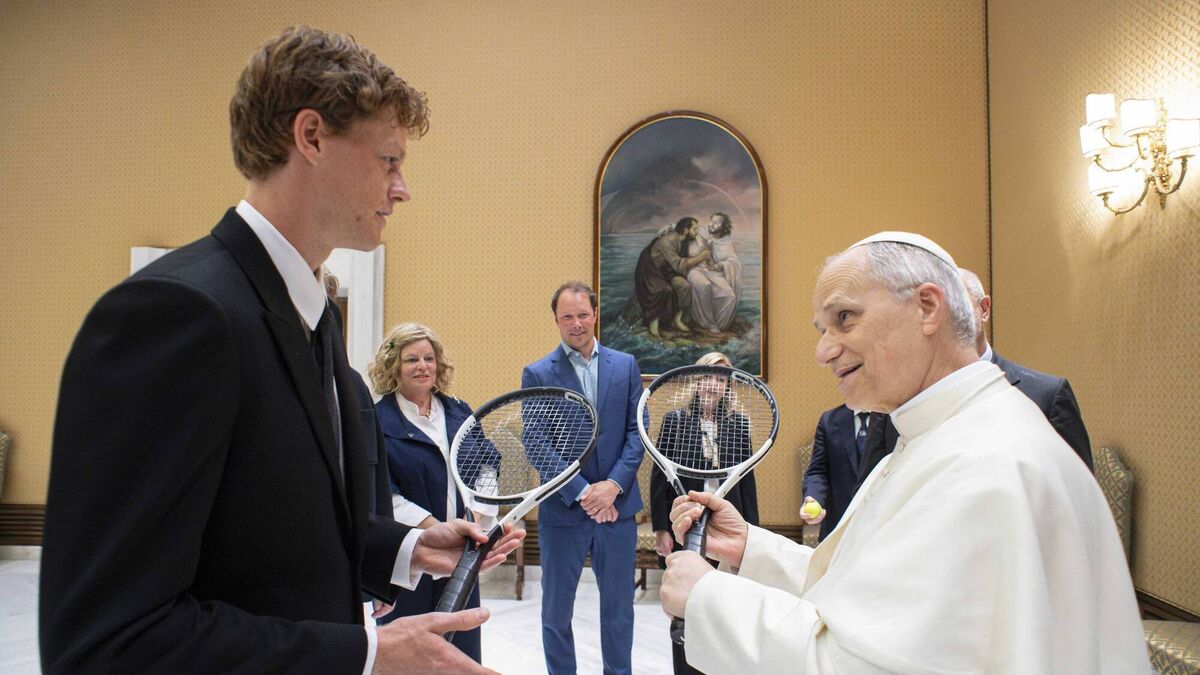
World tennis champion Jannik Sinner gifts a tennis racket to Pope Leo XIV, during a private meeting in the Vatican. Picture: Vatican Media
Pope Leo is a busy man. On a visit to Rome last year and a fleeting glimpse of the hectic round of appointments, meetings and Masses that mark his day, I got some sense of the daily and weekly schedule that is the lot of Pope Leo XIV. It was a privilege and an instruction to see him up close. Like so many others I found the experience unusually moving. Clearly a man of prayer and reflection, he seemed unusually placid and unself-absorbed as he took in his stride responsibilities that could easily overwhelm a less composed personality.
Extraordinarily calm and self-assured, here was the man who challenged Trump when others were indulging his childish fantasies. A man who up close looks extraordinarily young for a pope – even though he is 70. A polyglot, he has a high efficiency in a number of languages, easing out of one and seamlessly into another as he famously exhibited immediately after his election as pope. And, for the English-speaking world, crucially the first pope who speaks fluent English – his native language – and whose every comment we can understand clearly without the questionable benefit of Vatican bureaucrats mangling in translation some obscure indeed unintelligible version of King’s English.
It was a relief to hear too that Leo has, in so far as it is possible to achieve it in a crazily busy place like Rome, a determination to balance his impossible work-load by taking a full day away from his desk every week. Apparently, he has designated Tuesdays as his day off. He leaves Rome for Castel Gandolfo (25 km away) every week where he spends his Tuesdays, which includes a sleepover and a day relaxing by indulging his passion for tennis, swimming and (unusually) for horse-riding, a skill he acquired in his years in the diocese of Chiclayo in northern Peru when he visited villages that were only accessible on horse-back.
Unlike Pope Francis, who rarely visited Castel Gandolfo unless fleetingly, Leo realises the need to have an oasis of calm, a refuge in which to escape periodically from a busy and stressful life - and in the process to give a sensible example to bishops and priests who sometimes foolishly imagine that their dioceses or parishes couldn’t possibly survive their absence for one day a week. Francis never took a day off and that was his right but most Catholics I imagine are more than happy that on Tuesdays Pope Leo enjoys a necessary temporary relief from his demanding workload – playing tennis, swimming in the pool and galloping on his Arab stallion, Proton, in the grounds of Castel Gandolfo.
That’s not to say that the memory of his predecessor will be in any way compromised by Leo’s style. Far from it. Francis will forever be identified with bringing the vision and the teaching of the Second Vatican Council back on the agenda of the Catholic Church and in so doing has resurrected hope for the future of our church. During my Rome visit I had the privilege of visiting Francis’ grave, marked by a simple stone with one word FRANCISCUS in capitals. It was for me an emotional release of sheer gratitude to Francis for re-setting the agenda for the future and in so doing putting into due perspective the pontificates of his predecessors when Vatican Two was casually and (for the Church) shamefully relegated to the sidelines. I will remember that visit to his grave for as long as I live.
Meanwhile back in Leo’s office the recent challenge was what to do about the impending threat of the Society of Saint Pius X (SSPX) to ordain without papal permission four priests as ‘Catholic’ bishops. The (SSPX) was founded in 1970 by Archbishop Marcel Lefebre. A French bishop, he believed that the reforms of the Second Vatican Council had lost touch with what he (and his followers) were convinced was the authentic Catholic tradition. Even though the documents of ‘Vatican Two’ (as that Council came to be known) were discussed by representatives of the bishops of the Catholic world in tandem with the pope and thus became the official teaching of the Catholic Church, Lefebre and others refused to accept or even recognise the documents of Vatican Two.
At first the breakaway group was regarded as little more than an interesting hissy fit on the sidelines of church history but in 1988 Lefebre decided to consecrate four bishops without papal approval and this led to a number of excommunications and an immediate break with Rome.
Later Pope Benedict XVI lifted the excommunications as a way of drawing the group back into the Catholic fold and later again Pope Francis I granted SSPX priests faculties to validly hear confessions and to celebrate marriages in an effort to heal the division. But the more concessions were offered, the more confident and rigid in their beliefs the SSPX became.
Leo appealed to them – in effect, begged them – not to ordain any more bishops without a papal mandate. He described that decision as the equivalent of ‘tearing the seamless garment of Jesus Christ’.
The SSPX ignored him and went ahead with the ordinations. The following day the Dicastery for the Doctrine of the Faith in Rome announced a decree of automatic excommunication for the ordaining bishop, for the more than 700 priests of the SSPX society who ‘are in schism and who must therefore be considered schismatic’ as well as lay-people who ‘formally adhere’ to the society.
Who would want to be a bishop? is a cry not unknown in Catholic dioceses – especially when ‘difficult’ priests or ‘awkward’ parishioners, like the SSPX society, insist on having their own way regardless of the consequences – because they are always right! But who would want to be pope? must ring out late at night in the corridors of the Vatican.
Who would envy Leo his life’s work? Apart from possibly those who know it all but often, like the SSPX, don’t know how little they know and the damage they do.
Leo deserves his swim and his horse Proton.