What does it actually mean to be Irish?
I am plagued by a question that I keep turning over idly in my mind, a little too obsessively, like a stone in my pocket on a long walk, that I refuse to throw back into the hedgerows until I resolve its attraction. Not because I have a tidy answer, but because nobody does - and I'm increasingly wary of those who claim they do.
St Patrick's Day seemed as good a time as any to ask it. Better than most, actually, when the green bunting is up, and the trad session is already warming in the corner of every pub from Belmullet to Brisbane, and everyone is feeling comprehensively, uncritically Irish in the way that costs nothing and requires no examination whatsoever. Which is precisely why it bothers me; the definition is nebulous.
So what does it actually mean to be Irish? I'm not talking about surface-level expressions like tattoos of Ireland or the sentimental songs of the diaspora. I’m asking what it means to be genuinely, specifically, even uncomfortably Irish. My concern is that we no longer have a shared understanding of this, nor do we seem invested in defining it.
The conversation around Irish identity has adopted a verbal tic in recent years. Expressions like 'modern', 'inclusive', 'progressive' and 'shared values' are delivered with the confidence of those who have never been asked to define them. No one ever asks, and I would love, just once, to hear someone press the point in a radio studio or a Dáil committee room. These much-praised and vaunted shared values, which ones, exactly? Shared by whom? Agreed when and how? Instead, we all agree quietly, because asking apparently marks you as something you'd rather not be called.
This avoidance works as a clever strategy: curiosity is seen as hostility, and questioning unclear terms is treated as an attack on the values themselves. This prevents us from having to define what we really mean.
I understand the impulse. Ireland spent centuries being defined by those with vested interests: the Church, the British, and then nationalist Ireland, with its own myths and silences. The industrial schools. The Magdalene laundries. What is called 'shame' about our past isn't trendy ideology but an overdue reckoning. We should be clear-eyed enough to say so.
But, and it's a significant but, there is a key difference between honestly reckoning with history and merely treating it as an embarrassment to manage; between learning from the past and deciding it has nothing left to teach us. C.S. Lewis called this 'chronological snobbery': the assumption that the old is wrong and the new is better. It's a comfortable position. It requires almost no thought.
The irony is that our patron saint, whose feast day we celebrate with such uninhibited and bawdy enthusiasm, would have found the whole drift of this conversation frustrating.
Patrick, it should be recalled, was not born Irish. He was Romano-British, first arriving as a slave and later, against all personal comfort, returning by choice. He did not come with plans for cultural replacement, but with what seems to be a genuine, complex love for this place and its people. What he brought took root because the soil was ready. The tradition he helped establish was woven into Irish culture - slowly, organically, over centuries, until the two were inseparable. Such change is not imposed, but emerges as cultures truly evolve.
That's why I distrust both sides in this conversation.
The trenchant nativist view, Ireland for the Irish, everything taken, ignores that Irish identity has never been fixed. The Celts did not emerge fully formed, and the Normans reshaped Gaelic culture, and many Gaelic surnames are of Norman origin. English, imposed by dispossession and famine, became the language of our finest literature. We made it our own, giving birth to literary greats such as Yeats, Joyce, Beckett, Heaney, and McGahern. Identity is always a negotiation: plural, porous, more complicated than purists admit.
But the progressive version has its own blind spots, and they deserve to be named. A society can be open, diverse, genuinely multicultural, and can still articulate a distinct identity. It can also hold real commitments - not simply procedural ones - that it is ready to name and defend. The key issue is whether we are clearly defining those commitments. After all, 'we embrace everything' is not a cultural identity; it is the absence of one. And a vacancy isn't tolerance, it's simply space, waiting to be filled by whatever comes along.
There are wonderful things about Ireland that are genuinely, specifically distinct. A language - fragile, yes, battered by history, still alive, and worth protecting not as a heritage exhibit but as a living, breathing structure of thought and seeing that cannot be replicated in English. A landscape - the Atlantic light over a Connacht bog on an October afternoon - that has shaped the way we observe and describe the world in ways we've barely begun to understand. A literary and musical tradition of density and richness entirely out of proportion to our size. A particular kind of humour - dark, oblique, self-deflating - that functions almost as a complete philosophical system. A history of colonisation that gives us, or ought to give us, a specific and hard-won ethical sensibility around power, its uses and its abuses.
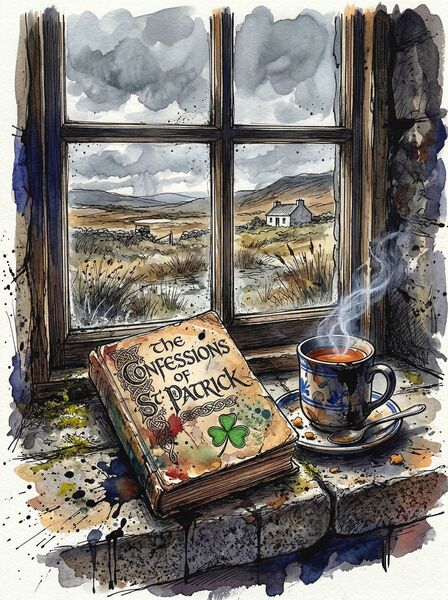
There's also a faith tradition. Christianity saturates Irish culture - its architecture, poetry, rhythms, moral language, landscape of holy wells and pilgrimage roads. Whatever one's belief - and I hold mine - the tradition lives in stone and syntax. It doesn't need uncritical acceptance. It does need recognition.
This is not an argument for reverting to Ireland of the 1950s, which masked cruelty as virtue. Instead, I might argue that any discussion about Ireland's future must start with an honest recognition of what Ireland currently is – including its contradictions, complexities, and realities.
And that conversation should include the people who have come to Ireland in recent years and are making their lives here. Many of them understand perfectly well what it means to have a culture worth protecting. They've come from places in which culture was the only thing that survived catastrophe, the only continuity amid rupture and loss. They know its value with an accuracy that those of us who inherited ours without effort sometimes lack. If they are respectful of our Irish culture and happy to assimilate and evolve, they're not a threat to Irish identity, as the anxious voices claim. In many cases, they're among its most attentive custodians.
I would encourage everyone involved, including myself, to avoid overly simplistic stances. Nostalgia can willfully ignore past harm, while an unexamined openness without substance doesn't preserve what's of value and thus fails to build something meaningful. The difficult work is to create a shared identity that people can truly belong to.
Patrick's prayer in the Confessions is worth reading today - not as theology, but as imagination. He prays for the Irish - not a sanitised, convenient, simplified, or reimagined version. For them: complicated, contradictory, burdened, infuriatingly themselves. He had every reason to leave Ireland - and didn't.
There's something worth reflecting on, this grey March morning, after the bunting is lowered and sessions go quiet and we all declare, loudly and unexamined, that Irishness is the greatest thing in the world.
Being Irish might be the greatest thing - if we can define what it means with genuine honesty and precision.