Western Rail Corridor a long-overdue regional game-changer
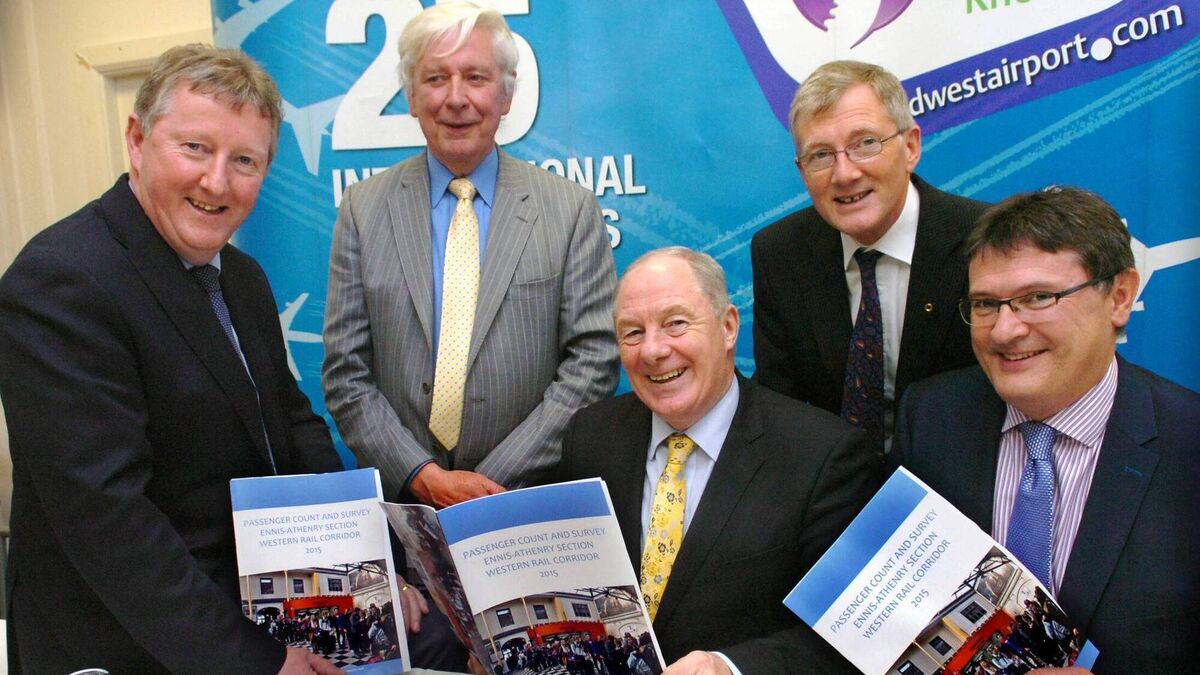
Pictured at the launch of the CICERO Report on Phase 1 of the Western Rail Corridor at Ireland West Airport Knock back in 2016 were, from left, Sean Canney, the then Minister of State for OPW and Flood Relief, Paddy McGuinness, who was Western Development Commission chairman, Michael Ring, then Minister of State for Rural Affairs, West on Track's Colmán Ó Raghallaigh, sponsors of the report, and Ireland West Airport Knock chief executive Joe Gilmore.
Depending on people’s perspective, the news of the reopening of the Western Rail Corridor into Mayo might trigger different emotions.
It was confirmed by Minister Seán Canney that the €400-million 34-mile section from Athenry to Claremorris will go ahead with preliminary work next year, construction commencing in 2028 with a targeted completion date of 2030.
There will be those who will argue that it should never have been closed in the first place, and so the announcement is nothing more than righting a 50-year wrong.
There will be others who will argue that the reopening of the line to Claremorris, which has been so diligently campaigned for over two decades, is long overdue, and so the news is of the better late than never variety.
There will be others, then, who felt for many years it may not happen, and the announcement is an immense relief and reason for considerable celebration.
And then there will be a small cohort opposed to what can only be termed as a hugely positive development for the west of Ireland who will be licking their wounds.
First and foremost this is absolutely a major boon for the west of Ireland, linking Mayo rail networks into Galway and enabling much greater movement via rail between the two counties. From a freight perspective, it opens up a much more efficient route to southern ports than heretofore.
Politicians can line up to take credit and it is warranted. There has been considerable cross party support and momentum behind the railway in recent years, which made it increasingly difficult for opponents, both in positions of power and on the outside, to hold off.
Seán Canney, the Galway East Independent TD who is Minister for State at the Department of Transport with Responsibility for Rail, has always seen the benefits of the project and argued cogently for it. His role in it becoming a reality is pivotal. Mayo Fianna Fáil TD Dara Calleary has always been a backer of it and his position at the Cabinet table was likely crucial too.
As are the roles played by many more west of Ireland TDs, senators and councillors and shows what can be achieved when politicians work together for the betterment of their region rather than allow themselves to be divided and conquered.
But it is extremely unlikely we would be talking about this now were it not for the tireless and fastidious efforts of advocacy group West on Track.
A community-led group of people all along the Western Rail Corridor from Sligo to Limerick, and beyond, they argued for the merits of the railway and for wider balanced regional development requirements.
Claremorris men Colmán Ó Raghallaigh and Martin Cunniffe got the ball rolling in 2003 and Ó Raghallaigh, in particular, plays a seismic role while Frank Dawson has been another key figure.
Superbly organised conferences by West on Track in Tuam and Sligo with a range of expert speakers helped enable cross-party support with the need and justification for the project made clear as day as was the wholesale support for it in the region.
Indeed, the grouping’s ability to harness cross-party support is a template for what is needed in the west of Ireland, where we have been left on the back foot compared to the east coast for far too long.
It has always struck me as instructive that there was a need for West on Track. When you consider the over-development of Dublin and the wider prevalence of rail networks around Europe, the reluctance of central government in Ireland to acknowledge the need to rebalance matters was striking.
West on Track and others had to keep banging the drum, making clear and convincing arguments for it and keeping it at the centre of discussions around infrastructural development in the region.
The reopening of the line from Limerick to Ennis and then onto Athenry were big steps forward but it was unclear if the political will was there to go north to Tuam and onto Claremorris.
The campaign was also beset by baffling levels of opposition by people in the region to investment in a better rail network for the west. Some politicians were part of this rump and it definitely hindered its progress. It remains odd that opposition to it was not just from institutionalised bureaucrats in Dublin but people from the region itself.
For too long the west has been held back by a lack of investment.
The Northern and Western Region of Ireland, one of three regions in Ireland for European purposes, incorporates the five counties of Connacht as well as Donegal, Monaghan and Cavan. It has been categorised by Europe as a ‘lagging region’, well behind the other two regions in Ireland (Eastern and Midland; and Southern) who have a GDP per capita of almost three times that of our region. Alarmingly, we rank 218th out of 234 European regions for transport infrastructure development, that is to say, in the bottom seven percent.
So infrastructural projects like the Western Rail Corridor ought to be merely the tip of the iceberg in addressing this grevious imbalance perpetuated by successive governments and high-ranking civil servants.
A seminal turning point was the publication of the Bradley report into the appraisal of the Athenry to Claremorris link, itself a response to a Government-commissioned EY report into the railway which said there was no business case for it.
The report’s author, Dr John Bradley, who sadly passed away in September, eviscerated the EY report, describing it as ‘deeply flawed’ and his own report delved into the question in great detail.
It was an outstanding piece of work and generated considerable momentum for the extension of the railway to Claremorris.
People like John Bradley and the late Fr Micheál Mac Gréil, a long-time Patron of West on Track and the man who set up the Western Inter-County Railway Committee in the late 1970s to campaign for its reopening as soon as it was closed, played huge roles in making the reopening a reality and it is no exaggeration to say that future generations of people from the west will have much to thank them for.
Because, again, this news would have not happened were it not for the assiduous campaigning by many people, trying to lead various Governments by the hand to convince them of the need and justification for the project.
It was telling to hear Seán Canney mention the continuation of the line to Sligo in his interviews around the announcement of the extension to Claremorris.
While there could be no real news about an extension to Sligo before any official announcement of the rail from Athenry to Claremorris, there was still plenty of furore there before this point.
Some in Sligo wanted a greenway on the old line, which would greatly weaken the potential for a railway, but with Iarnród Éireann now saying that is not possible, as they want to preserve the old line for potential future railway developments, the stars are beginning to align.
But if one thing has been clear from the campaign to extend the railway to Claremorris, it is that there is no such thing a fait accompli in these matters. The likes of West on Track, Sligo and Mayo County Councils and national and local politicians from the west will have to campaign relentlessly, together, to make it a reality.
A railway linking the two biggest urban areas in Connacht should be more straightforward than that but as evidenced by the failure to extend the M18 out of Galway and huge delays in road improvements on the N17 in Mayo and Sligo (and questions over the extent of those plans), nothing ever comes easy to us in the west.