Respect needed in debate on transgenderism
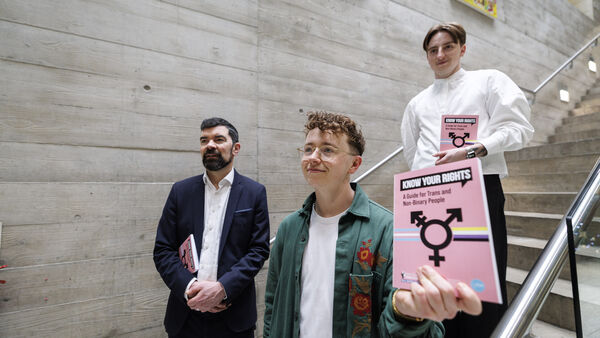
Pictured at the launch of a new 'Know Your Rights' guide for trans and non-binary people last December by the Irish Council for Civil Liberties (ICCL), in collaboration with Transgender Equality Network Ireland (TENI) and ShoutOut, were ICCL Executive Director, Joe O’Brien, ShoutOut Executive Director, Ruadhán Ó Críodáin and TENI Executive Director, Daire Dempsey.
Many people my age (43) or older have never met a transgender person or, if they have, were unaware of the fact.
It is, therefore, hard to understand the level of anger many of my generation, particularly men but also plenty of women, hold towards a small group of people who do not impact in any way on their day-to-day lives. You only have to see the hate stewed on social media towards this vulnerable sector of society to see what I mean.
Or maybe it is not that hard to understand. If people do not know someone affected or understand their lived experience, their ability to grasp those struggles is naturally limited. Unfortunately, many instead take their cues from online debates and narrow narratives.
The mental, physical and emotional anguish transgender people have to endure is something a great many people are completely ignorant of. Take, for instance, the reality that studies have shown significantly higher rates of suicidal ideation and attempts among transgender people compared to the general population.
Instead, the debate narrows around certain controversies like transgender athletes in sport, access to changing facilities and the use of pronouns.
Sport is the clearest example. It shows how obsessed many people are with sport that this becomes the lens through which they examine the issue.
And sport is a complex situation which needs discussion when it comes to transgender athletes. But I am sure if you asked anyone with gender dysphoria where sport fits in their wishes, it would be a long way down the list, considering the existential battles they have to endure.
We only have to see it with the highly polarised and ongoing Enoch Burke case and his family shouting repeatedly about ‘transgender ideology’ and ‘transgenderism’, very prejudiced terms. Unfortunately, they have amassed quite a following from people who fan the flames of hatred.
Most population studies suggest that around 0.5 percent to 1 percent of people identify as transgender and have grown up in the wrong body. That would mean many thousands of people across Ireland, including hundreds in counties like Mayo.
People you know. People you love and respect. It could be your child.
While the science behind being transgender is complex and evolving, research suggests that biological factors, including genetics and prenatal development, may play a role, although the science continues to evolve.
What is clear is that international medical guidance recognises that gender identity is a real and deeply personal aspect of human development.
It was very informative and revealing to watch the recent Virgin Media series ‘Dinner with the Enemy’, which pitched ten people with very opposing views around a table to talk about issues of the day. One of the contributors, Jacob from Meath, revealed he was a trans male, that is born a female and transitioned to male.
If you haven’t see it, I recommend watching it. Jacob is a very polite, pleasant young man who detailed his harrowing journey, the difficulties of getting his family to accept he was born in the wrong body, the mental health challenges as a teenager, how he was suicidal at 16 and where he is at now. It was a really important contribution because it showcased the lived experience.
Ultimately, who am I or you to stop someone living who they want to be?
In many ways, this feels like a 21st-century version of what gay people encountered. Go back a couple of decades and the existence of gay people was threatened. Far too many people were afraid to come out because of societal pressures and the shameful taboo that many people put on being gay, therefore so many people ended up living a lie all their lives.
Unfortunately, such homophobic mindsets still prevail but, mercifully, to a much smaller degree.
One of the challenges when it comes to transgender issues is teenagers who may seek to transition.
From talking to several secondary school teachers, the number of teenagers who identify as a gender at odds with what was recorded at birth has risen sharply. However, there is a fear that some children with issues, often related to their environment, may reach for this as a solution to their life’s challenges when the actual solution may lay elsewhere.
Adolescence is a complicated and often difficult period. Young people can experience distress for many reasons, including mental health challenges, social pressures, family difficulties, or a sense of not fitting in. For some, gender identity is central to that distress. For others, it may be one part of a broader set of challenges. That is why careful, professional assessment and proper support are essential to ensure that every young person receives the understanding and care they need.
In time, that may sort itself out, but if that child embarks down the road of physical treatment such as puberty blockers or gender-affirming hormones, then that can create bigger problems.
For someone trapped in the wrong body, such treatment is a very important step and makes the physical change a lot easier. However, it is not possible to revert easily if the issue turns out not to be gender dysphoria.
For teenagers navigating this, the social transition is very difficult, and the medical transition is invasive. Are there enough supports to guide people during these challenges and ensure they are embarking on the right road? We only have to look at the pitiful level of mental health support for adolescents in Ireland to know the answer to that question.
At present, medical intervention for adolescents remains relatively uncommon and is subject to specialist assessment. Research from the United States suggests that only a very small minority of young people who identify as transgender receive puberty blockers or hormone treatment.
There has been much wailing about two particular issues – the use of dressing rooms and unfair advantage in sports.
Dressing rooms is a hot potato. I am acutely conscious that as a male, I am far less impacted in this regard than women might be.
While it is always open to certain bad-faith actors to pretend to be female to get access to female spaces, the reality is that the overwhelming majority of violence against women is committed by men who identify as male. That context is often missing from public debate.
When it comes to sport, some sporting organisations have used testosterone levels as a way of calculating if a trans woman should be able to compete in female sports. There is no doubt that this does create challenges around fairness in sport.
The International Olympic Committee’s latest stance is to move towards a potential ban on transgender women who have gone through male puberty from competing in the female category.
But there remains uncertainty over proposals to ban athletes with DSD (differences of sexual development), people who were reported female at birth but have male chromosomes and male testosterone levels. Such athletes, which include the London 2012 and Rio 2016 gold medalist Caster Semenya of South Africa, have now been barred by World Athletics from the female category. It is further proof that this issue is extremely complex.
There have been a few situations in Ireland where people assigned male at birth who identify as women have played in female sports without any surgery, i.e. with the physical powers of a male. No one can deny that this is a problem and should not be allowed to persist.
Again, we’re in the midst of a storm here and still seeking equilibrium.
Concerns with regard to sport are understandable. I share them myself but people like Donald Trump have weaponised this to play to their base rather than to encourage careful and sensitive discussion.
If more people reached for compassion and understanding, particularly those who claim to be Christian, it might be possible to have a more measured debate where there are issues and people with gender dysphoria may actually be able to live their lives without their very existence being threatened. If that’s too much to ask, then it is a bad reflection on where we are as a society.