We think everyone loves us — they don’t!
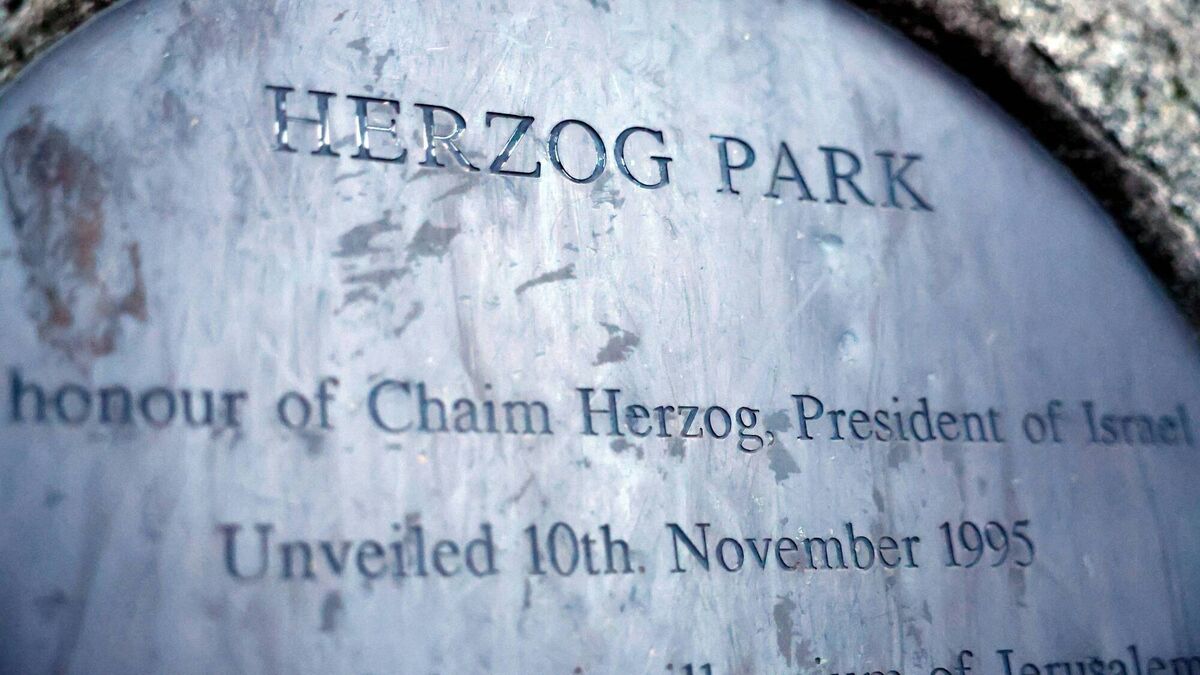
A plaque on a stone in Dublin reads 'Herzog Park' commemorating Chaim Herzog, Israel's sixth president, who was born in Belfast. Plans to rename 'Herzog Park' to 'Hind Rajab Park' after Hind Rajab from Gaza caused ripples around the world. Picture: REUTERS/Clodagh Kilcoyne
Behind the shamrock smiles, ‘Kiss Me I’m Irish’ tee-shirts and ‘Top-of-the-morning’ SNL skits, a darker perception of Ireland is spreading in the United States.
We Irish are fond of believing we’re the world’s favourite people. We assume everyone sees us as great craic – friendly, witty, fun, charming – and a nation of musicians, storytellers and soft-hearted rogues. But in the U.S. this past year, I’ve learned something uncomfortable: not everyone loves the Irish. Some people, in fact, are deeply suspicious of us.
This realisation didn’t come from some pub altercation or an online row. It came from a conversation with an older Jewish liberal friend of mine, a woman who recently campaigned in New York for self-avowed socialist and critic of Israel, Zohran Mamdani, in his ultimately successful mayoral race. She’s passionately progressive, anxious about the direction of the U.S. under Donald Trump and even considering moving abroad as a result.
We were discussing where she might go: the UK, Portugal, Eastern Europe – the latter region connected to her own family story. “What about Ireland?” I asked, genuinely curious. After all, she had visited North Mayo with me. She experienced our hospitality, our openness, our warmth.
She paused and I felt a heavy thought pass between us.
“But isn’t Ireland…the Irish government, very bad? Very… extreme and right-wing now?” My friend is a serious person and I knew she could not be joking. But Ireland Right-wing? Extreme? Bad?
This is the country that routinely ranks as one of the most welcoming in Europe and has become so liberal it collectively condemned Social Democrats TD Cian O'Callaghan for dressing up during Halloween when a student sixteen years ago, as his hero Barrack Obama. It prides itself on its ‘Céad Míle Fáilte’ welcome and has been ranked by Policy advisor and founder of the Good Country Index, Simon Anholt, as the country which “does the most good for the world”.
And yet here was this thoughtful, well-informed, progressive American woman holding a view of Ireland shaped not by experience but by a growing propaganda campaign portraying Ireland as an anti-Semitic, extremist outlier. And it’s working.
Since that conversation, several of my Jewish friends have sent me articles and social-media posts claiming to show anti-Semitism in Ireland. They ask for my opinion – gently, curiously, but with an undercurrent of worry.
A former colleague of mine posts frequently on Facebook about the Gaza conflict. To her, any criticism of Israel is automatically support for global jihad. She writes regularly about “Irish anti-Semitism,” convinced Ireland is hostile to Jews and “pro-Hamas” as she puts it. She is on the political left, anti-Trump, pro-civil-rights. Yet dovetailing with her strong support for Israel’s war on Gaza, her views of Ireland are now deeply negative.
A day after Trump was declared elected as U.S. President, I had a meeting with an Industry agent with a Jewish name, who grew noticeably colder the moment they realised I was Irish. When people start reacting to a nationality rather than a person, something deeper is going on.
This shift hasn’t happened by accident. It has been actively encouraged by the Israeli government and aligned lobby groups – further amplified by conservative American media figures who see Ireland’s vocal support for Palestinian rights as an existential threat to Jews. Ireland is being painted as the epicentre of anti-Semitic sentiment in Europe.
The most recent flashpoint making the rounds in the US press is the debate in Dublin City Council over removing the name of Chaim Herzog – the former Israeli president of Irish-Jewish heritage – from a city park. This local debate is being framed in America as “the latest expression by Irish officials of a radical anti-Israel sentiment tinged with antisemitism.” This takes place as US politicians are loudly criticising Ireland for its stance on Gaza. Support for Israel in Washington is broad and bipartisan and Ireland’s strong pro-Palestinian voice has drawn attention at the highest levels.
Prominent Senator, Lindsay Graham, claimed Ireland “has become a cesspool of antisemitism” and the American-Israel Public Affairs Committee ominously warned the Irish Government over its support of a boycott of exports from the Palestinian occupied territories: “There will be consequences to their immoral attempts to economically attack Israel.”
We Irish have a habit of assuming the world sees us the way we see ourselves. We imagine America as a place where everyone has an Irish granny, cries when they hear ‘Danny Boy’ and lights up at the mention of County Mayo, Saint Patrick and creamy pints of Guinness. Let me assure you: that is not universally true.
When I first moved to Los Angeles over a decade ago, I met several Black Californian women who, upon hearing my accent, asked if Ireland was in South America. Given my pale skin and inability to speak Spanish beyond ordering a grilled tortilla at Taco Bell, this was… unexpected.
In many communities here, especially those with no direct ancestral link, Ireland barely registers. To them, we are a vaguely European curiosity, or somehow part of the UK. And sometimes, our own behaviour doesn’t help.
I was chatting to a Mexican barman recently and I enthusiastically brought up the San Patricios – the Irish battalion that fought for Mexico in the 1840s. His face dropped. “I already know that story,” he sighed, with the air of a man who has heard one too many Irish lads wax lyrical about “our boys” in the Mexican–American War, “Don’t need to hear it again bro”.
Occasionally, we push our own narratives a bit too hard.
Ireland’s moral compass has long pointed toward the underdog. From South Africa to Palestine, from global poverty to global warming, we like to see ourselves as a small country punching above its weight for justice. But in 2025, nothing happens in isolation. A Dáil debate, a student protest, or a city-council vote can be clipped, reframed and broadcast to millions, instantaneously. A gesture that feels morally righteous at home – like renaming a park over the Gaza genocide – can land very differently abroad.
This doesn’t mean we abandon principle. But we do need to ask: Are we trying to be right, or are we trying to be effective?
If a symbolic act does more harm than good, if it gives ammunition to extremists, or undermines Ireland’s credibility, or sparks diplomatic retaliation, is it actually advancing justice? Or is it just making us feel virtuous?
Ireland’s reputation matters. Not because we crave approval (we do), but because we are a small nation in a large geopolitical world. When powerful lobbies in America – on both the right and the left – start painting Ireland as an enemy, that can translate into policy, influence and opportunity. And right now, that narrative is shifting against us.
This is not an argument for silence on Palestine, nor for moral cowardice. Ireland should continue standing for what it believes is right. But we must do so with awareness, not naïveté.
We need to recognise that we are being targeted by a coordinated messaging campaign by a powerful international lobby – and that it is landing. We need to understand that many Americans do not know us, do not love us and do not see us as we see ourselves. And we need to be strategic, thoughtful and united in how we present ourselves to the world. Because pretending everyone loves us has never made it true. But understanding how the world sees us – and why – might just help us protect both our values and our voice.