We never miss the water till the well runs dry
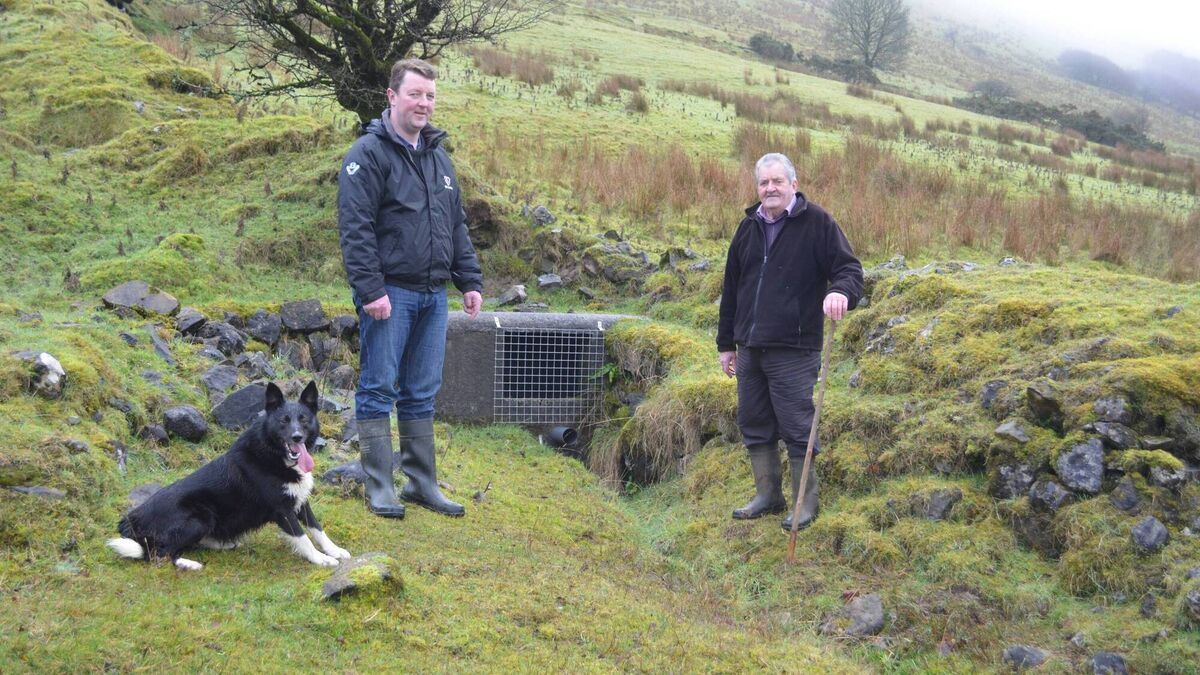
Pauric and J F Henry (RIP) on their land at the well that is reputed to be the source of the River Moy at Knocknashee, Co Sligo. Picture: Pat McCarrick
If the drought of this summer has taught us anything, surely it is the value of water. It seems we have lost touch with water, its availability and its importance. We have come to think of it as a commodity; something we can get easily and should always have available to us, almost like fresh air.
Many people resent water charges, assuming that water is some kind on God-given right, yet few people make provision to have water available when systems fail. In essence, we have come to take water for granted.
Maireid Sullivan, writing recently on the subject of 'Traditions and Beliefs about Water', points out that our world is facing a comprehensive paradigm shift in our attitudes towards water.
Sullivan reminds us that every culture on earth tells the legend of a deluge or great flood along with beliefs that all life came from water, and she says although the world's earliest civilisations had deep respect for this precious resource, contemporary western industrial nations seem to view water as something disposable. She goes on to reflect on the Celtic tradition around fresh water.
Even the most superficial examination of ancient civilisation will inform us about the respect that early people had for water and the value that they placed upon it. They quickly figured out that the sun and water were two of the most powerful, godlike things in their primitive lives.
The Nile, for example, served as the beating heart of Egyptian civilisation, providing life-sustaining floods, fertile soil, and transport. The Ganges, in India, has been revered for over 3,000 years as a living goddess that purifies the body and spirit. In Japan, in rituals of Shinto purification, practitioners perform ritual hand and mouth washing at water basins before entering sacred shrines. More generally, in global terms, bathing and total immersion served as universal symbols of spiritual rebirth and cleansing.
All of the above civilisations knew the value of water, seeing it as both precious and powerful in equal measure; they saw it as sacred.
Tobar is the Irish word for well or natural spring. Locations starting with "tubber” (Tubbercurry), or ending in "tubber" (Ballintubber), indicate the historical presence of a well. In the case of Tubbercurry (Tobar an Choire) - 'the well of the rock' - the well in question is still to be seen in the centre of the south Sligo town - albeit under a reenforced glass covering. The story goes that this was due to a cholera epidemic in the town’s history when the well was closed over. The well was uncovered in recent years but so was the legend of the epidemic, so all was speedily sealed up again. The well was of such note during its existence however, that it had already given the town its name.
Larger towns than Tubbercurry also had their origins built around a single well. Information provided by John C McTeirnan details a well near Tobergal Lane in Sligo town. Tober Geal, meaning 'white well', was the well in question. In November 1943, the well was uncovered at the back of O’Connor Brothers, off O'Connell St. This well is reputed to have supplied Sligo with water for centuries.
It was uncovered when the floor of the building was been repaired and as it was known that a well was known to be in the area, a search ensued and they found it 18 inches below the surface covered with rotten thick planks, the well was almost seven feet in diameter, and eleven feet deep. The shaft was constructed of perfectly formed stonework, and on drawing up the water, it was found to be crystal clear.
In and around the Ox Mountains, almost every home had their own spring well, if not every home, then every townland. I might have mentioned in the past about an old ruined cottage that I like to visit from time to time. It still has an old laneway leading to a nearby mountain stream, a front garden still showing the shadows of old lazy beds and stone walls that once separated children from cows. Neatly positioned under a crumbling stone wall, on the edge of that front garden, is the track of an old spring well. Its form is moss-filled and the stream that led from it is no more than a shallow drain, but it is mistakably a well.
The well that served my childhood home was situated about 300 yards from the house. It was known as Callaghan’s Well, because that was the name of the former land owners. Callaghan’s well was no ordinary well; in good times water constantly gushed from its depths and in drought, it never ran dry.
In my time, the well was walled in and pumped to meet our household needs, but despite this, I often visited the well, which remained unaffected by being harnessed. It was a magical place, off the beaten track, shaded and private. Its water was ice cold and its clarity was pristine. I could hang over its retaining wall and view the springs on the bottom displacing the sand around them as they surged from deep underground. It is no wonder, no wonder at all, that the ancient people who knew the value of water, saw such wells as life-giving; the earth providing with generosity and goodness.
“It took some deliberation, but at last the Uzbek soothsayer and her fellow wisewomen reached a consensus: the listlessness and depression plaguing the young man before them was caused by the fairies and sprites that lived in the local rivers and tributaries, specifically the peri, who were usually benevolent. And for what crime was the boy being punished? Urinating in the flowing water that the peri called home.”
This story comes from Central Asia, but the scene described is not unique to that part of the world. The folklore of many cultures highlight water spirits and deities who require respect. Stories and practices centred around water hint at the similar ways different cultures have thought about fresh and running water; how it might be contaminated, how pollution might be avoided, and how to reconcile “water’s necessity with its danger”. These stories were used to pass down knowledge through generations, and in some cases continue to do so. While modern society appears disconnected from the ancient world of myth, some of the knowledge hidden within these stories remains relevant today.